Identify the U.S. professional, regulatory, accreditation and quality-measurement sources that set expectations for patient communication.
Summarize the evidence linking communication behaviors to complaints and malpractice claims.
Open encounters with complete introductions and elicit the patient's full agenda using evidence-based wording.
Explore patients' ideas, concerns, expectations and explanatory models.
Respond to emotion using NURSE statements and de-escalate anger safely, in line with workplace violence prevention requirements.
Deliver serious news using SPIKES and Ask-Tell-Ask.
Explain information in plain language, assess written materials with PEMAT and write safe, clear portal messages.
Apply Section 1557, ADA and National CLAS Standards requirements to language and disability access, and work effectively with interpreters.
Adapt communication for telehealth, families and caregivers, adolescents, people with dementia and profession-specific settings.
Plan targeted remediation and gather evidence of changed communication after a concern.
Who this course is for
U.S. licensed health professionals: physicians, PAs, nurse practitioners and other APRNs, RNs and LPN/LVNs, pharmacists, dentists and dental hygienists, and allied health professionals.
Structured learning and a written reflection to show insight after a complaint, an investigation or a board inquiry.
Routine learning
Focused learning on a core standard of practice, with a certificate and reflection for your portfolio.
About this course
This course teaches U.S. licensed health professionals how to communicate with patients in ways that are clear, respectful and safe. It covers the whole encounter: opening and eliciting the full agenda, understanding the patient's perspective, responding to emotion and anger, giving serious news, explaining so that information is remembered, writing materials and portal messages patients can use, and closing well. It also covers the legal duties that make communication possible for everyone, including the Section 1557 language access rules, the ADA's effective communication requirements and the National CLAS Standards, and how to work skillfully with interpreters.
It is written for physicians, PAs, nurse practitioners and other APRNs, RNs and LPN/LVNs, pharmacists, dentists and dental hygienists, therapists, technologists and other allied professionals, in hospitals, clinics, pharmacies, dental offices, home health and telehealth. It is useful for anyone who wants to strengthen everyday communication, and for licensees who have received patient complaints, low patient experience scores or a concern from an employer or state board.
Communication matters in the United States because it is written into professional codes, CMS Conditions of Participation, Joint Commission standards and training competencies, and because patients rate it publicly through HCAHPS and CAHPS surveys. Research on plaintiff depositions, recorded visits and unsolicited complaints shows that how clinicians listen, explain and respond is closely tied to complaints and claims. Informed consent and disclosure after harm are covered in separate courses; this course focuses on the skills and duties of everyday patient communication.
Course details
Learning time
Approximately 3 hours (estimated learning time including knowledge checks, reflection and assessment)
Standards covered
AMA Code of Medical Ethics Opinion 1.1.3; 42 CFR 482.13(a); Joint Commission patient-centered communication and workplace violence prevention requirements; ACGME core competencies; HCAHPS and CAHPS; 45 CFR Part 92 (Section 1557), including 92.4, 92.11 and 92.201; ADA (28 CFR 36.303, 36.301(c), 35.160) and Section 504; National CLAS Standards (2013); 42 CFR 456.705 (OBRA '90 counseling); 45 CFR 164.510(b); 45 CFR Part 171; state practice acts and board rules
Format
Self-paced, gated lessons with knowledge checks, case studies and reflection
Assessment
20 scenario-based questions, 80% to pass (16 of 20)
Outcome
Certificate of completion and a written reflection for your learning record
Alignment
Mapped to U.S. professional ethics codes, CMS Conditions of Participation, Joint Commission requirements, federal civil rights rules on language and disability access and the standards of professional conduct applied by state boards; education, not board-approved
1Communication as a professional duty in U.S. practice3 lessons
Why patient communication is a licensing, accreditation and safety issue
What the evidence says about communication, complaints and claims
A shared framework for the clinical conversation
2Opening the encounter and eliciting the patient's agenda3 lessons
The first minute: introductions, setting and the screen
Eliciting the full agenda without being interrupted by it
Understanding the patient's perspective
3Emotion, empathy and difficult conversations3 lessons
Recognizing emotion and responding with empathy
Anger, distress and de-escalation
Serious news and serious illness conversations
4Explaining, written information and digital communication3 lessons
Explaining so that information is remembered and used
Written and visual information patients can use
Patient portals, messages and results patients read first
5Communication access: language and disability3 lessons
Language access in everyday practice
Effective communication for patients with disabilities
Working well in interpreter-mediated encounters
6Communication in remote care, with families and across professions3 lessons
Telehealth and telephone communication
Families, caregivers and companions
Communication across professions and settings
7When communication becomes a concern: complaints, insight and remediation2 lessons
How communication concerns surface and escalate
Insight, remediation and evidence of change
8Conclusion and key points1 lesson
Conclusion and key points
9References and further reading1 lesson
References and further reading
10Your reflective account1 lesson
Your reflective account
Assessment and certificate
Final assessment
20scenario-based questions
Pass mark 80%: 16 correct out of 20
Knowledge checks in each section as you go
Tests whether you can apply the standards, not recall a page
Not passed yet? Review the sections and retake it
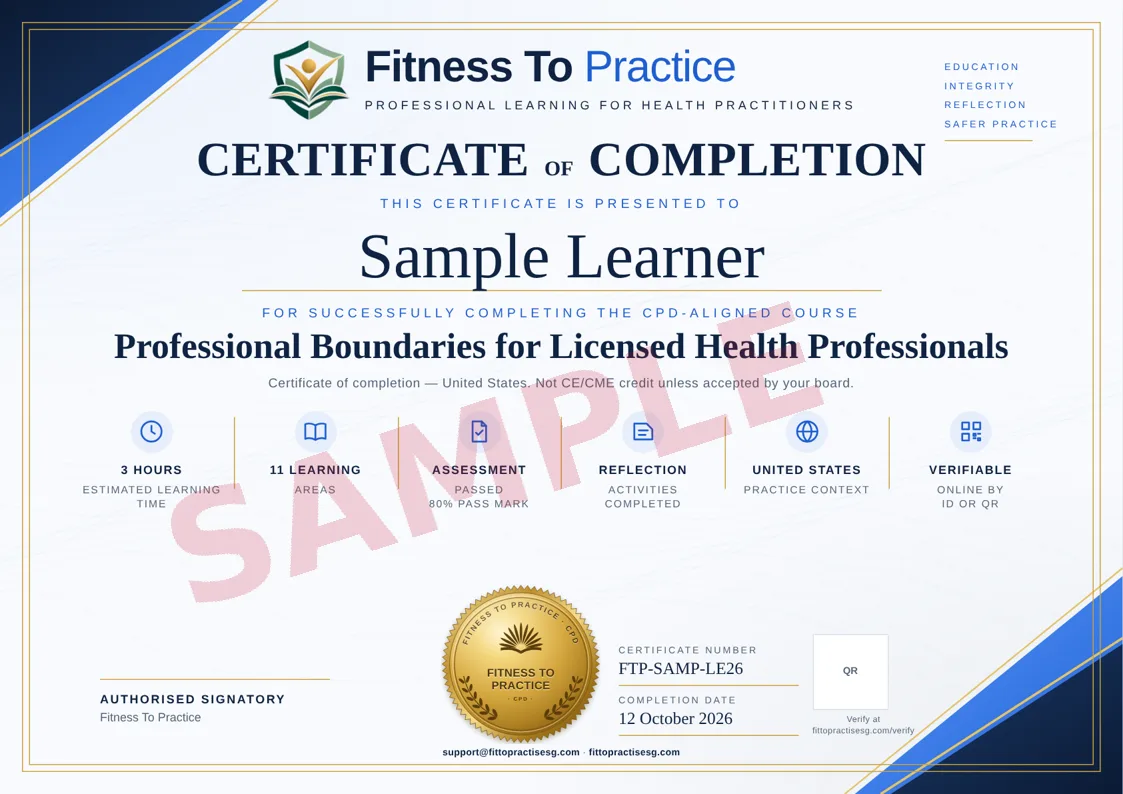
Certificate of completion
Certificate of completion. Not CE or CME credit unless accepted by your board.
Your name, the course title and the hours
Completion date and a unique certificate ID that can be verified
Ready to download as a PDF as soon as you complete the course
Sample certificate. Yours shows your name, the course, the completion date and a certificate number anyone can verify.
Your reflective account
The course includes a structured reflective account template: guided prompts to record what you learned, how you will apply it and how the change will show in your practice. It gives you written evidence of insight after a concern, and a ready record for your learning portfolio.
Write it in your own words and leave out anything that could identify a patient, a colleague or a case. If you have an open complaint or case, talk to your adviser before reflecting on it in writing.
Questions about this course
Is there evidence that communication affects complaints and claims?
Yes. Studies of plaintiff depositions, recorded visits and unsolicited patient complaints link how clinicians listen, explain and respond to the risk of complaints and malpractice claims. The course summarizes that evidence and then teaches specific behaviors, such as eliciting the full agenda and responding to emotion with NURSE statements, that address the patterns it describes.
What are my legal duties when a patient needs an interpreter?
Section 1557 of the Affordable Care Act and its language access rules, disability-law duties to communicate effectively and the National CLAS Standards set expectations for language and disability access. The course explains when a qualified interpreter is needed, why family members and untrained staff are risky, and how to work skillfully with interpreters in person and remotely.
Does the course help with angry or upset patients?
Yes. A section on emotion and difficult conversations covers responding to emotion, de-escalating anger safely in line with workplace violence prevention expectations, and delivering serious news using SPIKES and Ask-Tell-Ask. Worked scenarios come from clinics, pharmacies, dental offices and hospital settings, so the scripts fit different professions.
Does it cover patient portal messages and written materials?
It does. You learn to write portal messages that are clear, safe and appropriately brief, to assess handouts with the PEMAT tool, and to explain information in plain language so it is remembered. Telehealth, families and caregivers, adolescents and people living with dementia each get specific guidance.
How much is the communication course and what do I get?
$89 for three self-paced hours online, starting immediately. Checks follow each module and the final 20 questions need 80%; a pass brings the certificate and a review of your own consultation habits. Separate courses deal with consent and with disclosure after harm.
How this course was built
Official sources only
Every legal and regulatory point comes from primary sources: state practice acts and board rules, federal law and national professional codes of ethics. Anything we cannot confirm is left out.
Original, edition by edition
Lessons, scenarios and assessment questions are written by us for each edition separately, then checked for accuracy, teaching quality and fair assessment before publication.
Reviewed when rules change
When a code, standard or law changes, the affected courses are reviewed and updated. Reported errors in legal or regulatory facts are corrected first.
Informed consent from Canterbury v. Spence to the bedside: five elements, capacity, surrogates, minors, interpreters, intimate exams and documentation.
Disclosing adverse events and errors: AMA Opinion 8.6, state disclosure and apology laws, communication-and-resolution programs and second-victim support.