
· United States edition: online, self-paced courses with certificate

Ethics and professional conduct

Health Equity, Implicit Bias and Respectful Care

Non-discrimination law after 2025, bias in clinical decisions, disability access and state implicit bias CE rules

  • 3hours
  • 11sections
  • 20final questions
  • 80%pass mark
  • PDFcertificate
  • Online and self-paced, on any device
  • Reflective account template
  • Knowledge checks in every section
  • Instant certificate of completion

Reviewed by our expert editorial team · how we check every course

Written for US practiceUpdated 5 October 2026

What you will learn

  • Distinguish health disparities, health care disparities and health equity, and use disparity data without stereotyping individual patients.
  • Identify the federal statutes that prohibit discrimination in health care, the providers each covers and how they are enforced.
  • Explain the 2024 Section 1557 rule's obligations, the vacatur of its gender identity provisions and the duties that remain in force.
  • Summarize the main federal policy changes of 2025 and 2026 and distinguish changes to program design from unchanged patient care duties.
  • Recognize where implicit and explicit bias enter clinical decisions and apply practical strategies such as the swap test and explicit criteria.
  • Evaluate clinical algorithms, decision support tools and devices for discrimination risk, including duties under 45 CFR 92.210.
  • Apply ADA and Section 504 requirements on reasonable modifications, accessible equipment, service animals, direct threat and treatment decisions.
  • Respond professionally to patient requests based on a clinician's characteristics and to discriminatory conduct by colleagues.
  • Respond to an equity-related complaint with insight and design specific, evidence-based remediation.
  • Identify the implicit bias and health equity CE requirements in California, Michigan, Illinois, Maryland and Washington and keep audit-ready records.

Who this course is for

U.S. licensed health professionals: physicians, PAs, nurse practitioners and other APRNs, RNs and LPN/LVNs, pharmacists, dentists and dental hygienists, and allied health professionals.

After a concern

Structured learning and a written reflection to show insight after a complaint, an investigation or a board inquiry.

Routine learning

Focused learning on a core standard of practice, with a certificate and reflection for your portfolio.

About this course

This course explains what equitable, non-discriminatory care requires of U.S. licensees today. It covers the federal statutes and the 2024 Section 1557 and Section 504 rules, the federal policy changes of 2025 and 2026 and what they did and did not change, how bias enters clinical judgment, clinical algorithms and medical devices, disability access and treatment decisions, and how to respond to bias from patients, colleagues or a complaint.

It is written for physicians, PAs, nurse practitioners and other APRNs, RNs and LPN/LVNs, pharmacists, dentists and dental hygienists, and allied health professionals in any practice setting, including private offices that receive no federal funds. Cases are set in a range of states and professions.

Unequal care is a quality and safety failure and, when it is discriminatory, a matter for state boards, the HHS Office for Civil Rights and employers. Several states also require implicit bias or health equity education for licensure. With federal policy changing quickly, licensees need an accurate account of their obligations and practical habits that make care consistent for every patient.

Course details

Learning time
Approximately 3 hours (estimated learning time including knowledge checks, reflection and assessment)
Standards covered
Title VI and the HHS Title VI rule of July 2026 (45 CFR Part 80); Section 504 and 45 CFR Part 84 (2024 rule); Age Discrimination Act; ADA Titles II and III (28 CFR Parts 35 and 36); Section 1557 and 45 CFR Part 92 (2024 rule, including 92.7 to 92.11, 92.201, 92.210) and the 2026 notice of vacatur; Executive Orders 14151, 14168, 14173, 14224 and 14281; AMA Opinions 1.1.2 and 8.5; ANA Code (2025); ADA Code 4.A; APhA Code; AAPA Guidelines; Cal. Bus. & Prof. Code 2190.1; Mich. R 338.7004; 20 ILCS 2105/2105-15.7; Md. Health Occ. 1-225; RCW 43.70.613
Format
Self-paced, gated lessons with knowledge checks, case studies and reflection
Assessment
20 scenario-based questions, 80% to pass (16 of 20)
Outcome
Certificate of completion and a written reflection for your learning record
Alignment
Mapped to federal civil rights law as in force in 2026, U.S. professional ethics codes, the standards of professional conduct applied by state boards and confirmed state implicit bias and health equity CE requirements; education, not board-approved

Course curriculum

11 sections · 25 lessons · 3 hours · 20-question final assessment

  1. 1Health equity as a professional duty3 lessons
    • What health equity means, and what it does not
    • What U.S. data show, and how to use data honestly
    • Why discrimination is a professional conduct issue
  2. 2The legal framework for non-discrimination3 lessons
    • The federal statutes behind non-discrimination in health care
    • Section 1557 and its 2024 rule: what is in force in 2026
    • The state layer: civil rights laws and board rules
  3. 3Federal policy changes in 2025 and 20263 lessons
    • Executive orders and federal enforcement since 2025
    • Quality programs, accreditation and accessibility deadlines
    • Practicing well when the policy ground is moving
  4. 4Bias in clinical judgment3 lessons
    • Explicit and implicit bias: what the evidence does and does not show
    • Where bias enters clinical care
    • Practical strategies that change decisions
  5. 5Algorithms, devices and the medical record3 lessons
    • Race and other variables in clinical algorithms
    • Devices, decision support and Section 1557 section 92.210
    • Demographic data and the language of the record
  6. 6Disability access and equal treatment2 lessons
    • Disability rights in the clinical encounter
    • Disability, life value and treatment decisions
  7. 7Responding to bias from patients, colleagues and complaints3 lessons
    • When a patient refuses a clinician because of who the clinician is
    • Witnessing discrimination and speaking up
    • If a discrimination concern is raised about you
  8. 8State implicit bias and health equity CE requirements2 lessons
    • State implicit bias and health equity CE requirements
    • Meeting requirements and building lasting practice
  9. 9Conclusion and key points1 lesson
    • Conclusion and key points
  10. 10References and further reading1 lesson
    • References and further reading
  11. 11Your reflective account1 lesson
    • Your reflective account

Assessment and certificate

Final assessment

20scenario-based questions

  • Pass mark 80%: 16 correct out of 20
  • Knowledge checks in each section as you go
  • Tests whether you can apply the standards, not recall a page
  • Not passed yet? Review the sections and retake it

Certificate of completion

Certificate of completion. Not CE or CME credit unless accepted by your board.
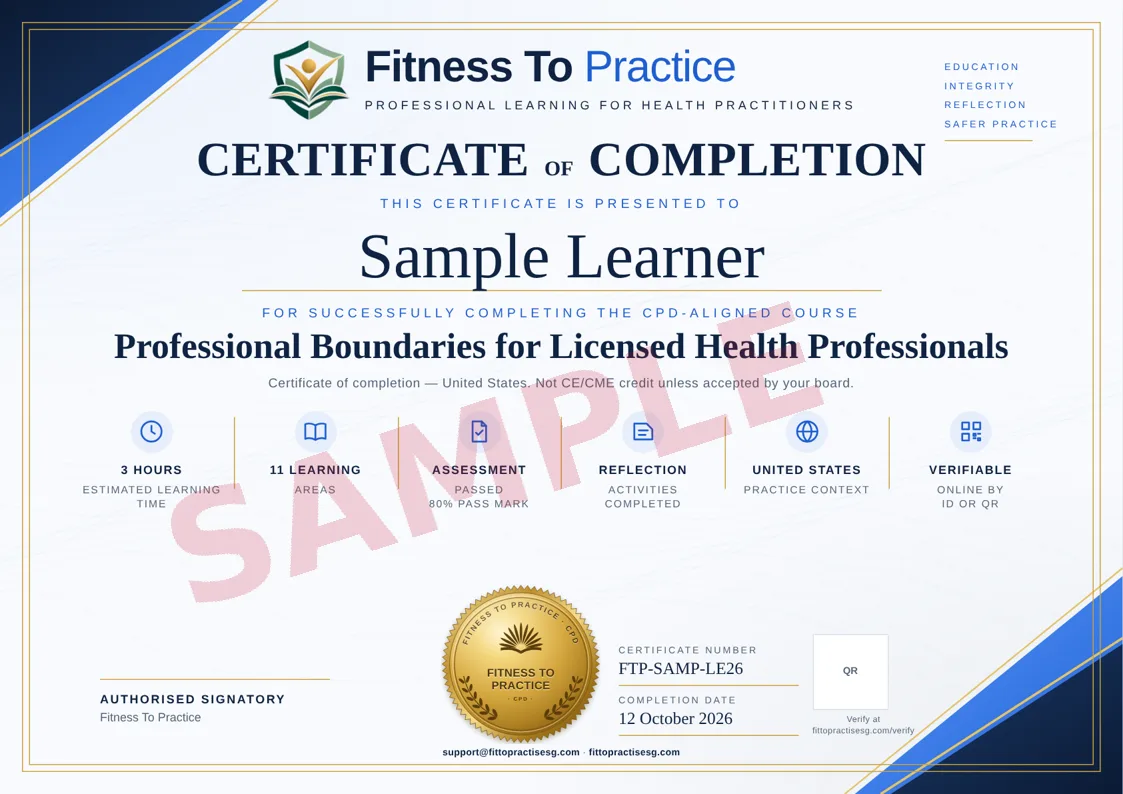
  • Your name, the course title and the hours
  • Completion date and a unique certificate ID that can be verified
  • Ready to download as a PDF as soon as you complete the course
Sample certificate of completion issued to a sample learner
Sample certificate. Yours shows your name, the course, the completion date and a certificate number anyone can verify.

Your reflective account

The course includes a structured reflective account template: guided prompts to record what you learned, how you will apply it and how the change will show in your practice. It gives you written evidence of insight after a concern, and a ready record for your learning portfolio.

Write it in your own words and leave out anything that could identify a patient, a colleague or a case. If you have an open complaint or case, talk to your adviser before reflecting on it in writing.

Questions about this course

Will this course meet my state's implicit bias CE requirement?

Do not assume so. States such as California, Michigan, Illinois, Maryland and Washington set their own implicit bias or health equity requirements, and some limit which providers count. This course does not claim board approval or CE credit, but it explains those state rules so you can check what your board accepts.

What did the 2025 and 2026 federal policy changes actually change?

The course separates changes to program design, funding and enforcement priorities from the patient care duties that remain in force under federal statutes. It explains the vacatur of the 2024 Section 1557 rule's gender identity provisions and which nondiscrimination obligations still apply, so licensees act on an accurate picture rather than headlines.

How can a clinical algorithm or device be discriminatory?

Some tools have used race or other factors in ways that change care, and some devices perform less accurately for certain patients. The course explains the duty under 45 CFR 92.210 for covered entities to identify and mitigate discrimination risk from patient care decision support tools, with practical checks you can apply.

How should I respond when a patient asks for a different clinician because of my characteristics?

The course gives a structured approach that weighs clinical urgency, patient safety, staff wellbeing and employer policy, and distinguishes requests that can reasonably be accommodated from those that should not be. It also covers responding to discriminatory conduct by colleagues and to an equity-related complaint about your own practice.

What is included in the implicit bias training?

Three self-paced hours for $89, with case checks drawn from several states and professions. Score 16 of 20 in the final and you receive a certificate plus an equity reflection to file with your renewal records. Topics run from language access to bias in clinical decisions.

How this course was built

Official sources only

Every legal and regulatory point comes from primary sources: state practice acts and board rules, federal law and national professional codes of ethics. Anything we cannot confirm is left out.

Original, edition by edition

Lessons, scenarios and assessment questions are written by us for each edition separately, then checked for accuracy, teaching quality and fair assessment before publication.

Reviewed when rules change

When a code, standard or law changes, the affected courses are reviewed and updated. Reported errors in legal or regulatory facts are corrected first.

Page updated 5 October 2026

Related courses

All courses
Consent, privacy and communication3 hours

Effective Patient Communication

Everyday patient communication: agenda setting, empathy, de-escalation, SPIKES, plain language, portal messages and language and disability access.

20-question final assessment, 80% pass

US$893 hours · 20 questions
Enrol now