Define work-based learning and distinguish competence from performance in everyday practice.
Explain why CE and CME hours are a renewal minimum rather than evidence of safe performance under the U.S. state-based model.
Apply the six ACGME practice-based learning and improvement abilities (CPR 4.7.a to 4.7.f) as a personal learning checklist.
Describe how nursing competency validation, ACPE continuing professional development and NCCPA Category 2 CME rely on learning at work.
Plan and complete a personal practice review using baseline data, a small test of change and re-measurement.
Seek and use specific feedback, including direct observation and multisource feedback.
Explain OPPE and FPPE, HCQIA peer review standards and when privileges restrictions, including proctoring, become NPDB-reportable.
Record work-based learning concisely, honestly and without protected health information, distinguishing levels of evidence.
Build a credible workplace learning plan and explain what voluntary learning can and cannot achieve in a board or employment process.
Who this course is for
U.S. licensees: physicians (MD/DO), PAs, RNs, LPNs/LVNs and APRNs, pharmacists, dentists and dental hygienists, and other licensed health professionals.
Structured learning and a written reflection to show insight after a complaint, an investigation or a board inquiry.
Routine learning
Focused learning on a core standard of practice, with a certificate and reflection for your portfolio.
About this course
This course shows U.S. licensed health professionals how to learn deliberately from their own work: capturing and answering clinical questions, reviewing personal practice data, seeking direct observation and multisource feedback, engaging with peer review and hospital professional practice evaluation, learning from near misses and teaching, and keeping a concise, honest record that shows real change in practice.
It is written for physicians, PAs, nurses and APRNs, pharmacists, dentists and dental hygienists, and other licensed professionals in any setting, from large hospitals with OPPE and FPPE systems to small and solo practices that must build their own feedback loops. Case examples are set in California, Texas, Florida, New York and Pennsylvania.
In the United States, state boards measure ongoing learning mostly in CE and CME hours, yet board concerns usually arise from everyday performance. This course bridges that gap. It draws on the ACGME's practice-based learning and improvement competency, the AMA PRA credit system, ACPE's definition of continuing professional development, NCCPA requirements, Medicare hospital rules, Joint Commission professional practice evaluation, HCQIA and NPDB rules, and state board orders, and it explains what voluntary learning can and cannot achieve.
Course details
Learning time
Approximately 3 hours (estimated learning time including knowledge checks, reflection and assessment)
Standards covered
ACGME Common Program Requirements (current, reformatted) and Milestones; AAMC Core EPAs; AMA PRA Category 2 Credit; AMA Principle V; ANA Code of Ethics (2025); ACPE CPD; NCCPA CME; 42 CFR 482.22, 482.23 and 482.24; Joint Commission OPPE/FPPE; HCQIA (42 U.S.C. 11112); NPDB Guidebook; HIPAA Privacy Rule; Patient Safety Act (42 CFR Part 3); state board CE rules and orders (CA, TX, FL, NY)
Format
Self-paced, gated lessons with knowledge checks, case studies and reflection
Assessment
20 scenario-based questions, 80% to pass (16 of 20)
Outcome
Certificate of completion and a written reflection for your learning record
Alignment
Mapped to ACGME practice-based learning and improvement, professional code duties of continuing competence, hospital professional practice evaluation and the continuing competence expectations of U.S. state boards of medicine, nursing, pharmacy and dentistry; independent and not board-approved
Why work-based learning matters for U.S. licensees
How adults learn at work
2U.S. competence frameworks that run on work-based learning3 lessons
Physicians and PAs: competencies, Milestones and entrustment
Nurses: orientation, competency validation and clinical ladders
Pharmacists, dentists and other licensees
3Learning from your own practice data and outcomes3 lessons
Your practice as a source of data
Running a personal practice review
Learning from patients and outcomes
4Feedback, observation and professional practice evaluation3 lessons
Feedback and direct observation
Professional practice evaluation in hospitals: OPPE and FPPE
Peer review: learning, fairness and legal context
5Everyday learning activities at work3 lessons
Clinical questions and point-of-care learning
Learning together: conferences, case discussions and teaching
Learning from events, near misses and surprises
6Recording, planning and evidencing work-based learning3 lessons
From activity to evidence: recording work-based learning
Planning work-based learning across the year
Privacy, honesty and the limits of what you record
7When performance is questioned: structured workplace learning2 lessons
When a concern is raised: structured workplace learning
Building a credible workplace learning plan
8Conclusion and key points1 lesson
Conclusion and key points
9References and further reading1 lesson
References and further reading
10Your reflective account1 lesson
Your reflective account
Assessment and certificate
Final assessment
20scenario-based questions
Pass mark 80%: 16 correct out of 20
Knowledge checks in each section as you go
Tests whether you can apply the standards, not recall a page
Not passed yet? Review the sections and retake it
Certificate of completion
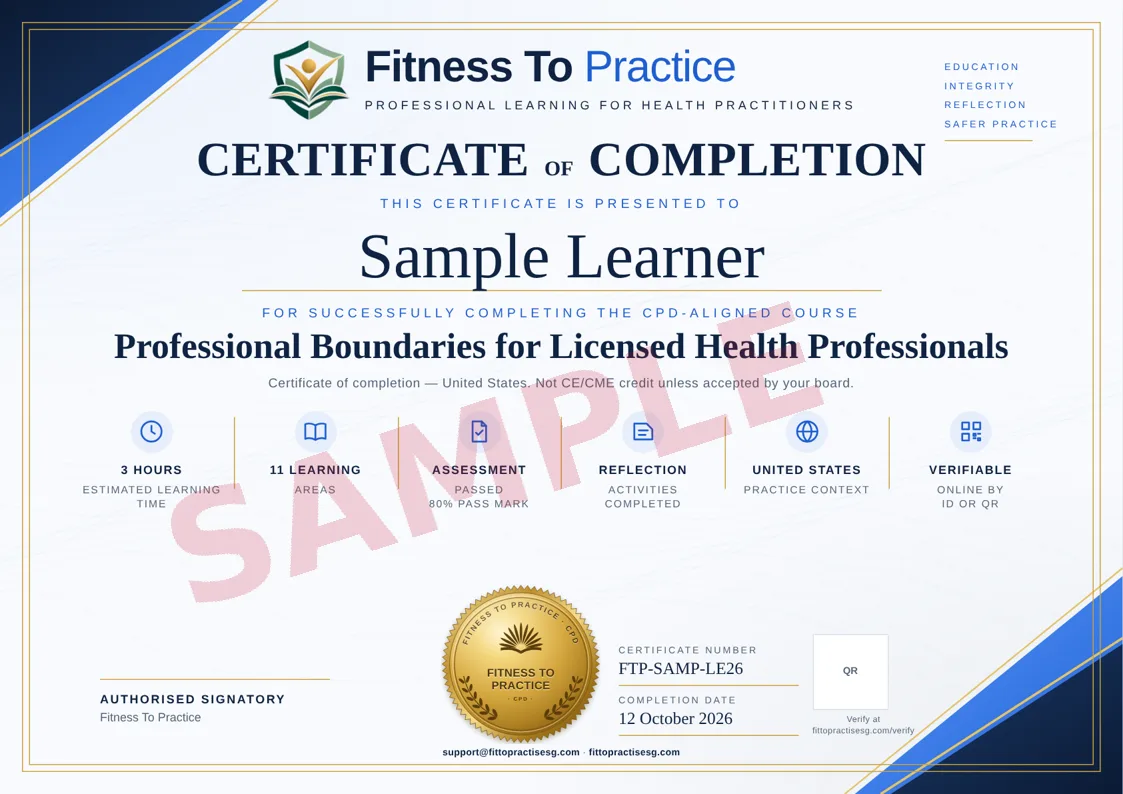
Certificate of completion. Not CE or CME credit unless accepted by your board.
Your name, the course title and the hours
Completion date and a unique certificate ID that can be verified
Ready to download as a PDF as soon as you complete the course
Sample certificate. Yours shows your name, the course, the completion date and a certificate number anyone can verify.
Your reflective account
The course includes a structured reflective account template: guided prompts to record what you learned, how you will apply it and how the change will show in your practice. It gives you written evidence of insight after a concern, and a ready record for your learning portfolio.
Write it in your own words and leave out anything that could identify a patient, a colleague or a case. If you have an open complaint or case, talk to your adviser before reflecting on it in writing.
Questions about this course
What are the six ACGME practice-based learning and improvement abilities?
They include identifying strengths, deficiencies and limits in your knowledge, setting learning goals, performing improvement activities, using performance data and evidence, incorporating feedback and locating and appraising evidence. The course turns them into a personal learning checklist for licensees at any career stage, not just residents.
How is work-based learning different from earning CE hours?
CE hours are a renewal minimum and usually show attendance. Work-based learning uses your own practice: clinical questions, data, feedback and near misses. The course explains why board concerns usually arise from everyday performance, and how to record learning in a way that shows real change.
Can multisource feedback help my professional development?
Yes, if it is specific and acted on. The course explains how to seek direct observation and multisource feedback from colleagues and patients, how to interpret it without defensiveness, and how to turn it into one or two concrete changes you can measure.
When does a proctoring requirement become NPDB-reportable?
It can be reportable when a proctoring requirement restricts privileges for more than 30 days, for example where a proctor must be present or approve care before it is given, and arises from professional competence or conduct. The course explains OPPE, FPPE, HCQIA peer review standards and where that line sits.
What does the practice-based learning course include?
$89 for three online hours. Checks in each section, a 20-question final at 80%, then a certificate and a reflection on learning from your own work. The course is candid about the limits of voluntary learning when a board or employer is involved.
How this course was built
Official sources only
Every legal and regulatory point comes from primary sources: state practice acts and board rules, federal law and national professional codes of ethics. Anything we cannot confirm is left out.
Original, edition by edition
Lessons, scenarios and assessment questions are written by us for each edition separately, then checked for accuracy, teaching quality and fair assessment before publication.
Reviewed when rules change
When a code, standard or law changes, the affected courses are reviewed and updated. Reported errors in legal or regulatory facts are corrected first.