Distinguish the four routes a patient grievance can take in U.S. health care: state board complaint, malpractice claim, organizational grievance under 42 CFR 482.13(a)(2), and other agency or payer complaints.
Summarize published AMA data on malpractice claim frequency by age and specialty and NCSBN data on nursing discipline, and explain the limits of national complaint data.
Use the FSMB grounds for discipline, board probation conditions, Texas BON remedial courses and state CE mandates to identify recurring problem areas for your profession.
Recognize early warning signs that a patient may complain and respond with a structured approach.
Set expectations about outcome, risk, cost, timing and contacts, and check understanding with teach-back.
Build closed loops for test results and referrals, document diagnostic reasoning and safety-net advice, and apply prescribing safeguards including PDMP checks.
Manage handoffs, no-shows and ending a professional relationship without abandonment.
Keep license, CE, self-reporting, scope and cross-border licensure obligations in order, and answer application questions honestly.
Avoid boundary drift and respond to online reviews without breaching HIPAA or professional standards.
Resolve concerns early through local grievance processes, communication and resolution after harm and prompt insurer notification, and write a personal prevention plan.
Who this course is for
U.S. licensed health professionals: physicians, PAs, RNs, LPN/LVNs and APRNs, pharmacists, dentists and dental hygienists, and allied and behavioral health professionals.
Structured learning and a written reflection to show insight after a complaint, an investigation or a board inquiry.
Routine learning
Focused learning on a core standard of practice, with a certificate and reflection for your portfolio.
About this course
This course is about prevention. It explains how patient dissatisfaction travels through four routes in U.S. health care (state board complaints, malpractice claims, organizational grievances and other agencies), what published AMA, NCSBN, FSMB and NPDB information says about how often things go wrong, and which grounds boards act on for physicians, PAs, nurses, pharmacists, dentists and allied professionals. It then turns those patterns into practical habits: spotting early warning signs, setting expectations, closing loops on results and referrals, prescribing safely, keeping license administration in order, protecting boundaries, handling online reviews and resolving concerns early.
It is written for licensed health professionals in every state and setting: physicians, PAs, RNs, LPN/LVNs and APRNs, pharmacists, dentists and dental hygienists, and allied and behavioral health professionals. It is especially useful for licensees in higher-risk specialties, those starting practice or moving states, telehealth clinicians, practice owners and managers, and anyone who has had a near-miss complaint and wants to stop it from happening again.
In the United States, licensing and discipline are state functions, and rules differ by state and profession. A complaint that is closed still costs time and stress, and a formal adverse action or malpractice payment can follow you through the NPDB. Preventing avoidable complaints protects patients first and your license second. This course is separate from our Responding to a State Licensing Board Complaint course, which covers what to do once a complaint has arrived.
Course details
Learning time
Approximately 3 hours (estimated learning time including knowledge checks, reflection and assessment)
Standards covered
State practice acts and board rules; FSMB grounds for discipline and Guidelines (2024); FSMB Social Media and Electronic Communications (2019); NCSBN discipline information, A Nurse's Guide to Professional Boundaries (2024) and A Nurse's Guide to the Use of Social Media; NPDB reporting (45 CFR Part 60); 42 CFR 482.13(a)(2) and 482.24; HIPAA right of access (45 CFR 164.524); AMA Code of Medical Ethics Opinions 1.2.4, 8.6 and 9.1.1; AAPA Guidelines; ADA Principles of Ethics; AHRQ CANDOR; Pennsylvania MCARE Act; Florida §§90.4026 and 395.1051; MATE Act
Format
Self-paced, gated lessons with knowledge checks, case studies and reflection
Assessment
20 scenario-based questions, 80% to pass (16 of 20)
Outcome
Certificate of completion and a written reflection for your CE record
Alignment
Mapped to the grounds for discipline and conduct expectations applied by state medical, nursing, pharmacy and dental boards, FSMB and NCSBN guidance, and federal requirements on grievances, records and privacy; education, not board-approved
1How complaints and claims arise in the United States3 lessons
Four routes a grievance can take in U.S. health care
What the data say about how often things go wrong
Triggers, root causes and the prevention mindset
2Common causes of complaints, by profession3 lessons
Physicians and PAs: where board cases come from
Nurses and APRNs: practice, documentation and conduct
Pharmacists, dentists and other licensed professionals
3Communication habits that prevent complaints3 lessons
Early warning signs that a patient may complain
Setting expectations before care starts
Dealing with dissatisfaction in the moment
4Clinical safeguards against claim-prone failures3 lessons
Missed and delayed diagnosis: closing the loops
Medication and prescribing safeguards
Transitions, no-shows and ending a professional relationship
5Licensing compliance, scope and records3 lessons
The administrative complaints nobody expects
Scope, supervision and practicing across state lines
Records and consent as prevention tools
6Conduct, boundaries, online presence and wellbeing3 lessons
Boundary drift and sensitive examinations
Online reviews, social media and public statements
Stress, fatigue and impairment
7Early resolution and your personal prevention plan3 lessons
Resolving concerns early, at the local level
Learning from near-complaints and feedback
Building your personal prevention plan
8Conclusion and key points1 lesson
Conclusion and key points
9References and further reading1 lesson
References and further reading
10Your reflective account1 lesson
Your reflective account
Assessment and certificate
Final assessment
20scenario-based questions
Pass mark 80%: 16 correct out of 20
Knowledge checks in each section as you go
Tests whether you can apply the standards, not recall a page
Not passed yet? Review the sections and retake it
Certificate of completion
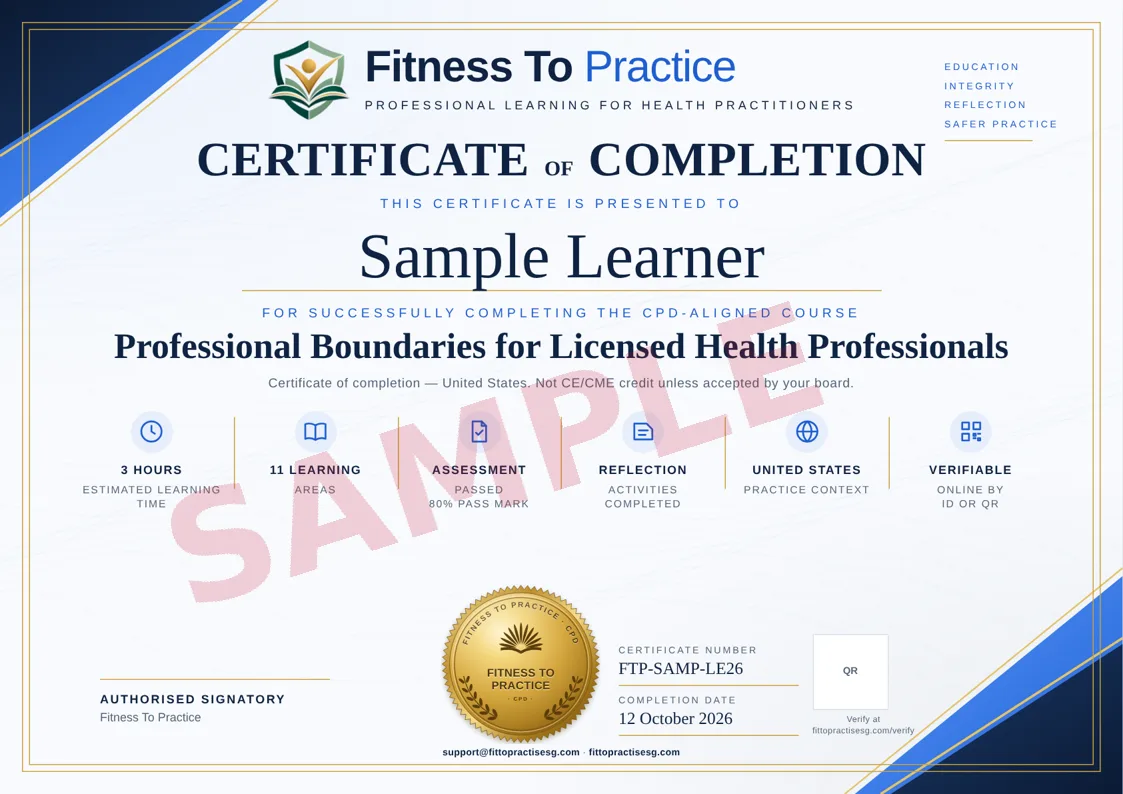
Certificate of completion. Not CE or CME credit unless accepted by your board.
Your name, the course title and the hours
Completion date and a unique certificate ID that can be verified
Ready to download as a PDF as soon as you complete the course
Sample certificate. Yours shows your name, the course, the completion date and a certificate number anyone can verify.
Your reflective account
The course includes a structured reflective account template: guided prompts to record what you learned, how you will apply it and how the change will show in your practice. It gives you written evidence of insight after a concern, and a ready record for your learning portfolio.
Write it in your own words and leave out anything that could identify a patient, a colleague or a case. If you have an open complaint or case, talk to your adviser before reflecting on it in writing.
Questions about this course
What are the four routes a patient grievance can take?
A dissatisfied patient can file a state board complaint, bring a malpractice claim, use the grievance process that 42 CFR 482.13(a)(2) requires hospitals to run, or go to another agency or a payer. The course explains how each route works, what it can lead to, and why a single event often ends up on several of these routes together.
Which habits most often prevent a complaint from starting?
The course focuses on habits that published discipline and claims data keep pointing to: setting expectations about outcome, risk, cost and timing, checking understanding with teach-back, closing the loop on test results and referrals, documenting reasoning and safety-net advice, and ending professional relationships without abandonment. Each habit comes with a short, practical routine you can use in clinic.
How should I reply to a negative online review from a patient?
Carefully, and usually without confirming that the person was ever your patient. A public reply that reveals treatment details can breach HIPAA and lead to a board complaint of its own. The course gives a safe reply structure, explains when to move the conversation offline, and shows how to use local grievance processes to resolve the underlying concern.
How is this different from the course on responding to a board complaint?
This course is about prevention, before any complaint exists. It uses AMA, NCSBN, FSMB and NPDB information to show where problems cluster for each profession and turns that into a personal prevention plan. Our separate board complaint response course covers what to do once a board letter has actually arrived: the investigation, your written response and possible outcomes.
What does the complaint prevention course include for $89?
Three hours online at your own pace, open from the moment you enroll. Each section ends with a short check; the last step is a 20-question exam you pass with 16 right. Passing unlocks a completion certificate and a reflective account that converts your prevention plan into commitments in writing. $89.
How this course was built
Official sources only
Every legal and regulatory point comes from primary sources: state practice acts and board rules, federal law and national professional codes of ethics. Anything we cannot confirm is left out.
Original, edition by edition
Lessons, scenarios and assessment questions are written by us for each edition separately, then checked for accuracy, teaching quality and fair assessment before publication.
Reviewed when rules change
When a code, standard or law changes, the affected courses are reviewed and updated. Reported errors in legal or regulatory facts are corrected first.
What happens after a state board letter arrives: investigation, your written response, settlement conferences, consent orders, hearings and NPDB reporting.