Define hazard, risk, adverse event and near miss and distinguish clinical risk management from QAPI and claims management.
Describe the U.S. risk management framework, including 42 CFR 482.21 and 483.75, accreditation, state facility laws such as Fla. Stat. §395.0197, OSHA and FDA device reporting.
Explain how unmanaged clinical risk leads to board complaints, malpractice claims and NPDB reports.
Identify sources of clinical risk using a systems view of active errors and latent conditions, and prioritize high-risk, high-volume and problem-prone activities.
Assess risk by likelihood and severity, distinguish inherent and residual risk, and contribute to a failure mode and effects analysis.
Select stronger controls using the hierarchy of controls, close loops on tests, referrals and prescriptions, and escalate uncontrolled risks effectively.
Apply risk controls to diagnostic and test-result risk, falls, pressure injuries, deterioration, suicide risk and office, dental, pharmacy and telehealth practice.
Apply OSHA bloodborne pathogens and workplace violence guidance and FDA device reporting duties to daily practice.
Respond appropriately when things go wrong, working with risk management and your insurer and closing the learning loop.
Build a personal risk management plan and respond credibly if a risk-related concern is raised about you.
Who this course is for
U.S. licensed health professionals: physicians, PAs, RNs, LPN/LVNs and APRNs, pharmacists, dentists and dental hygienists, and allied professionals in hospital, long-term care, ambulatory, dental and pharmacy settings.
Structured learning and a written reflection to show insight after a complaint, an investigation or a board inquiry.
Routine learning
Focused learning on a core standard of practice, with a certificate and reflection for your portfolio.
About this course
This course teaches the practical discipline of clinical risk management for U.S. licensees: how to identify hazards before they cause harm, assess risk by likelihood and severity, choose controls that work under real-world pressure, escalate risks you cannot fix yourself, and respond and learn when something goes wrong. It covers proactive tools such as failure mode and effects analysis and dynamic point-of-care risk assessment, high-risk domains including diagnosis and test-result follow-up, falls, deterioration, telehealth, sedation and pharmacy dispensing, and staff and environmental risks such as sharps injuries, workplace violence and medical devices.
It is written for physicians, PAs, nurses and APRNs, pharmacists, dentists and hygienists, and allied professionals in hospitals, long-term care, ambulatory clinics, dental practices and community pharmacies. It suits licensees who want to strengthen safety in their own practice, take on a quality or safety role, prepare for a new service, or respond constructively after a near miss, adverse event, claim or board concern.
In the United States, risk management expectations come from several sources at once: the CMS Conditions of Participation on quality assessment and performance improvement (42 CFR 482.21 and 483.75), accreditation standards, state facility laws such as Florida's internal risk management statute, OSHA's Bloodborne Pathogens Standard and FDA device reporting rules. Unmanaged clinical risk is also behind many board complaints and malpractice claims, and malpractice payments are reported to the National Practitioner Data Bank with no minimum amount. Managing risk well protects patients, colleagues and your license.
Course details
Learning time
Approximately 3 hours (estimated learning time including knowledge checks, reflection and assessment)
Standards covered
42 CFR 482.21 (hospital QAPI) and 42 CFR 483.75 (long-term care QAPI); CMS QAPI Five Elements; The Joint Commission Sentinel Event Policy; Fla. Stat. §395.0197 (internal risk management program); OSHA Bloodborne Pathogens Standard, 29 CFR 1910.1030, and Guidelines for Preventing Workplace Violence (OSHA 3148); FDA Medical Device Reporting, 21 CFR Part 803; Patient Safety and Quality Improvement Act (42 CFR Part 3); NPDB malpractice payment reporting (45 CFR Part 60); AHRQ PSNet, TeamSTEPPS, SOPS and testing and falls toolkits; NIOSH hierarchy of controls
Format
Self-paced, gated lessons with knowledge checks, case studies and reflection
Assessment
20 scenario-based questions, 80% to pass (16 of 20)
Outcome
Certificate of completion and a written reflection for your learning record
Alignment
Mapped to CMS Conditions of Participation on QAPI, federal OSHA and FDA requirements and the standard-of-care expectations applied by state boards; not board-approved and not accredited for CME or CE contact hours
1Clinical risk management in U.S. health care3 lessons
What clinical risk management is, and what it is not
The U.S. framework: CMS, accreditation, states and federal agencies
Why risk management matters to you personally
2Identifying clinical risk3 lessons
Where clinical risk comes from: a systems view
High-risk, high-volume and problem-prone areas
Finding risk before it finds you: sources of intelligence
3Assessing and prioritizing risk3 lessons
Likelihood, severity and the risk matrix
Proactive risk assessment: process mapping and FMEA
Dynamic risk assessment at the point of care
4Controlling risk and escalating concerns3 lessons
Choosing controls: the hierarchy and strong versus weak actions
Everyday clinical controls: standardization, checks and closed loops
Escalating risks you cannot control yourself
5High-risk clinical domains3 lessons
Diagnostic and test-result risk
Patient-specific risks in hospitals and long-term care
Risk in ambulatory, office, dental and pharmacy settings
6Staff safety, devices and the care environment3 lessons
Bloodborne pathogens and sharps: OSHA requirements
Workplace violence and other staff hazards
Medical devices, equipment and technology
7Responding, learning and liability3 lessons
Working with risk management when something goes wrong
Closing the learning loop
Claims, lawsuits and board complaints
8Your personal risk management practice2 lessons
Your personal clinical risk profile
When a risk-related concern is raised about you
9Conclusion and key points1 lesson
Conclusion and key points
10References and further reading1 lesson
References and further reading
11Your reflective account1 lesson
Your reflective account
Assessment and certificate
Final assessment
20scenario-based questions
Pass mark 80%: 16 correct out of 20
Knowledge checks in each section as you go
Tests whether you can apply the standards, not recall a page
Not passed yet? Review the sections and retake it
Certificate of completion
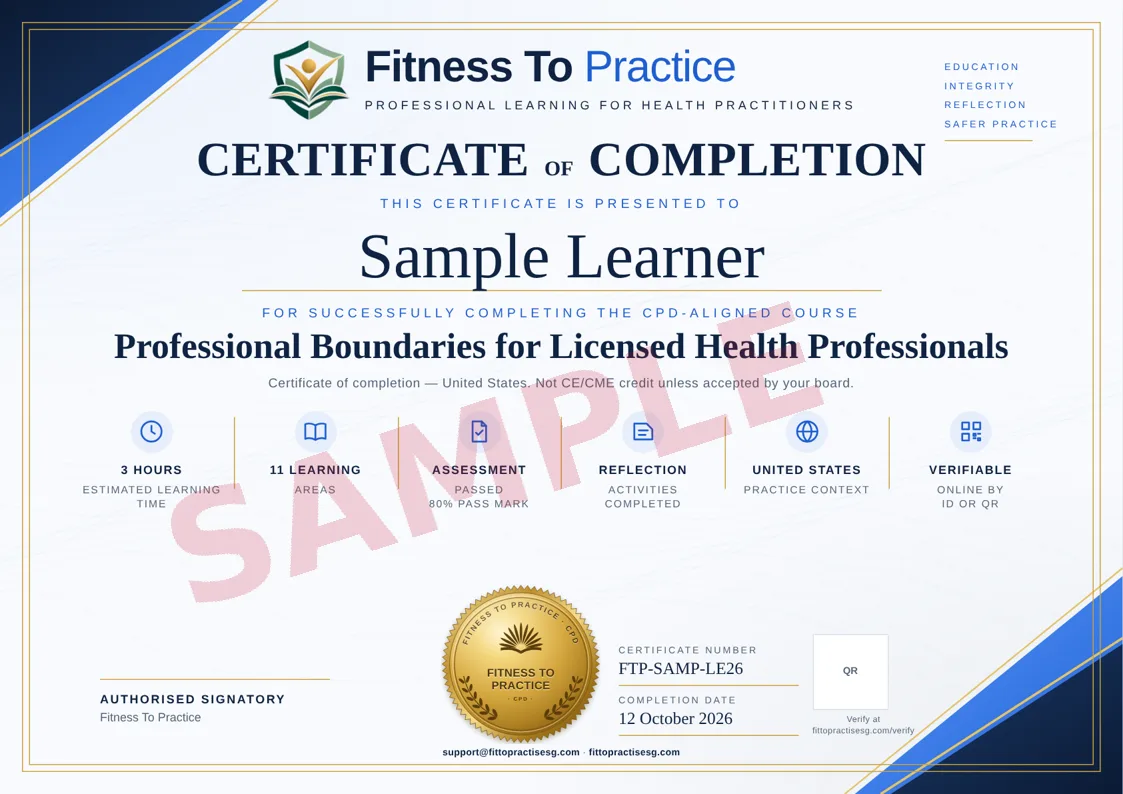
Certificate of completion. Not CE or CME credit unless accepted by your board.
Your name, the course title and the hours
Completion date and a unique certificate ID that can be verified
Ready to download as a PDF as soon as you complete the course
Sample certificate. Yours shows your name, the course, the completion date and a certificate number anyone can verify.
Your reflective account
The course includes a structured reflective account template: guided prompts to record what you learned, how you will apply it and how the change will show in your practice. It gives you written evidence of insight after a concern, and a ready record for your learning portfolio.
Write it in your own words and leave out anything that could identify a patient, a colleague or a case. If you have an open complaint or case, talk to your adviser before reflecting on it in writing.
Questions about this course
What is the difference between clinical risk management and claims management?
Clinical risk management aims to prevent harm by identifying and controlling hazards before they reach patients. Claims management deals with the consequences once a claim or complaint exists. The course also explains how both relate to the QAPI rules for hospitals and nursing homes (42 CFR 482.21 and 483.75).
How do I run a failure mode and effects analysis?
Map the process, identify how each step could fail, score each failure mode for severity, likelihood and detectability, and act on the highest priorities. The course walks through an FMEA as a team member would experience it, alongside dynamic point-of-care risk assessment for decisions made at the bedside.
What should I do about a risk I cannot fix myself?
Escalate it through the right channel with a clear description of the hazard, the likely harm and what you have already done. The course gives a structured escalation approach and shows how to document it, so the risk is owned by someone with authority to control it and your concern is on record.
Which high-risk clinical areas does the course cover?
Diagnostic and test-result follow-up, falls, pressure injuries, clinical deterioration, suicide risk, sedation, telehealth, office and dental practice and pharmacy dispensing. It also covers risks to staff and the environment, including needlestick injuries, workplace violence and reporting device problems to the FDA.
What's included in the clinical risk management course?
For $89 you study for about three hours online at your own speed, with instant access. A final 20 questions (16 correct to pass) leads to a certificate and a written personal risk plan. No CE, CME or risk management certification credit is attached.
How this course was built
Official sources only
Every legal and regulatory point comes from primary sources: state practice acts and board rules, federal law and national professional codes of ethics. Anything we cannot confirm is left out.
Original, edition by edition
Lessons, scenarios and assessment questions are written by us for each edition separately, then checked for accuracy, teaching quality and fair assessment before publication.
Reviewed when rules change
When a code, standard or law changes, the affected courses are reviewed and updated. Reported errors in legal or regulatory facts are corrected first.
Disclosing adverse events and errors: AMA Opinion 8.6, state disclosure and apology laws, communication-and-resolution programs and second-victim support.