
Profession-specific standards2 hours
Professional Standards for Pharmacists
Everyday pharmacy standards: license vs permit, PIC duties, technician supervision and ratios, the Patient Care Process, DEA records and QA.
US$69DetailsAdd to cart
Profession-specific standards
Dispensing judgment, corresponding responsibility, conscience, business integrity and board expectations in U.S. pharmacy
U.S. licensed pharmacists in community, hospital, clinic, specialty, compounding and long-term care settings, including pharmacists-in-charge.
Structured learning and a written reflection to show insight after a complaint, an investigation or a board inquiry.
Focused learning on a core standard of practice, with a certificate and reflection for your portfolio.
This course is written specifically for U.S. pharmacists. It applies the APhA Code of Ethics for Pharmacists to the decisions that define pharmacy practice: prospective drug review and counseling, questioning or declining unsafe orders, controlled substance dispensing under the DEA's corresponding responsibility rule, conscience objections and nondiscrimination, workload and business pressure, billing integrity, disclosure after dispensing errors, compounding, drug shortages, pharmacist prescribing, and diversion or impairment within the pharmacy team.
It is designed for community, hospital, clinic, specialty, compounding and long-term care pharmacists, pharmacists-in-charge, and pharmacists returning to practice or responding to a concern. It is practical rather than theoretical: each section uses U.S. cases, state examples from Texas, California, New York, Florida and Washington, DEA decisions such as Holiday CVS (2012) and Pine Pharmacy (2026), and step-by-step routines you can use on your next shift.
In the United States, pharmacists are licensed and disciplined by state boards of pharmacy under each state's Pharmacy Practice Act, while the DEA regulates controlled substance dispensing and federal fraud and abuse laws govern billing. An ethical lapse in pharmacy can therefore lead to board discipline, loss of a pharmacy's DEA registration, civil or criminal liability and a permanent NPDB report. Sound ethical judgment, honest documentation and a credible response to concerns protect patients, communities and your license.
10 sections · 23 lessons · 3 hours · 20-question final assessment
Final assessment
20scenario-based questions
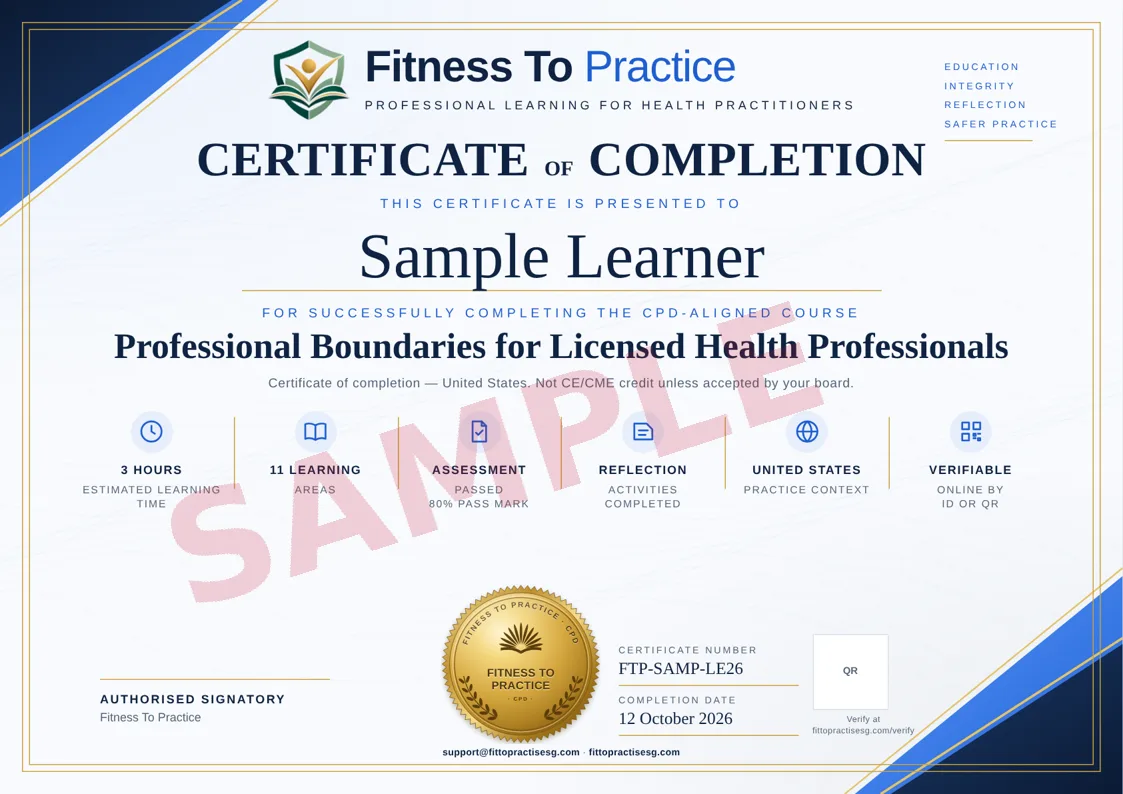
Certificate of completion
Certificate of completion. Not CE or CME credit unless accepted by your board.
The course includes a structured reflective account template: guided prompts to record what you learned, how you will apply it and how the change will show in your practice. It gives you written evidence of insight after a concern, and a ready record for your learning portfolio.
Write it in your own words and leave out anything that could identify a patient, a colleague or a case. If you have an open complaint or case, talk to your adviser before reflecting on it in writing.
Under 21 CFR 1306.04(a), a pharmacist filling a controlled substance prescription carries a corresponding responsibility to make sure it serves a legitimate medical purpose. The course explains the rule and what the DEA's Holiday CVS (2012) and Pine Pharmacy (2026) decisions teach, and shows how to resolve and document red flags without denying legitimate patients care.
The course distinguishes clinical refusals, conscience objections and unlawful discrimination, which are treated very differently by boards and employers. It shows how to plan an objection in advance, with a transfer route, so it never delays a patient's access to medication, and explains how state rules on this question vary.
It treats workload and business pressure as ethical issues, not just staffing complaints. Using California's AB 1286 reforms as an example, it explains how to document unsafe conditions, raise them through the right channels and protect patient safety, and how billing irregularities and dispensing errors should be handled honestly.
About three hours online for $89, built on pharmacy cases from five large states. Checks run through each section; the final 20 questions need 16 correct, and passing gives you a certificate and a reflection on your dispensing decisions. No ACPE or board credit is claimed.
Every legal and regulatory point comes from primary sources: state practice acts and board rules, federal law and national professional codes of ethics. Anything we cannot confirm is left out.
Lessons, scenarios and assessment questions are written by us for each edition separately, then checked for accuracy, teaching quality and fair assessment before publication.
When a code, standard or law changes, the affected courses are reviewed and updated. Reported errors in legal or regulatory facts are corrected first.
Everyday pharmacy standards: license vs permit, PIC duties, technician supervision and ratios, the Patient Care Process, DEA records and QA.
Prescribing standards for every profession: authority, assessment, valid prescriptions, off-label and REMS use, telehealth, and requests from family.
Principlism, a seven-step decision model and the AMA, ANA (2025), ADA, APhA and AAPA codes, from EMTALA and resource allocation to board expectations.