
Profession-specific standards3 hours
Pharmacy Ethics for Pharmacists
The APhA Code at the counter: drug review, declining to fill, corresponding responsibility, conscience, workload, billing and disclosure after error.
US$89DetailsAdd to cart
Profession-specific standards
Competence, patient care, technician supervision, PIC duties and quality systems in U.S. pharmacy practice
U.S. licensed pharmacists in community, hospital, long-term care, mail-order, specialty and compounding settings, including pharmacists-in-charge.
Structured learning and a written reflection to show insight after a complaint, an investigation or a board inquiry.
Focused learning on a core standard of practice, with a certificate and reflection for your portfolio.
This course sets out the professional practice standards that U.S. pharmacists are expected to meet every day. It covers the state Pharmacy Practice Act and board rules, the distinction between a pharmacist's license and a pharmacy's permit, competence and continuing pharmacy education, the JCPP Pharmacists' Patient Care Process, supervision of pharmacy technicians and support staff, the duties of the pharmacist-in-charge, DEA inventory and record requirements, quality assurance programs, multistate and remote practice, and institutional standards in hospitals and long-term care.
It is written for community, hospital, long-term care, mail-order, specialty and compounding pharmacists, for current and prospective pharmacists-in-charge, and for pharmacists changing settings or returning to practice. Examples come from the laws and rules of California, Texas, Florida and New York, including California's 2026 technician ratio rule, Texas Class A personnel rules, Florida's technician registration statute and New York's Regents Rules Part 29.7, with realistic cases throughout.
In the United States, many board actions against pharmacists concern practice standards rather than dramatic misconduct: unlicensed or unregistered staff, ratio breaches, verification lapses, missing records, weak PIC oversight and CE shortfalls. Because boards can act against the pharmacy, the PIC and the pharmacist on duty for the same event, knowing your own standards and showing that you meet them protects patients and your license.
10 sections · 20 lessons · 2 hours · 20-question final assessment
Final assessment
20scenario-based questions
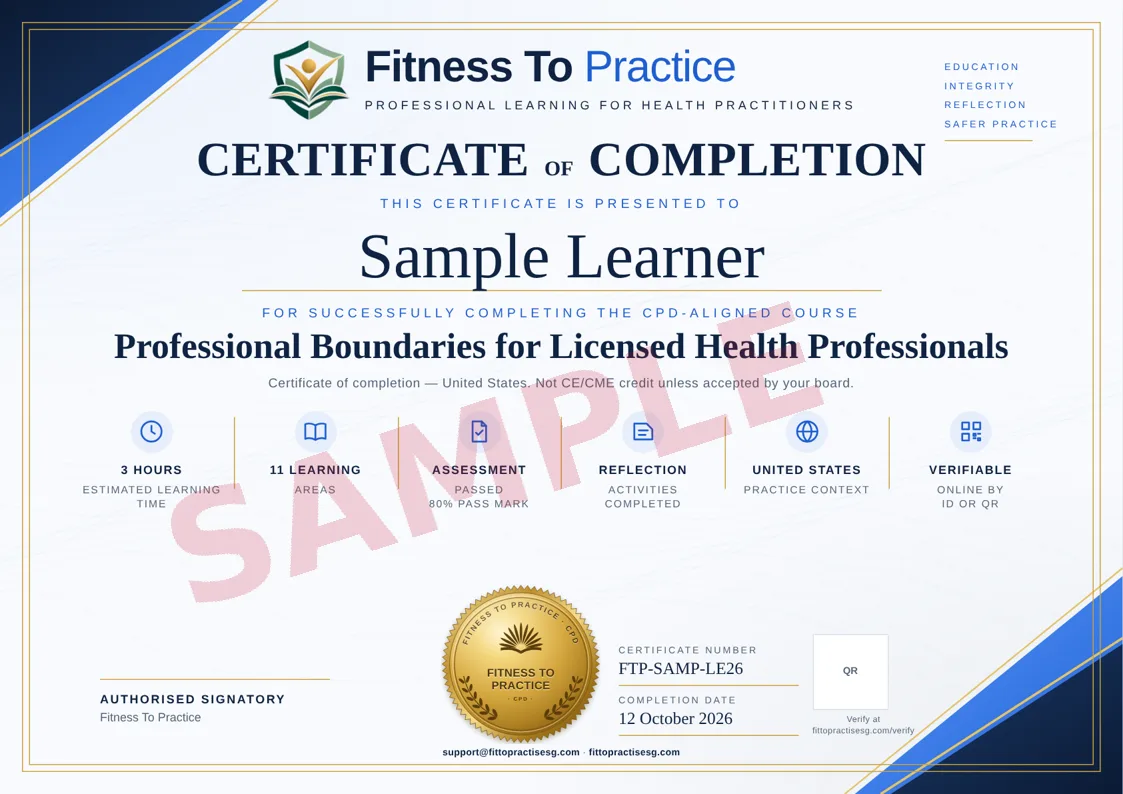
Certificate of completion
Certificate of completion. Not CE or CME credit unless accepted by your board.
The course includes a structured reflective account template: guided prompts to record what you learned, how you will apply it and how the change will show in your practice. It gives you written evidence of insight after a concern, and a ready record for your learning portfolio.
Write it in your own words and leave out anything that could identify a patient, a colleague or a case. If you have an open complaint or case, talk to your adviser before reflecting on it in writing.
Yes. A pharmacist's license and the pharmacy's permit are two different things, and a board can act against the pharmacy, the pharmacist-in-charge and the pharmacist on duty over one incident. The course explains how that works and how each role can show it met its own standards.
A PIC is usually accountable for making sure the pharmacy follows state and federal law on staffing, recordkeeping, security and written policies. The course uses California B&P Code 4113 and Texas 22 TAC 291.32 as worked examples and lists the questions to ask before you agree to become a PIC.
Ratios and delegable tasks vary considerably. The course compares California (including its 2026 ratio rule for technicians), Texas Class A staffing rules, Florida's technician registration law and New York's Regents Rules Part 29.7, and shows how to identify tasks that only a pharmacist may perform.
It focuses on operational practice standards and takes about two hours, compared with three for most courses. Ethics topics such as corresponding responsibility, conscience objections and workload are covered separately in the Pharmacy Ethics course, so the two can be taken together without repetition.
Two self-paced hours for $69. Module checks, a closing 20-question exam (80% to pass), then a certificate and a review of your pharmacy's standards. It is not ACPE-approved and nothing is reported to CPE Monitor. Cases cover the counter, the dispensary and PIC duties.
Every legal and regulatory point comes from primary sources: state practice acts and board rules, federal law and national professional codes of ethics. Anything we cannot confirm is left out.
Lessons, scenarios and assessment questions are written by us for each edition separately, then checked for accuracy, teaching quality and fair assessment before publication.
When a code, standard or law changes, the affected courses are reviewed and updated. Reported errors in legal or regulatory facts are corrected first.
The APhA Code at the counter: drug review, declining to fill, corresponding responsibility, conscience, workload, billing and disclosure after error.
The whole medication-use process: safe orders, high-alert drugs, look-alike names, bar codes, smart pumps, double checks, reconciliation and error response.
Competence as a legal duty: how it drifts, how CE, certification, OPPE and FPPE check it, and a personal plan to keep and evidence it.