How U.S. licensees speak up about unsafe care, fraud and colleagues, choose the right route and protect themselves under federal and state whistleblower laws
Describe the range of routes for raising a concern, from a real-time challenge to an external whistleblower report.
Explain why U.S. whistleblower protection depends on the subject of the concern, the recipient and any notice steps.
Summarize the qui tam process and the protections and remedies under 31 U.S.C. §3730(h).
Apply the EMTALA, PSQIA, OSHA Section 11(c), NLRA Section 7 and HIPAA 164.502(j)(1) provisions to realistic scenarios.
Compare health care whistleblower laws in New York, California and New Jersey, and describe the Texas duty for nurses to report.
Choose an appropriate internal or external route for concerns about systems, facilities, fraud and individual colleagues.
Raise urgent safety concerns in real time and write a clear, factual written concern.
Preserve evidence lawfully without breaching patient privacy or employer policy.
Recognize retaliation, including through privileges, peer review and board complaints, and respond within filing deadlines.
Receive concerns as a leader in a way that supports a speak-up culture and meets accreditation and compliance expectations.
Who this course is for
U.S. licensed health professionals: physicians and residents, PAs, APRNs, RNs and LPN/LVNs, pharmacists, dentists and dental hygienists, therapists and other licensees, plus managers and clinical leaders who receive concerns.
Structured learning and a written reflection to show insight after a complaint, an investigation or a board inquiry.
Routine learning
Focused learning on a core standard of practice, with a certificate and reflection for your portfolio.
About this course
This course teaches U.S. licensed health professionals how to raise concerns effectively and lawfully, from a real-time challenge at the bedside to a report to a state board, a state survey agency, The Joint Commission, HHS-OIG or a federal court. It maps the patchwork of protections that apply, including the False Claims Act's qui tam and anti-retaliation provisions (31 U.S.C. §3730), EMTALA's whistleblower clause, PSQIA reporter protection, OSHA Section 11(c), NLRA Section 7 and HIPAA's whistleblower disclosure rule, together with health care whistleblower laws in New York, California and New Jersey and the Texas duty for nurses to report.
It is written for physicians and residents, PAs, APRNs, RNs and LPN/LVNs, pharmacists, dentists and hygienists, therapists and other licensees, and for managers and clinical leaders who receive concerns. Realistic cases set in hospitals, clinics, pharmacies, dental offices, long-term care and home health show how to choose a route, write a factual concern, handle evidence without breaching patient privacy, track short filing deadlines and respond to retaliation.
In the United States there is no single whistleblower law for health care workers, and protection often depends on what the concern is about, who receives it and whether notice steps were followed. Licensees who stay silent risk patient harm and their own professional standing; licensees who speak up carelessly risk losing protection. This course gives you the knowledge and habits to do it well.
Course details
Learning time
Approximately 3 hours (estimated learning time including knowledge checks, reflection and assessment)
Standards covered
False Claims Act, 31 U.S.C. §3730(b), (d), (e)(4) and (h); EMTALA, 42 U.S.C. §1395dd(i); PSQIA, 42 U.S.C. §299b-22(e); HIPAA 45 CFR 164.502(j)(1); OSH Act Section 11(c); ACA Section 1558; NLRA Section 7; New York Labor Law §§740–741; California Health and Safety Code §1278.5; New Jersey CEPA (N.J.S.A. 34:19-3, 34:19-4); Texas Occupations Code §§301.352, 301.401, 301.402, 301.413; Joint Commission APR.09.01.01 and APR.09.02.01; AMA Opinions 9.4.2 and 9.3.2
Format
Self-paced, gated lessons with knowledge checks, case studies and reflection
Assessment
20 scenario-based questions, 80% to pass (16 of 20)
Outcome
Certificate of completion and a written reflection for your learning record
Alignment
Mapped to state board expectations on reporting and professional conduct, AMA, ANA, AAPA, APhA and ADA ethical guidance, HHS-OIG compliance guidance and Joint Commission accreditation requirements; education, not board-approved
1Speaking up in U.S. health care: what counts and why it is hard3 lessons
From a hallway question to a federal lawsuit: the range of concerns
Why licensees stay quiet
Professional duties to speak up: the ethical baseline
2The federal legal map: which laws protect which concerns4 lessons
The patchwork principle
The False Claims Act: qui tam suits and §3730(h)
Emergency care, patient safety reports, accreditors and HIPAA
Workplace safety, collective concerns and federal employees
3State whistleblower laws and duties to report3 lessons
Health care whistleblower statutes in three states
Mandatory reporting of colleagues: Texas as a worked model
The right to refuse: objecting to unsafe or unlawful instructions
4Choosing the right route4 lessons
A route-finder for U.S. licensees
When and how to escalate
Concerns about a colleague: impairment, competence and conduct
Going public: the media, social media and petitions
5Building a well-founded concern4 lessons
Speaking up in the moment
Putting a concern in writing
Evidence, records and patient privacy
Getting advice and tracking deadlines
6Retaliation: recognizing it and responding3 lessons
What retaliation looks like in health care
Responding to suspected retaliation
When the concern is about you
7Receiving concerns and building a speak-up culture3 lessons
Receiving a concern well
Policies, programs and accreditation expectations
Closing the loop and measuring culture
8Conclusion and key points1 lesson
Conclusion and key points
9References and further reading1 lesson
References and further reading
10Your reflective account1 lesson
Your reflective account
Assessment and certificate
Final assessment
20scenario-based questions
Pass mark 80%: 16 correct out of 20
Knowledge checks in each section as you go
Tests whether you can apply the standards, not recall a page
Not passed yet? Review the sections and retake it
Certificate of completion
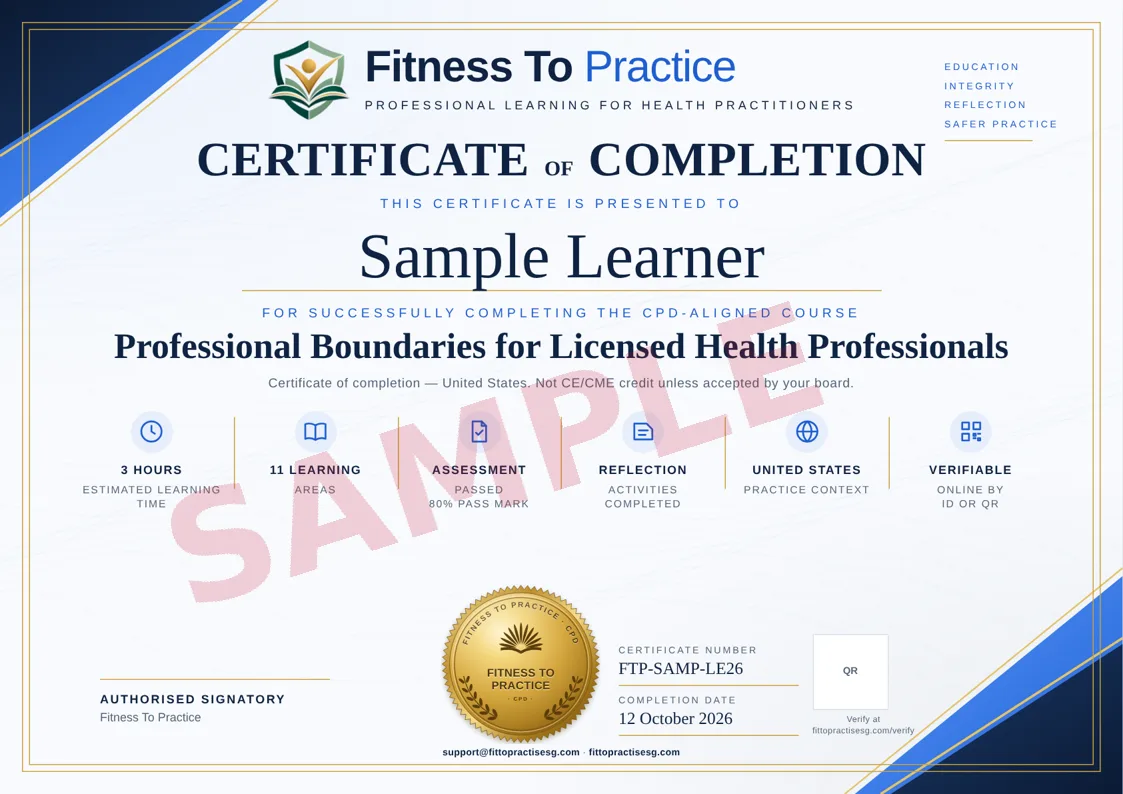
Certificate of completion. Not CE or CME credit unless accepted by your board.
Your name, the course title and the hours
Completion date and a unique certificate ID that can be verified
Ready to download as a PDF as soon as you complete the course
Sample certificate. Yours shows your name, the course, the completion date and a certificate number anyone can verify.
Your reflective account
The course includes a structured reflective account template: guided prompts to record what you learned, how you will apply it and how the change will show in your practice. It gives you written evidence of insight after a concern, and a ready record for your learning portfolio.
Write it in your own words and leave out anything that could identify a patient, a colleague or a case. If you have an open complaint or case, talk to your adviser before reflecting on it in writing.
Questions about this course
Is there one federal law that protects healthcare whistleblowers?
No. Whether you are protected turns on the subject of the concern, the person you tell and whether you gave any required notice. The course maps the anti-retaliation protections in the False Claims Act, EMTALA, the PSQIA, OSHA Section 11(c) and NLRA Section 7, plus HIPAA's rule allowing whistleblower disclosures.
Can I take patient records to support my concern?
Be very careful. HIPAA allows certain disclosures by whistleblowers to oversight agencies or an attorney, but taking records outside those limits can breach privacy law and employer policy and undermine your protection. The course explains how to preserve evidence lawfully and what to record instead.
Which state whistleblower laws does the course cover?
It compares the health care whistleblower statutes of New York, California and New Jersey, which offer broader protections than many states, and explains when Texas nurses must report. It shows how notice requirements and short filing deadlines can decide whether a retaliation claim succeeds.
How do I recognize retaliation for raising a concern?
Retaliation is not always dismissal. It can take the form of schedule changes, loss of privileges, sudden peer review, a board complaint or exclusion from the team. The course explains how to recognize it, document it and respond within filing deadlines, and when to seek legal advice.
What do I get with the raising concerns course?
$89 for three self-paced hours. Checks throughout, a final 20-question test at 80%, and a certificate plus a reflection on speaking up. Managers who receive concerns also get a section on building a speak-up culture. The course is education, not legal advice.
How this course was built
Official sources only
Every legal and regulatory point comes from primary sources: state practice acts and board rules, federal law and national professional codes of ethics. Anything we cannot confirm is left out.
Original, edition by edition
Lessons, scenarios and assessment questions are written by us for each edition separately, then checked for accuracy, teaching quality and fair assessment before publication.
Reviewed when rules change
When a code, standard or law changes, the affected courses are reviewed and updated. Reported errors in legal or regulatory facts are corrected first.