Describe the roles of Medicare contractors, HHS-OIG, DOJ, state MFCUs and state boards in reviewing and enforcing billing integrity.
Explain how NPI, Medicare enrollment and reassignment link claims to the individual licensee, and the consequences of revocation.
Name the seven elements of the 2023 HHS-OIG General Compliance Program Guidance and apply them to large and small organizations.
Document medical necessity in line with section 1862(a)(1)(A), NCDs and LCDs, and use the ABN correctly.
Select E/M levels by medical decision making or total time, and apply incident-to, split or shared, teaching physician and locum tenens rules.
Apply NCCI edits, modifiers and global surgical package rules, and identify high-risk services for your profession.
Plan internal audits and respond to ADRs, TPE, extrapolation and Medicare appeals within required timeframes.
Evaluate compensation, ownership and contract arrangements against FMV, commercial reasonableness, Stark exceptions, AKS safe harbors and OIG alerts.
Apply the rules on copayment waivers, nominal gifts, manufacturer coupons, good faith estimates and patient billing protections.
Respond appropriately to investigations and plan measurable remediation and reflection after a financial integrity concern.
Who this course is for
U.S. licensed health professionals: physicians, PAs, nurse practitioners and other APRNs, RNs, pharmacists, dentists and dental hygienists, therapists, behavioral health clinicians, and practice owners and leaders.
Structured learning and a written reflection to show insight after a complaint, an investigation or a board inquiry.
Routine learning
Focused learning on a core standard of practice, with a certificate and reflection for your portfolio.
About this course
This course teaches U.S. licensees how to keep the financial side of their practice accurate, lawful and fair. Building on the basics of fraud and abuse law, it goes into the practical machinery of billing compliance: the 2023 HHS-OIG General Compliance Program Guidance and its seven elements, documentation that supports medical necessity and coding, evaluation and management levels, incident-to, split or shared and teaching physician billing, NCCI edits and modifiers, high-risk services, risk adjustment and AI tools, internal and external audits, appeals, overpayment response, compensation and ownership arrangements, copayment waivers, good faith estimates and patient billing protections.
It is written for physicians, PAs, nurse practitioners and other APRNs, registered nurses, pharmacists, dentists and dental hygienists, physical, occupational and speech therapists, behavioral health clinicians and practice owners and leaders. It is also useful for licensees whose billing has been questioned by a payer, an employer, a government contractor or a state board, and who need to understand what went wrong and how to show change.
Financial integrity matters in the United States because every claim relies on a licensee's documentation and identity, and because enforcement is increasingly data driven. Billing problems can lead to repayment, civil and criminal liability, exclusion from federal programs, Medicare revocation, NPDB reports and board discipline. This course gives you the knowledge and practical tools to prevent problems, use compliance structures well and respond honestly if something goes wrong.
Course details
Learning time
Approximately 3 hours (estimated learning time including knowledge checks, reflection and assessment)
Standards covered
HHS-OIG General Compliance Program Guidance (2023) and Nursing Facility ICPG (2024); False Claims Act 31 U.S.C. §§3729–3733 and §3730(h); Anti-Kickback Statute and 42 CFR 1001.952; Physician Self-Referral Law and 42 CFR 411.352–411.357; Civil Monetary Penalties Law; EKRA 18 U.S.C. §220; Social Security Act §§1862(a)(1)(A), 1893(f) and 1802(b); 42 CFR 410.26, 415.172, 424.535, 447.15 and 483.85; CMS E/M, NCCI, ABN and appeals rules; No Surprises Act; OIG Special Fraud Alerts and nominal value policy; state practice acts
Format
Self-paced, gated lessons with knowledge checks, case studies and reflection
Assessment
20 scenario-based questions, 80% to pass (16 of 20)
Outcome
Certificate of completion and a written reflection for your learning record
Alignment
Mapped to HHS-OIG compliance guidance, CMS billing and documentation requirements and the unprofessional conduct standards applied by state boards; education, not board-approved
1Financial integrity and the U.S. compliance landscape3 lessons
Why billing compliance is part of your professional practice
The enforcement map: who reviews claims and who investigates
Your NPI, your enrollment and your attestations
2Compliance programs under the 2023 OIG General Compliance Program Guidance3 lessons
The 2023 General Compliance Program Guidance and its seven elements
Compliance leadership, committees and the small practice
Your part in the program: training, questions and speaking up
3Documentation that supports the claim3 lessons
Medical necessity, coverage rules and the ABN
Evaluation and management coding: decision making and time
Who did the work: incident-to, split or shared visits and teaching physicians
4Coding rules, high-risk services and technology3 lessons
Coding edits, modifiers and global packages
High-risk services and settings across the professions
Electronic records, risk adjustment and automated coding tools
5Audits, reviews and responding to problems3 lessons
Internal auditing and monitoring that actually helps
External audits, records requests and appeals
When you find a problem: stop, assess, fix and disclose
6Ownership, compensation and business arrangements3 lessons
Compensation: fair market value, productivity and medical directorships
Ownership, investment and the business of practice
Getting reliable answers: advisory opinions, fraud alerts and contract review
7Money and patients: fair charges and lawful generosity2 lessons
Copayments, waivers, discounts and gifts to patients
Fair charges: estimates, balance billing and extra fees
8When financial integrity is questioned: response and remediation3 lessons
Government investigations: subpoenas, demands and interviews
Outcomes and collateral consequences
Remediation: rebuilding billing practice and demonstrating change
9Conclusion and key points1 lesson
Conclusion and key points
10References and further reading1 lesson
References and further reading
11Your reflective account1 lesson
Your reflective account
Assessment and certificate
Final assessment
20scenario-based questions
Pass mark 80%: 16 correct out of 20
Knowledge checks in each section as you go
Tests whether you can apply the standards, not recall a page
Not passed yet? Review the sections and retake it
Certificate of completion
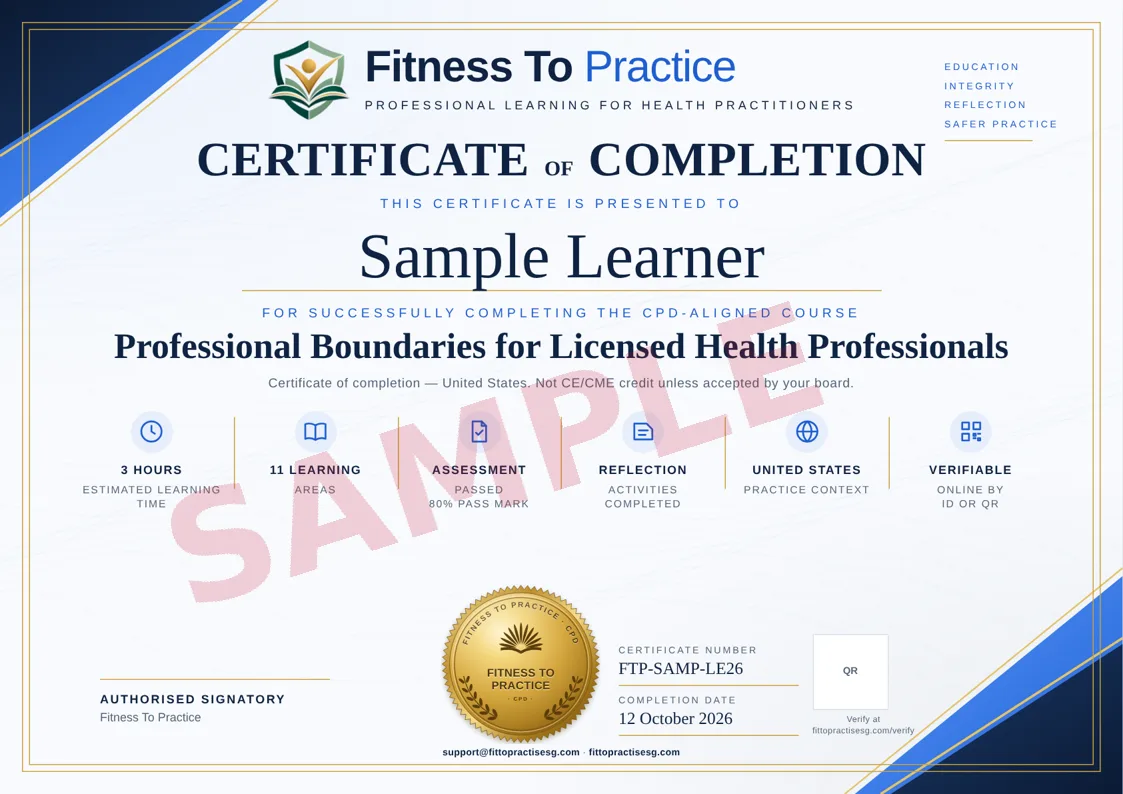
Certificate of completion. Not CE or CME credit unless accepted by your board.
Your name, the course title and the hours
Completion date and a unique certificate ID that can be verified
Ready to download as a PDF as soon as you complete the course
Sample certificate. Yours shows your name, the course, the completion date and a certificate number anyone can verify.
Your reflective account
The course includes a structured reflective account template: guided prompts to record what you learned, how you will apply it and how the change will show in your practice. It gives you written evidence of insight after a concern, and a ready record for your learning portfolio.
Write it in your own words and leave out anything that could identify a patient, a colleague or a case. If you have an open complaint or case, talk to your adviser before reflecting on it in writing.
Questions about this course
What are the seven elements of an effective compliance program?
The 2023 HHS-OIG General Compliance Program Guidance describes written policies, a compliance officer and committee, training, effective communication lines, enforcement and discipline, auditing and monitoring, and responding to detected problems. The course explains each element and how it looks in a large health system versus a small practice.
Does the course explain incident-to and split or shared billing?
Yes. It covers when services by NPs, PAs and other clinicians can be billed incident-to a physician, the rules for split or shared visits in facility settings, teaching physician rules and locum tenens billing. It also covers selecting E/M levels by medical decision making or total time.
What should I do if I find that I was overpaid by Medicare?
Report and return it. Federal law requires identified overpayments to be reported and returned within set timeframes, and keeping them can create False Claims Act liability. The course explains how to quantify an overpayment, involve compliance and counsel, and document what changed so the problem does not recur.
Where does billing compliance end and the integrity course begin?
The integrity course introduces fraud and abuse law as one part of honesty in practice. This course goes deeper into the machinery of billing compliance: documentation for medical necessity, coding rules, audits, ADRs and appeals, fair market value in compensation arrangements, copayment waivers and good faith estimates.
How much does the billing compliance course cost?
$89 buys three self-paced hours, open immediately. Billing scenarios are checked as you go, the 20-question final requires 80%, and your reflective account plus certificate follow. This is education rather than legal advice, and it carries no CE or coding certification credit.
How this course was built
Official sources only
Every legal and regulatory point comes from primary sources: state practice acts and board rules, federal law and national professional codes of ethics. Anything we cannot confirm is left out.
Original, edition by edition
Lessons, scenarios and assessment questions are written by us for each edition separately, then checked for accuracy, teaching quality and fair assessment before publication.
Reviewed when rules change
When a code, standard or law changes, the affected courses are reviewed and updated. Reported errors in legal or regulatory facts are corrected first.
Honesty where it is tested: records and late entries, license and DEA attestations, billing under federal fraud and abuse law, and conflicts of interest.
Accurate, timely, defensible records: CMS entry rules, medical necessity, cloned notes and AI scribes, corrections and addenda, access requests and retention.