
· United States edition: online, self-paced courses with certificate

Patient safety and medicines

Infection Prevention and Control

Standard and transmission-based precautions, injection safety and OSHA, CMS and state requirements for U.S. licensees

  • 3hours
  • 10sections
  • 20final questions
  • 80%pass mark
  • PDFcertificate
  • Online and self-paced, on any device
  • Reflective account template
  • Knowledge checks in every section
  • Instant certificate of completion

Reviewed by our expert editorial team · how we check every course

Written for US practiceUpdated 5 October 2026

What you will learn

  • Explain why infection prevention is a personal professional duty for U.S. licensees and how IPC lapses lead to board action.
  • Distinguish the roles of CDC guidance, OSHA standards, CMS Conditions of Participation and state law in IPC.
  • Apply the chain of infection to identify which measures break transmission in a given situation.
  • Apply CDC standard precautions, including hand hygiene method selection, task-based PPE use and safe doffing.
  • Follow CDC safe injection practices for syringes, single-dose and multi-dose vials, insulin pens and spinal procedures.
  • Select contact, droplet, airborne or Enhanced Barrier Precautions and apply OSHA respirator fit testing and seal check rules.
  • Describe employer and employee duties under OSHA 29 CFR 1910.1030 and take correct action after an occupational exposure.
  • Describe hospital and nursing home IPC and antibiotic stewardship program requirements under 42 CFR 482.42 and 483.80.
  • Recognize possible clusters, report notifiable diseases and support outbreak investigations.
  • Plan credible remediation and reflection after an infection control concern, including state-specific training such as New York's.

Who this course is for

U.S. licensed health professionals: physicians, PAs, RNs, LPN/LVNs and APRNs, pharmacists, dentists and dental hygienists, and allied professionals in hospital, long-term care, ambulatory, pharmacy and home care settings.

After a concern

Structured learning and a written reflection to show insight after a complaint, an investigation or a board inquiry.

Routine learning

Focused learning on a core standard of practice, with a certificate and reflection for your portfolio.

About this course

This course gives U.S. licensees a thorough, practical grounding in infection prevention and control (IPC). It covers the chain of infection; CDC standard precautions, including hand hygiene, PPE selection and doffing, respiratory hygiene, cleaning and safe injection practices; contact, droplet and airborne precautions; C. difficile, norovirus, multidrug-resistant pathogens and CMS Enhanced Barrier Precautions; tuberculosis control and respirator fit testing; and invasive device and aseptic practice. It also covers occupational protection under OSHA's Bloodborne Pathogens Standard, what to do after a needlestick, antibiotic stewardship, surveillance and outbreak response.

It is written for physicians, PAs, RNs, LPN/LVNs and APRNs, pharmacists, dentists and hygienists, and allied professionals in hospitals, long-term care, ambulatory clinics, pharmacies and home care. It suits licensees refreshing their knowledge, those who lead or own a practice and carry responsibility for its IPC systems, and those responding to an infection control concern raised by an employer, health department or board.

In the United States, IPC duties come from several sources at once: CDC guidance that defines the standard of care, OSHA's Bloodborne Pathogens and Respiratory Protection Standards, CMS Conditions of Participation for hospitals (42 CFR 482.42) and long-term care facilities (42 CFR 483.80), and state law. New York, for example, defines failure to use accepted barrier precautions and infection control practices as misconduct for physicians and PAs and requires approved infection control training every four years for many professions. Basic lapses, such as reusing syringes or skipping hand hygiene, cause outbreaks, patient notifications and board action.

Course details

Learning time
Approximately 3 hours (estimated learning time including knowledge checks, reflection and assessment)
Standards covered
CDC/HICPAC Guideline for Isolation Precautions (2007); CDC Core Infection Prevention and Control Practices; CDC hand hygiene, injection safety, disinfection and sterilization, norovirus, tuberculosis and outpatient guidance; OSHA Bloodborne Pathogens Standard, 29 CFR 1910.1030; OSHA Respiratory Protection Standard, 29 CFR 1910.134; CMS Conditions of Participation 42 CFR 482.42 (hospitals) and 42 CFR 483.80 (long-term care), including Enhanced Barrier Precautions (F880 guidance, first issued in QSO-24-08-NH); CDC Core Elements of Antibiotic Stewardship; New York Public Health Law §239 and Education Law §6530(47)
Format
Self-paced, gated lessons with knowledge checks, case studies and reflection
Assessment
20 scenario-based questions, 80% to pass (16 of 20)
Outcome
Certificate of completion and a written reflection for your learning record

Course curriculum

10 sections · 25 lessons · 3 hours · 20-question final assessment

  1. 1Infection prevention in U.S. health care: framework and accountability3 lessons
    • Why infection prevention is a licensure issue
    • The U.S. framework: who sets the rules
    • How infections spread: the chain of infection
  2. 2Standard precautions in everyday practice4 lessons
    • Standard precautions and hand hygiene
    • Personal protective equipment: selection, donning and doffing
    • Respiratory hygiene, source control and patient placement
    • Environmental cleaning, equipment, linen and waste
  3. 3Safe injections, medications and invasive devices3 lessons
    • Safe injection practices and medication vials
    • Drug diversion, tampering and infection risk
    • Invasive devices, aseptic technique and procedures
  4. 4Transmission-based precautions and high-risk pathogens3 lessons
    • Contact, droplet and airborne precautions
    • MDROs, C. difficile, norovirus and Enhanced Barrier Precautions
    • Tuberculosis, respirators and respiratory protection
  5. 5Protecting yourself and colleagues: OSHA and occupational health3 lessons
    • The OSHA Bloodborne Pathogens Standard in practice
    • After an exposure: immediate actions and follow-up
    • Occupational health: vaccination, illness and presenteeism
  6. 6Programs, stewardship and outbreak response3 lessons
    • Facility IPC programs under CMS: hospitals and nursing homes
    • Antibiotic stewardship as infection prevention
    • Surveillance, reporting and outbreak response
  7. 7Settings, culture and professional accountability3 lessons
    • IPC outside the hospital: offices, pharmacies, home care and long-term care
    • Speaking up, culture and sepsis recognition
    • When IPC becomes a board matter: state requirements, discipline and remediation
  8. 8Conclusion and key points1 lesson
    • Conclusion and key points
  9. 9References and further reading1 lesson
    • References and further reading
  10. 10Reflection1 lesson
    • Your reflective account

Assessment and certificate

Final assessment

20scenario-based questions

  • Pass mark 80%: 16 correct out of 20
  • Knowledge checks in each section as you go
  • Tests whether you can apply the standards, not recall a page
  • Not passed yet? Review the sections and retake it

Certificate of completion

Certificate of completion. Not CE or CME credit unless accepted by your board.
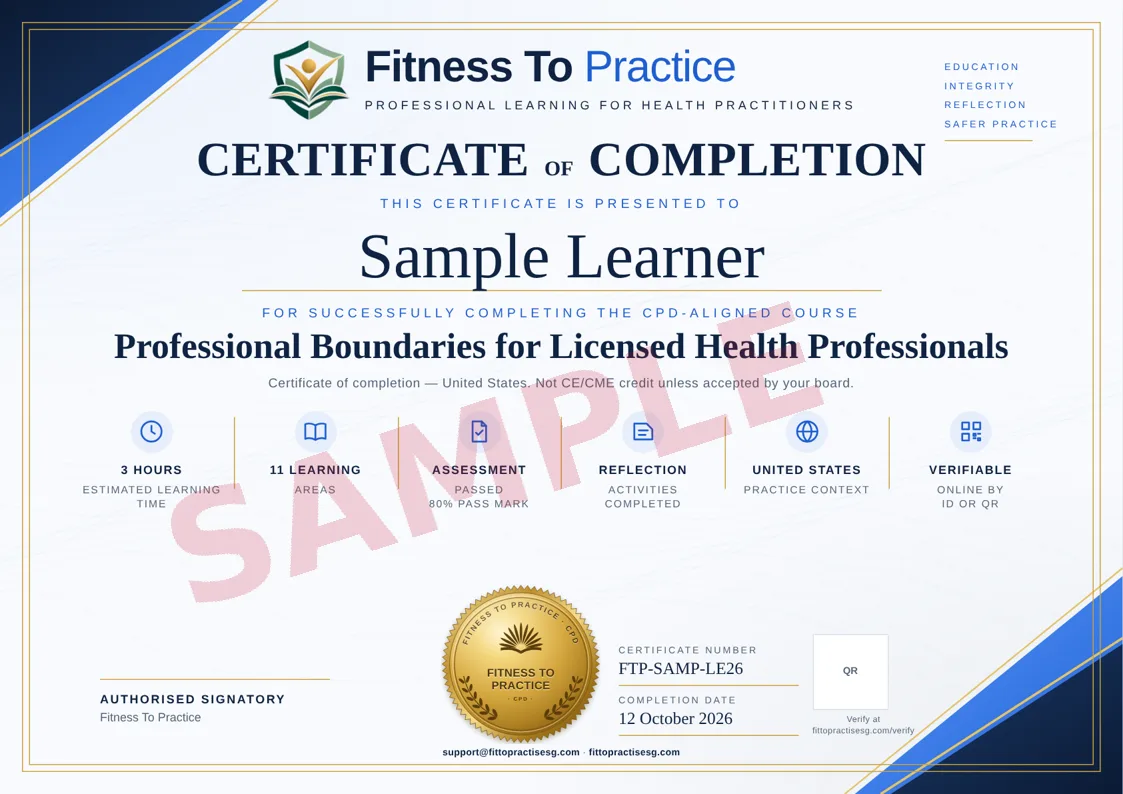
  • Your name, the course title and the hours
  • Completion date and a unique certificate ID that can be verified
  • Ready to download as a PDF as soon as you complete the course
Sample certificate of completion issued to a sample learner
Sample certificate. Yours shows your name, the course, the completion date and a certificate number anyone can verify.

Your reflective account

The course includes a structured reflective account template: guided prompts to record what you learned, how you will apply it and how the change will show in your practice. It gives you written evidence of insight after a concern, and a ready record for your learning portfolio.

Write it in your own words and leave out anything that could identify a patient, a colleague or a case. If you have an open complaint or case, talk to your adviser before reflecting on it in writing.

Questions about this course

Does this course meet New York's mandatory infection control training?

No. New York requires infection control training every four years from providers approved by the State Education Department or Department of Health, and our course is not an approved New York provider. It does explain New York's requirement and its misconduct definition, and is useful for refreshing knowledge or remediation planning elsewhere.

What are the safe injection practices covered in the course?

The course follows CDC safe injection practices: one needle and one syringe for one patient, correct use of single-dose and multi-dose vials, insulin pen rules and infection control for spinal and epidural procedures. It explains how syringe reuse and vial contamination have caused outbreaks and patient notifications in US settings.

What should I do immediately after a needlestick injury?

Wash the site, report it at once and seek prompt evaluation, because post-exposure prophylaxis for HIV works best when started quickly. The course explains employer and employee duties under OSHA's bloodborne pathogens rule (29 CFR 1910.1030), including the exposure control plan, source testing and confidential follow-up.

When are Enhanced Barrier Precautions used?

CMS expects Enhanced Barrier Precautions in nursing homes for residents with certain multidrug-resistant organisms or with wounds or indwelling devices, during high-contact care activities. The course explains when to use them, how they differ from contact precautions, and how respirator fit testing and seal checks apply for airborne precautions.

What's included in the infection control course?

$89 for about three hours of online study. Checks along the way, then 20 final questions with 16 needed to pass; you finish with a certificate and an infection prevention reflection. It suits hospital, long-term care, clinic, pharmacy, dental and home care licensees.

How this course was built

Official sources only

Every legal and regulatory point comes from primary sources: state practice acts and board rules, federal law and national professional codes of ethics. Anything we cannot confirm is left out.

Original, edition by edition

Lessons, scenarios and assessment questions are written by us for each edition separately, then checked for accuracy, teaching quality and fair assessment before publication.

Reviewed when rules change

When a code, standard or law changes, the affected courses are reviewed and updated. Reported errors in legal or regulatory facts are corrected first.

Page updated 5 October 2026

Related courses

All courses
Patient safety and medicines3 hours

Sepsis and the Deteriorating Patient

Recognizing sepsis and deterioration early, escalating effectively, SEP-1 and Surviving Sepsis 2021 care, and documentation that shows it.

20-question final assessment, 80% pass

Patient safety and medicines3 hours

Clinical Risk Management

Proactive risk management for licensees: hazards, likelihood and severity, FMEA, stronger controls, escalation and high-risk clinical domains.

20-question final assessment, 80% pass

Patient safety and medicines3 hours

Medication Safety and Error Prevention

The whole medication-use process: safe orders, high-alert drugs, look-alike names, bar codes, smart pumps, double checks, reconciliation and error response.

20-question final assessment, 80% pass

US$893 hours · 20 questions
Enrol now