
Consent, privacy and communication3 hours
Clinical Handoffs and Patient Safety
Safe handoffs at shift change, transfer and discharge using I-PASS, SBAR and read-back, with Joint Commission, CMS, EMTALA and ACGME requirements.
US$89DetailsAdd to cart
Patient safety and medicines
Recognize, escalate and treat sepsis and clinical deterioration under U.S. standards, from the bedside to the board
U.S. licensed health professionals: physicians and residents, PAs, nurse practitioners and other APRNs, RNs and LPN/LVNs, pharmacists, dentists and dental hygienists, paramedics and allied health professionals.
Structured learning and a written reflection to show insight after a complaint, an investigation or a board inquiry.
Focused learning on a core standard of practice, with a certificate and reflection for your portfolio.
This course teaches U.S. licensees to recognize sepsis and clinical deterioration early, escalate effectively and support time-critical treatment. It covers the definitions in use in U.S. care (Sepsis-3, SIRS-based severe sepsis and the 2024 Phoenix criteria for children), the CDC Hospital Sepsis Program Core Elements, the CMS SEP-1 measure and its place in the Hospital Inpatient Quality Reporting and Value-Based Purchasing programs, The Joint Commission's requirement that hospitals recognize and respond to changes in a patient's condition, the Surviving Sepsis Campaign 2021 guidelines, rapid response systems, and New York's Rory's Regulations and Parents' Bill of Rights.
It is written for physicians and residents, PAs, nurse practitioners and other APRNs, RNs and LPN/LVNs, pharmacists, dentists and dental hygienists, paramedics and other allied health professionals working in emergency departments, inpatient units, ICUs, nursing facilities, urgent care, primary care, telehealth, dental practices and community pharmacies. It is also useful for licensees whose recognition or escalation of a deteriorating patient has been questioned by an employer, a peer review committee or a state board.
Sepsis matters in the United States because it is common, deadly and often recognized late. The CDC reports about 1.7 million adult cases a year, and many patients had recent contact with health care before they were admitted. Hospitals are measured and paid partly on sepsis care, and state boards judge each licensee on whether they assessed, recognized, escalated and documented to the standard of care. This course gives you practical habits, scripts and documentation skills to do that, and to show it.
10 sections · 26 lessons · 3 hours · 20-question final assessment
Final assessment
20scenario-based questions
Certificate of completion
Certificate of completion. Not CE or CME credit unless accepted by your board.
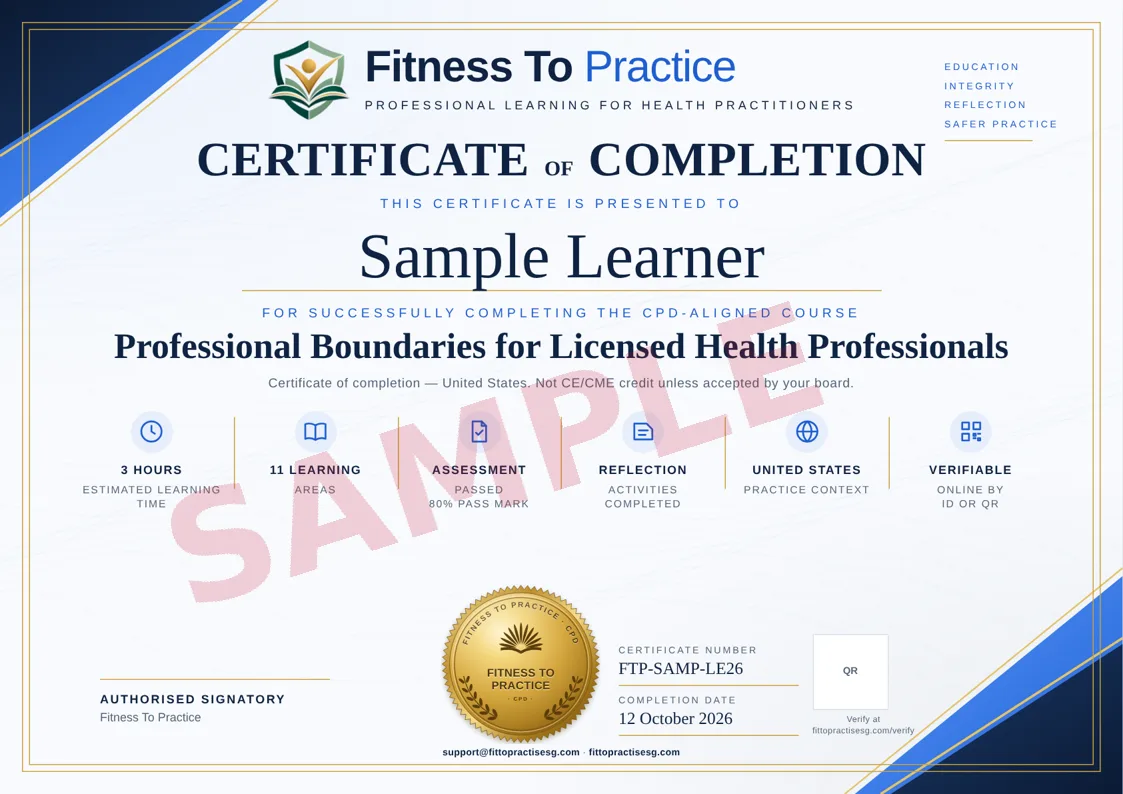
The course includes a structured reflective account template: guided prompts to record what you learned, how you will apply it and how the change will show in your practice. It gives you written evidence of insight after a concern, and a ready record for your learning portfolio.
Write it in your own words and leave out anything that could identify a patient, a colleague or a case. If you have an open complaint or case, talk to your adviser before reflecting on it in writing.
No. The Surviving Sepsis Campaign 2021 guidelines recommend against using qSOFA as a single screening tool compared with SIRS, NEWS or MEWS. The course compares the tools and electronic alerts, and stresses basics that are often missed, such as a properly counted respiratory rate, mental status and trends from the patient's baseline.
SEP-1 is the CMS measure for early management of severe sepsis and septic shock, used in hospital quality reporting and value-based purchasing. It defines time zero and bundle elements such as lactate, blood cultures, antibiotics and fluids. The course explains how individual actions and documentation feed into it.
Use a structured call with a clear, timed request, then CUS language and the two-challenge rule if needed, and follow the chain of command or call the rapid response team. The course gives scripts for each step and covers responding when a family member says the patient is not themselves.
Yes. Many patients have seen a clinician shortly before they are admitted with sepsis. The course covers recognition and referral in EMS, urgent care, primary care, telehealth, nursing facilities, dental practices and community pharmacies, as well as atypical presentations in older, immunocompromised, pediatric and pregnant or postpartum patients.
$89 for about three online hours, self-paced. Checks per section, 20 final questions at 80%, then the certificate and a review of how you spot and escalate sepsis. New York's Rory's Regulations and the pediatric Parents' Bill of Rights are explained, but no state-mandate credit is claimed.
Every legal and regulatory point comes from primary sources: state practice acts and board rules, federal law and national professional codes of ethics. Anything we cannot confirm is left out.
Lessons, scenarios and assessment questions are written by us for each edition separately, then checked for accuracy, teaching quality and fair assessment before publication.
When a code, standard or law changes, the affected courses are reviewed and updated. Reported errors in legal or regulatory facts are corrected first.
Safe handoffs at shift change, transfer and discharge using I-PASS, SBAR and read-back, with Joint Commission, CMS, EMTALA and ACGME requirements.
CDC standard and transmission-based precautions, safe injections, OSHA bloodborne pathogens and respirator rules, stewardship and outbreak response.
Accurate, timely, defensible records: CMS entry rules, medical necessity, cloned notes and AI scribes, corrections and addenda, access requests and retention.