
· United States edition: online, self-paced courses with certificate

Profession-specific standards

Dental Ethics for Dentists and Hygienists

The ADA and ADHA codes and state dental law applied to treatment planning, fees, advertising, the dental team and board scrutiny

  • 3hours
  • 11sections
  • 20final questions
  • 80%pass mark
  • PDFcertificate
  • Online and self-paced, on any device
  • Reflective account template
  • Knowledge checks in every section
  • Instant certificate of completion

Reviewed by our expert editorial team · how we check every course

Written for US practiceUpdated 5 October 2026

What you will learn

  • Describe the structure of the ADA Principles of Ethics and Code of Professional Conduct and the ADHA Code of Ethics for Dental Hygienists, and explain how they relate to state Dental Practice Acts.
  • Present treatment options, including reasonable alternatives and monitoring, in a way that meets ADA 1.A and state fair-dealing rules, and manage informed refusal.
  • Recognize overtreatment, unnecessary services and conflicts in second opinions, and respond to questions about other dentists' work truthfully and justifiably.
  • Apply the ADA 5.B advisory opinions to copayment waivers, fee differentials, treatment dates and procedure coding, and identify when federal fraud and abuse law applies.
  • Evaluate advertising, websites, social media posts, specialty announcements and marketing contracts against the ADA Code and state law, including fee-splitting rules.
  • Apply the ADA opinions on unsubstantiated claims, amalgam removal, product sales and adverse reaction reporting, and the state examination rules for remote orthodontic care.
  • Make patient-selection, emergency-care and dismissal decisions that meet ADA 4.A, 4.B and 2.F and state notice rules, and maintain professional boundaries.
  • Delegate lawfully to allied dental personnel, protect clinical independence, and meet state duties to report sedation-related adverse events and suspected abuse.
  • Describe how state dental boards investigate and resolve ethics complaints, including NPDB reporting, and respond to a board without compromising record integrity.
  • Build practice systems and a written reflection that show acceptance of responsibility and concrete, verifiable change.

Who this course is for

U.S. licensed dentists (general dentists, specialists, owners and associates) and registered dental hygienists; also relevant to dental practice managers.

After a concern

Structured learning and a written reflection to show insight after a complaint, an investigation or a board inquiry.

Routine learning

Focused learning on a core standard of practice, with a certificate and reflection for your portfolio.

About this course

This course applies the American Dental Association's Principles of Ethics and Code of Professional Conduct and the ADHA Code of Ethics for Dental Hygienists to the decisions dental professionals make every day. It works through the ADA's five principles and its advisory opinions on treatment planning, unnecessary services, second opinions, fees and dental benefits claims, advertising, specialty announcements, websites and social media, product sales, amalgam and unsubstantiated claims, patient selection, abandonment, boundaries, delegation, impairment, records and abuse reporting, alongside the Dental Practice Act provisions of California, Texas, Florida and New York.

It is written for licensed dentists (general dentists, specialists, practice owners and associates) and registered dental hygienists, and is useful for dental practice managers who shape billing and marketing systems. It suits professionals who want a dental-specific grounding in ethics, are preparing for a state dental law or ethics requirement, are working in a high-pressure production environment, or want to respond constructively to a concern raised about their practice.

In the United States, dentistry is regulated state by state, and state Dental Practice Acts turn many ethical duties into grounds for discipline: fee fraud, misleading advertising, fee splitting, overtreatment, improper delegation, patient abandonment and record alteration. Formal board actions are public and reportable to the National Practitioner Data Bank, and the commercial realities of dental practice make these risks part of everyday work, not rare dilemmas.

Course details

Learning time
Approximately 3 hours (estimated learning time including knowledge checks, reflection and assessment)
Standards covered
ADA Principles of Ethics and Code of Professional Conduct (2026 version, advisory opinions revised to October 2025); ADHA Code of Ethics for Dental Hygienists (October 2024); California Bus. & Prof. Code §1680; Texas 22 TAC Chapter 108; Florida Statutes §466.028; New York Regents Rules Part 29 (§§29.1 and 29.5) and Education Law §§6510 to 6511; HIPAA Privacy Rule (45 CFR 164.524); False Claims Act and Anti-Kickback Statute; NPDB reporting rules (45 CFR Part 60)
Format
Self-paced, gated lessons with knowledge checks, case studies and reflection
Assessment
20 scenario-based questions, 80% to pass (16 of 20)
Outcome
Certificate of completion and a written reflection for your learning record
Alignment
Mapped to the ADA and ADHA codes and to the unprofessional conduct provisions of state boards of dentistry and dental examiners; not board-approved and not recognized for dental CE

Course curriculum

11 sections · 29 lessons · 3 hours · 20-question final assessment

  1. 1Dental ethics in the United States: codes, law and your license4 lessons
    • Why dentistry has its own ethics
    • The ADA Principles of Ethics and Code of Professional Conduct
    • The ADHA Code of Ethics for Dental Hygienists
    • From code to law: Dental Practice Acts and unprofessional conduct
  2. 2Autonomy and veracity in diagnosis and treatment planning3 lessons
    • Patient involvement, alternatives and informed refusal
    • Overdiagnosis, unnecessary services and second opinions
    • Commenting on previous work and reporting faulty treatment
  3. 3Fees, dental benefits and billing integrity3 lessons
    • Honest fees: the ADA veracity opinions on billing
    • Claims, coding and the law
    • Cost conversations, financing and conflicts of interest
  4. 4Advertising, credentials and your online presence3 lessons
    • Truthful advertising
    • Specialty announcements, degrees and credentials
    • Websites, social media, reviews and paid marketing
  5. 5Evidence, esthetics and remote care3 lessons
    • Evidence, unsubstantiated claims and the amalgam opinion
    • Esthetic and elective treatment
    • Teledentistry and remote orthodontic care
  6. 6Justice, access and the dentist–patient relationship4 lessons
    • Patient selection, disability and bloodborne infections
    • Emergency care, abandonment and ending the relationship
    • Personal relationships and boundaries in the dental setting
    • Recognizing and reporting abuse and neglect
  7. 7The dental team, safety and professional integrity3 lessons
    • Delegation, allied personnel and clinical independence
    • Sedation, adverse events and exposure incidents
    • Impairment, workplace conduct and patient records
  8. 8When dental ethics reaches the board, and how to prevent it3 lessons
    • How dental boards handle ethics complaints
    • Ethics and jurisprudence education, remediation and accountability
    • Building an ethical dental practice
  9. 9Conclusion and key points1 lesson
    • Conclusion and key points
  10. 10References and further reading1 lesson
    • References and further reading
  11. 11Your reflective account1 lesson
    • Your reflective account

Assessment and certificate

Final assessment

20scenario-based questions

  • Pass mark 80%: 16 correct out of 20
  • Knowledge checks in each section as you go
  • Tests whether you can apply the standards, not recall a page
  • Not passed yet? Review the sections and retake it

Certificate of completion

Certificate of completion. Not CE or CME credit unless accepted by your board.
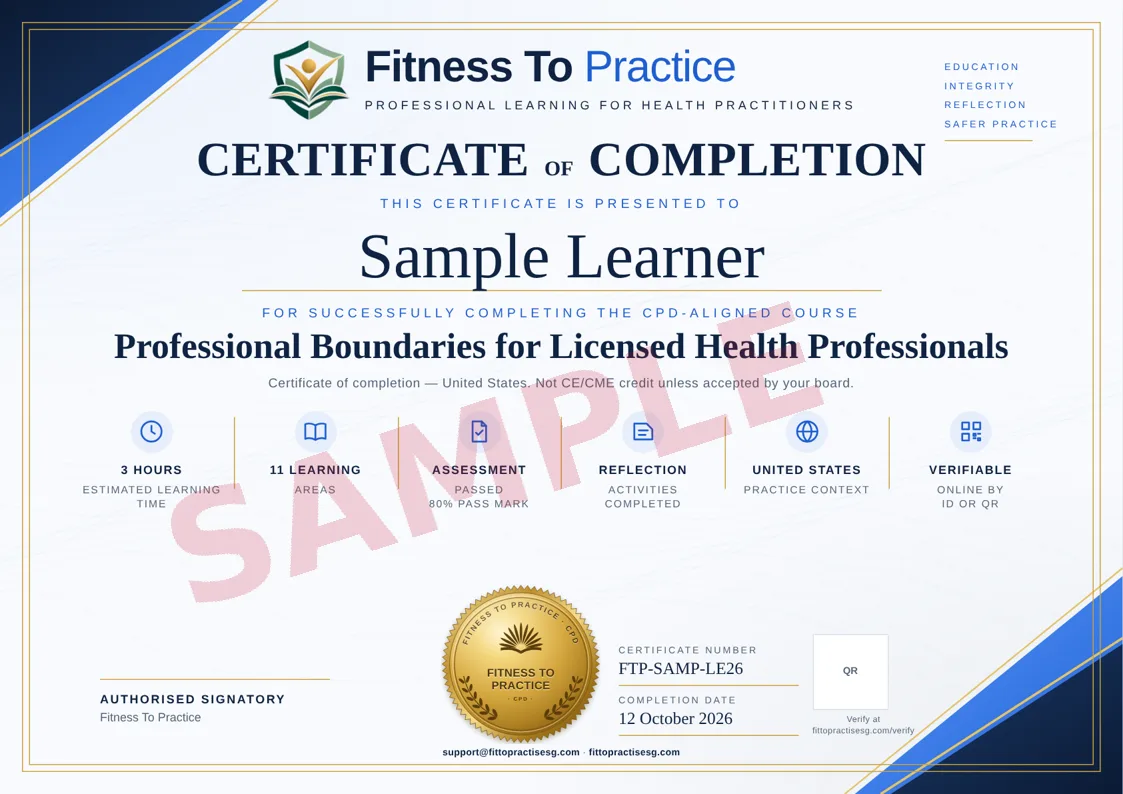
  • Your name, the course title and the hours
  • Completion date and a unique certificate ID that can be verified
  • Ready to download as a PDF as soon as you complete the course
Sample certificate of completion issued to a sample learner
Sample certificate. Yours shows your name, the course, the completion date and a certificate number anyone can verify.

Your reflective account

The course includes a structured reflective account template: guided prompts to record what you learned, how you will apply it and how the change will show in your practice. It gives you written evidence of insight after a concern, and a ready record for your learning portfolio.

Write it in your own words and leave out anything that could identify a patient, a colleague or a case. If you have an open complaint or case, talk to your adviser before reflecting on it in writing.

Questions about this course

Which ADA advisory opinions does the dental ethics course cover?

It covers the ADA's five principles and the advisory opinions most often tested in practice: treatment planning and unnecessary services, second opinions and justifiable criticism, fees and dental benefits claims under 5.B, advertising and specialty announcements, unsubstantiated claims and amalgam removal, patient selection, emergency care and dismissal.

Is a copayment waiver ever acceptable for a dentist?

The ADA treats routinely waiving copayments while billing the full fee to a benefit plan as a form of overbilling, and federal fraud and abuse law can apply where government programs pay. The course explains the advisory opinions on copayment waivers, fee differentials, treatment dates and procedure coding, and where the ethical line sits.

Does the course include content for dental hygienists?

Yes. It applies the ADHA Code of Ethics for Dental Hygienists alongside the ADA Code, and covers delegation and supervision, clinical independence, reporting abuse and record integrity from the hygienist's side as well as the dentist's. Office managers responsible for billing and marketing will also find it useful.

Will this course satisfy a state dental law or ethics requirement?

It may not. Some state dental boards require courses from ADA CERP or AGD PACE recognized providers or their own approved lists, and this course claims neither status nor CE credit. It explains what the California, Texas, Florida and New York dental practice laws provide, but check your board's rules before relying on it.

How long is the dental ethics course and what does it cost?

A 3-hour online course at $89 that you take at your own pace. Dental-practice checks run through it, the final test is 20 questions marked at 80%, and success earns a certificate plus reflective notes centered on your own office systems.

How this course was built

Official sources only

Every legal and regulatory point comes from primary sources: state practice acts and board rules, federal law and national professional codes of ethics. Anything we cannot confirm is left out.

Original, edition by edition

Lessons, scenarios and assessment questions are written by us for each edition separately, then checked for accuracy, teaching quality and fair assessment before publication.

Reviewed when rules change

When a code, standard or law changes, the affected courses are reviewed and updated. Reported errors in legal or regulatory facts are corrected first.

Page updated 5 October 2026

Related courses

All courses
US$893 hours · 20 questions
Enrol now