
· United States edition: online, self-paced courses with certificate

Consent, privacy and communication

Clinical Handoffs and Patient Safety

Safer shift changes, transfers, discharges and referrals for U.S. licensed health professionals

  • 3hours
  • 10sections
  • 20final questions
  • 80%pass mark
  • PDFcertificate
  • Online and self-paced, on any device
  • Reflective account template
  • Knowledge checks in every section
  • Instant certificate of completion

Reviewed by our expert editorial team · how we check every course

Written for US practiceUpdated 5 October 2026

What you will learn

  • Define a clinical handoff and explain how information, authority and responsibility transfer, using AHRQ TeamSTEPPS principles.
  • Describe the U.S. framework for handoffs, including The Joint Commission's hand-off requirement (NPG.01.04.01 EP 2 for hospitals from 2026), related National Performance Goals, CMS rules and ACGME requirements.
  • Give and receive a structured I-PASS handoff that includes illness severity, an action list, if/then contingencies and receiver synthesis.
  • Use SBAR with read-back to escalate a change in a patient's condition.
  • Apply The Joint Commission's minimum handoff content and recommended conditions for time, place and interruptions.
  • Assign clear ownership of pending tests and critical results at shift change, transfer and discharge.
  • Manage high-risk handoffs in perioperative care, the emergency department, behavioral health and interfacility transfer, including EMTALA requirements.
  • Carry out discharge and long-term care handoffs that meet CMS requirements, using medication reconciliation and teach-back.
  • Explain responsibility after handoff, patient abandonment concerns and handing off within scope, and document handoffs accurately.
  • Plan improvement and targeted remediation, and gather evidence of changed handoff practice for an employer or state board.

Who this course is for

U.S. licensed health professionals: physicians and residents, PAs, nurse practitioners and other APRNs, RNs and LPN/LVNs, pharmacists, dental professionals and allied health professionals.

After a concern

Structured learning and a written reflection to show insight after a complaint, an investigation or a board inquiry.

Routine learning

Focused learning on a core standard of practice, with a certificate and reflection for your portfolio.

About this course

This course teaches U.S. licensees how to hand off patients safely: at shift change, between units and teams, between facilities, at discharge and on referral. It covers the standards that apply, including The Joint Commission's hand-off requirement and related National Performance Goals, CMS Conditions of Participation for medical records and discharge planning, long-term care transfer rules and EMTALA, and the ACGME requirements for residency hand-overs, and it turns them into practical habits using AHRQ TeamSTEPPS tools, I-PASS and SBAR.

It is written for physicians, residents, PAs, nurse practitioners and other APRNs, registered and practical nurses, pharmacists, dental professionals and allied health professionals in hospitals, emergency departments, perioperative and procedural areas, nursing facilities, urgent care and community practice. It is also useful for licensees who have been involved in a handoff-related event or board concern and want to show insight and changed practice.

Handoffs matter because they are frequent and fragile. A teaching hospital may have thousands every day, and communication failures are a recurring factor in adverse events, malpractice claims and board complaints. State boards judge each licensee on whether they communicated what the next clinician needed, followed up what they owned and did not leave patients without care. This course gives you the tools to do that every shift, and to evidence it.

Course details

Learning time
Approximately 3 hours (estimated learning time including knowledge checks, reflection and assessment)
Standards covered
The Joint Commission hospital National Performance Goals (effective January 2026): NPG.01.04.01 EP 2 hand-off communication (formerly PC.02.02.01 EP 2), NPG.01.01.01, NPG.01.02.01 and NPG.14.05.01 (formerly NPSG.01.01.01, NPSG.02.03.01 and NPSG.03.06.01); Sentinel Event Alert 58 (2017); 42 CFR 482.24, 482.43(b), 483.15(c)(2)(iii) and 489.24(e)(2) (EMTALA); ACGME Common Program Requirements on transitions of care; AHRQ TeamSTEPPS (Handoff, I-PASS, SBAR, SHARQ, ANTICipate); state practice acts and board standards
Format
Self-paced, gated lessons with knowledge checks, case studies and reflection
Assessment
20 scenario-based questions, 80% to pass (16 of 20)
Outcome
Certificate of completion and a written reflection for your learning record
Alignment
Mapped to Joint Commission hand-off and patient safety requirements, CMS Conditions of Participation, AHRQ TeamSTEPPS guidance and the standards of practice applied by state boards; education, not board-approved

Course curriculum

10 sections · 23 lessons · 3 hours · 20-question final assessment

  1. 1Handoffs as a patient-safety risk in U.S. health care3 lessons
    • What a handoff is, and what actually changes hands
    • Why handoffs fail: the evidence behind the rules
    • The U.S. framework: accreditation, federal rules, training standards and boards
  2. 2Structured handoff tools and how to use them3 lessons
    • I-PASS: the evidence-based handoff bundle
    • SBAR, SHARQ, ANTICipate and specialty mnemonics
    • The receiver's job: synthesis, questions and closed-loop communication
  3. 3Shift-change handoffs for physicians and nurses3 lessons
    • Physician sign-out, night coverage and contingency planning
    • Nursing shift report and bedside handoff
    • The handoff environment: time, place, interruptions and the EHR
  4. 4High-risk handoffs: deterioration, procedures and the emergency department3 lessons
    • Deteriorating patients, pending results and critical values
    • Perioperative and procedural handoffs
    • Emergency department, EMS and behavioral health handoffs
  5. 5Transitions across facilities and settings3 lessons
    • Interfacility transfers and EMTALA
    • Hospital discharge: handing off to the patient, the family and the next clinician
    • Post-acute, community, pharmacy, dental and allied handoffs
  6. 6Responsibility, documentation and accountability3 lessons
    • Who owns the patient? Responsibility, scope and leaving safely
    • Documenting the handoff
    • When a handoff fails: reporting, review and board complaints
  7. 7Improving handoffs and showing changed practice2 lessons
    • Improving handoffs on your unit or service
    • Your personal handoff practice, and remediation after a concern
  8. 8Conclusion and key points1 lesson
    • Conclusion and key points
  9. 9References and further reading1 lesson
    • References and further reading
  10. 10Your reflective account1 lesson
    • Your reflective account

Assessment and certificate

Final assessment

20scenario-based questions

  • Pass mark 80%: 16 correct out of 20
  • Knowledge checks in each section as you go
  • Tests whether you can apply the standards, not recall a page
  • Not passed yet? Review the sections and retake it

Certificate of completion

Certificate of completion. Not CE or CME credit unless accepted by your board.
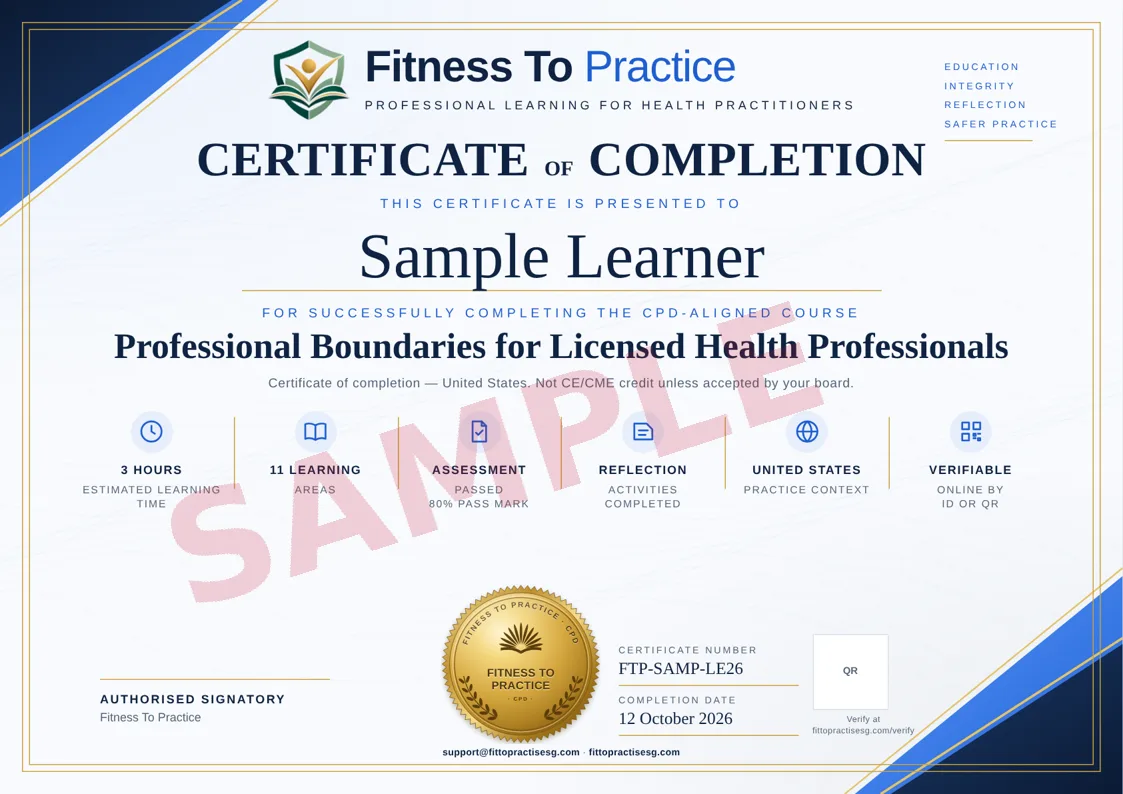
  • Your name, the course title and the hours
  • Completion date and a unique certificate ID that can be verified
  • Ready to download as a PDF as soon as you complete the course
Sample certificate of completion issued to a sample learner
Sample certificate. Yours shows your name, the course, the completion date and a certificate number anyone can verify.

Your reflective account

The course includes a structured reflective account template: guided prompts to record what you learned, how you will apply it and how the change will show in your practice. It gives you written evidence of insight after a concern, and a ready record for your learning portfolio.

Write it in your own words and leave out anything that could identify a patient, a colleague or a case. If you have an open complaint or case, talk to your adviser before reflecting on it in writing.

Questions about this course

What makes an I-PASS handoff different from an informal report?

I-PASS breaks a handoff into five parts: how sick the patient is, a short summary, the to-do list, situation awareness with if/then contingency plans, and a synthesis spoken back by the receiver. The course shows how each element prevents a common failure, how to run it at shift change for physicians and nurses, and why the receiver's synthesis matters.

Who owns a test result that comes back after a handoff?

It must be explicit. The course teaches you to assign clear ownership of pending tests and critical results at shift change, transfer and discharge, and to document who will follow up. Unowned results are a recurring factor in adverse events and claims, and boards judge whether you followed up what you owned.

Which Joint Commission and CMS rules apply to handoffs?

The course covers The Joint Commission's hospital handoff standard, including the 2026 NPG.01.04.01 EP 2 element, related National Performance Goals, CMS Conditions of Participation on records and discharge planning, rules for transfers into and out of long-term care, EMTALA for interfacility transfers and ACGME requirements for residency hand-overs.

Can I be responsible for a patient after I hand off care?

Responsibility transfers only when the handoff is complete and accepted. The course explains how abandonment concerns arise, why you should hand off only within scope and to someone able to accept, and how to document the handoff so the record shows what was communicated and who accepted the patient.

How is the handoff course delivered and assessed?

It is a 3-hour online course at $89, done at your own pace. Short checks lead to a final of 20 questions with a pass at 16, and a reflection on your own handoffs; the certificate is issued when you pass.

How this course was built

Official sources only

Every legal and regulatory point comes from primary sources: state practice acts and board rules, federal law and national professional codes of ethics. Anything we cannot confirm is left out.

Original, edition by edition

Lessons, scenarios and assessment questions are written by us for each edition separately, then checked for accuracy, teaching quality and fair assessment before publication.

Reviewed when rules change

When a code, standard or law changes, the affected courses are reviewed and updated. Reported errors in legal or regulatory facts are corrected first.

Page updated 5 October 2026

Related courses

All courses
Patient safety and medicines3 hours

Sepsis and the Deteriorating Patient

Recognizing sepsis and deterioration early, escalating effectively, SEP-1 and Surviving Sepsis 2021 care, and documentation that shows it.

20-question final assessment, 80% pass

US$893 hours · 20 questions
Enrol now