
· United States edition: online, self-paced courses with certificate

Patient safety and medicines

Controlled Substances: Safe Prescribing and Dispensing

DEA registration, valid prescriptions, telemedicine, PDMPs, opioid and benzodiazepine safety, records, disposal and diversion under federal and state law

  • 3hours
  • 11sections
  • 20final questions
  • 80%pass mark
  • PDFcertificate
  • Online and self-paced, on any device
  • Reflective account template
  • Knowledge checks in every section
  • Instant certificate of completion

Reviewed by our expert editorial team · how we check every course

Written for US practiceUpdated 5 October 2026

What you will learn

  • Explain how the Controlled Substances Act, DEA regulations, state law and board rules combine, and classify common clinical drugs by schedule using the findings in 21 U.S.C. 812.
  • Manage a DEA registration correctly, including state-specific registration, updates, MATE Act training, accurate attestations and the grounds for DEA action in 21 U.S.C. 824.
  • Write controlled substance prescriptions that meet 21 CFR 1306.05 and the legitimate medical purpose standard, using EPCS securely and meeting the CMS Part D e-prescribing requirement.
  • Apply the Schedule II and Schedule III to V rules on refills, multiple prescriptions, emergency oral orders, faxes, partial fills and transfers.
  • Apply the current federal rules on telemedicine prescribing, including the temporary flexibilities and the permanent buprenorphine pathway, together with state requirements.
  • Use the 2022 CDC opioid guideline, the FDA's tapering warning and PDMP data to make and document safe decisions for acute pain, long-term therapy and non-opioid controlled substances.
  • Offer naloxone, counsel on storage and disposal, and treat or refer patients with opioid use disorder within the rules on buprenorphine, opioid treatment programs and the three-day rule.
  • Meet federal requirements for ordering, storage, inventories, records, waste and disposal of controlled substance stock.
  • Recognize and respond to theft, loss, fraudulent prescriptions and workplace diversion, including DEA reporting within one business day and Form 106 within 45 days.
  • Respond to a board, DEA or other inquiry about controlled substances in a way that protects patients and demonstrates insight through measurable remediation.

Who this course is for

U.S. licensed health professionals who prescribe, dispense, administer or store controlled substances: physicians, PAs, NPs and other APRNs, dentists, pharmacists and pharmacists-in-charge, RNs and anesthesia providers, and controlled substance leads in clinics, surgical centers and dental offices.

After a concern

Structured learning and a written reflection to show insight after a complaint, an investigation or a board inquiry.

Routine learning

Focused learning on a core standard of practice, with a certificate and reflection for your portfolio.

About this course

This course gives U.S. licensees a complete, practical working knowledge of controlled substances: how the Controlled Substances Act and DEA regulations at 21 CFR Parts 1300 to 1321 fit together with state law and board rules; how to obtain and keep a DEA registration and meet MATE Act and state education requirements; how to write prescriptions that are both legally complete and clinically legitimate, including electronic prescribing, Schedule II rules, partial fills and telemedicine; and how to apply the 2022 CDC Clinical Practice Guideline for Prescribing Opioids for Pain, PDMP checks, naloxone and treatment for opioid use disorder in everyday decisions. It then covers ordering, storage, inventories, records, waste and disposal, theft and loss reporting, and workplace diversion.

It is written for everyone who prescribes, dispenses, administers or stores controlled substances: physicians, PAs, nurse practitioners and other APRNs, dentists, pharmacists and pharmacists-in-charge, registered nurses and anesthesia providers, and practice managers of clinics, surgical centers and dental offices. It suits licensees preparing for a DEA renewal or inspection, starting telehealth or in-office dispensing, taking on a pharmacist-in-charge or controlled substance lead role, or responding to a board, DEA or employer concern about controlled substances.

In the United States, controlled substance practice is regulated on several levels at once. DEA can suspend or revoke a registration independently of the state license, state boards discipline licensees for improper prescribing, dispensing and diversion, CMS requires electronic prescribing for Medicare Part D controlled substances, and formal board actions are reported to the National Practitioner Data Bank. Rules have changed rapidly, from the end of the buprenorphine waiver and the MATE Act training requirement to new pharmacy transfer rules and the extended telemedicine flexibilities. This course brings those changes together in one place, with cases from many states and professions.

Course details

Learning time
Approximately 3 hours (estimated learning time including knowledge checks, reflection and assessment)
Standards covered
Controlled Substances Act (21 U.S.C. 801 and following, including 812 and 824); DEA regulations 21 CFR Parts 1300 to 1321 (1300.01, 1301, 1304, 1305, 1306, 1311, 1317); MATE Act training requirement; Consolidated Appropriations Act, 2023, section 1262; DEA and HHS telemedicine flexibilities (through December 31, 2026) and buprenorphine telemedicine rule; SUPPORT Act section 2003 and the CMS EPCS Program; 42 CFR Part 8; CDC Clinical Practice Guideline for Prescribing Opioids for Pain (2022); FDA safety communications on opioid tapering (2019) and benzodiazepines (2020); state PDMP laws (California CURES, Florida E-FORCSE, New York I-STOP); NPDB reporting (45 CFR Part 60); Ruan v. United States (2022)
Format
Self-paced, gated lessons with knowledge checks, case studies and reflection
Assessment
20 scenario-based questions, 80% to pass (16 of 20)
Outcome
Certificate of completion and a written reflection for your learning record
Alignment
Mapped to federal DEA, CMS, CDC and FDA requirements and guidance and to the controlled substance prescribing, dispensing and record-keeping standards applied by state medical, nursing, pharmacy and dental boards; not board-approved, not accredited for CME or CE contact hours, and not a substitute for MATE Act or state-mandated training unless accepted

Course curriculum

11 sections · 27 lessons · 3 hours · 20-question final assessment

  1. 1The U.S. controlled substances framework3 lessons
    • Why controlled substances sit under a separate legal regime
    • Federal and state law working together
    • Who may prescribe, dispense and administer
  2. 2DEA registration and required training3 lessons
    • Getting and keeping a DEA registration
    • Required training: the MATE Act and state education rules
    • How DEA can act against a registration
  3. 3Writing lawful controlled substance prescriptions3 lessons
    • What makes a controlled substance prescription valid
    • Schedule-specific rules: refills, emergencies, faxes and partial fills
    • Telemedicine prescribing of controlled substances
  4. 4Clinical decision-making for controlled substances3 lessons
    • Using the 2022 CDC guideline for acute pain
    • Long-term opioid therapy: monitoring, changing doses and tapering
    • Beyond opioids: benzodiazepines, stimulants and other controlled drugs
  5. 5PDMPs, harm reduction and opioid use disorder3 lessons
    • Prescription drug monitoring programs in practice
    • Reducing harm: naloxone, counseling, storage and disposal
    • Treating opioid use disorder within the rules
  6. 6Dispensing, storage, records and disposal3 lessons
    • Dispensing: checking, filling and transferring controlled substance prescriptions
    • Ordering, storage, inventory and records
    • Waste and disposal of registrant stock
  7. 7Diversion, theft and loss3 lessons
    • Theft, loss and fraudulent prescriptions
    • Diversion by health care workers
    • Prescribing for yourself, family and colleagues
  8. 8When controlled substance concerns reach regulators3 lessons
    • Parallel tracks: boards, DEA, prosecutors and payers
    • What boards do with controlled substance cases
    • Responding and remediating after a controlled substance concern
  9. 9Conclusion and key points1 lesson
    • Conclusion and key points
  10. 10References and further reading1 lesson
    • References and further reading
  11. 11Your reflective account1 lesson
    • Your reflective account

Assessment and certificate

Final assessment

20scenario-based questions

  • Pass mark 80%: 16 correct out of 20
  • Knowledge checks in each section as you go
  • Tests whether you can apply the standards, not recall a page
  • Not passed yet? Review the sections and retake it

Certificate of completion

Certificate of completion. Not CE or CME credit unless accepted by your board.
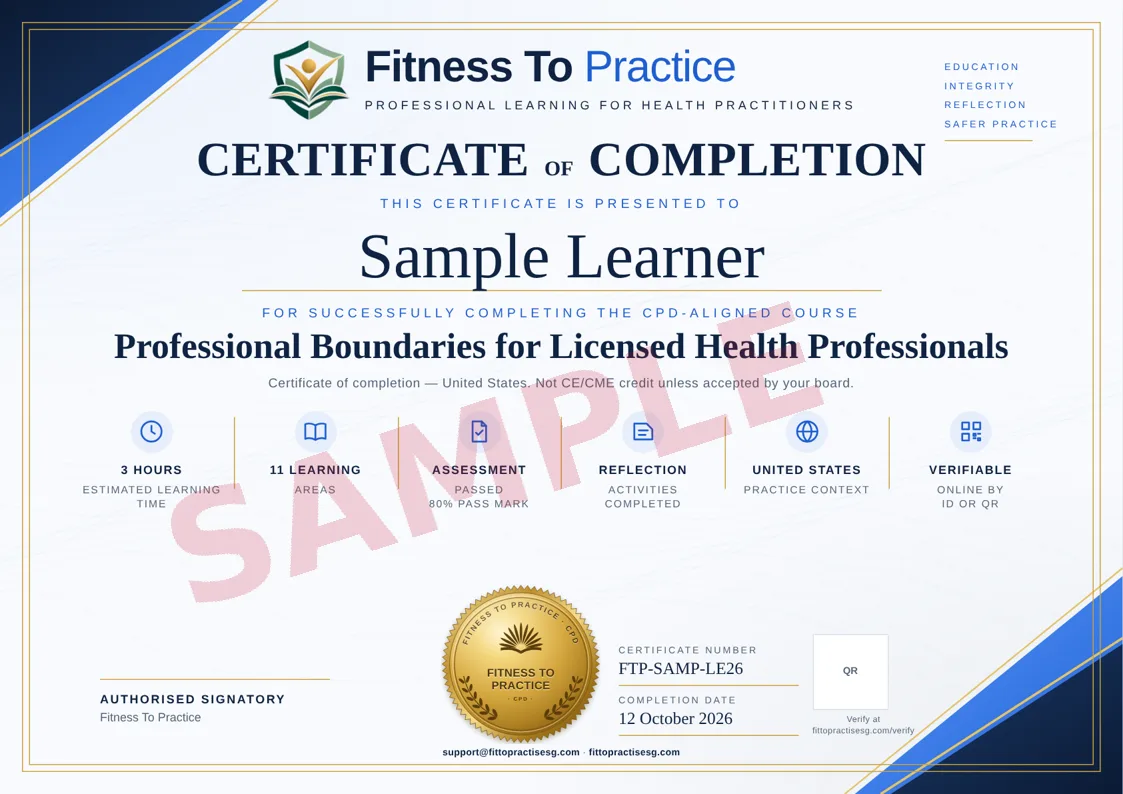
  • Your name, the course title and the hours
  • Completion date and a unique certificate ID that can be verified
  • Ready to download as a PDF as soon as you complete the course
Sample certificate of completion issued to a sample learner
Sample certificate. Yours shows your name, the course, the completion date and a certificate number anyone can verify.

Your reflective account

The course includes a structured reflective account template: guided prompts to record what you learned, how you will apply it and how the change will show in your practice. It gives you written evidence of insight after a concern, and a ready record for your learning portfolio.

Write it in your own words and leave out anything that could identify a patient, a colleague or a case. If you have an open complaint or case, talk to your adviser before reflecting on it in writing.

Questions about this course

Does this course satisfy the MATE Act 8-hour training requirement?

No. The MATE Act training must come from specified accredited organizations, and this independent 3-hour course makes no such claim. The course explains what the MATE Act requires and how the one-time attestation works at DEA registration, so you can check that you have met it through an eligible provider.

What are the rules for refilling or splitting Schedule II prescriptions?

Schedule II prescriptions cannot be refilled, but federal rules allow multiple prescriptions in some circumstances, emergency oral orders with follow-up, certain faxed prescriptions and partial fills. The course works through these rules, and the different refill and transfer rules for Schedules III to V, with examples from prescriber and pharmacy practice.

When must I report theft or loss of controlled substances?

Federal rules require written notice to the DEA field office within one business day of discovering a theft or significant loss, followed by DEA Form 106 within 45 days. The course also covers internal investigation, state board and police notification, fraudulent prescriptions and how to recognize workplace diversion early.

Does the course cover prescribing controlled substances by telemedicine?

Yes. It explains the temporary federal telemedicine flexibilities, the permanent buprenorphine pathway and the state requirements that sit on top of federal rules. Because these rules have changed several times, the course focuses on how to check current requirements and document a legitimate medical purpose for every remote prescription.

Who is the controlled substances course for, and what does it cost?

Prescribers, pharmacists and PICs, nurses who give or store controlled substances, and practice managers. The price is $89 for roughly three hours online; section checks lead to a 20-item final with an 80% bar, then the certificate and a self-review of how you handle controlled substances.

How this course was built

Official sources only

Every legal and regulatory point comes from primary sources: state practice acts and board rules, federal law and national professional codes of ethics. Anything we cannot confirm is left out.

Original, edition by edition

Lessons, scenarios and assessment questions are written by us for each edition separately, then checked for accuracy, teaching quality and fair assessment before publication.

Reviewed when rules change

When a code, standard or law changes, the affected courses are reviewed and updated. Reported errors in legal or regulatory facts are corrected first.

Page updated 5 October 2026

Related courses

All courses
Profession-specific standards3 hours

Pharmacy Ethics for Pharmacists

The APhA Code at the counter: drug review, declining to fill, corresponding responsibility, conscience, workload, billing and disclosure after error.

20-question final assessment, 80% pass

Profession-specific standards3 hours

Professional Standards for Physicians

What boards and hospitals expect of MDs and DOs: standard of care, prescribing, telemedicine, supervision, privileges, peer review and conflicts.

20-question final assessment, 80% pass

US$893 hours · 20 questions
Enrol now