Distinguish clinical supervision from legal, training, administrative, precepting, mentoring and board-ordered monitoring relationships, and identify where each one's duties come from.
Describe the administrative, educational and supportive functions of supervision and the supervisor's gatekeeping role.
Identify the U.S. sources of supervision requirements, including state licensure rules for supervised experience, ACGME standards and the NASW, ACA and APA standards for supervisors.
Draft a written supervision agreement covering goals, methods, evaluation, confidentiality limits, emergencies, documentation and ending.
Apply standards on client consent, confidentiality, documentation and boundaries in supervision.
Match supervision to the supervisee's developmental stage and grade supervision to demonstrated ability and patient risk, using ACGME levels and entrustment.
Use direct observation and give specific formative feedback, and conduct fair evaluation and remediation when a supervisee is struggling.
Use informed self-assessment and external data to identify development needs.
Write an Individual Development Plan with specific objectives, effective learning activities and evidence of changed practice.
Review and adjust a development plan, and distinguish voluntary development planning from board-ordered remediation.
Who this course is for
U.S. licensed health professionals who supervise, precept or mentor others or are supervised: counselors, social workers, MFTs and psychologists; physicians and residents; nurses and NPs; pharmacists; dentists and hygienists; PAs and allied professionals.
Structured learning and a written reflection to show insight after a complaint, an investigation or a board inquiry.
Routine learning
Focused learning on a core standard of practice, with a certificate and reflection for your portfolio.
About this course
This course teaches clinical supervision and professional development planning as they work in U.S. health care. It explains the many relationships called supervision, from supervised experience for licensure to residency supervision, precepting and peer consultation; the functions and ethics of supervision set out by NASW, ASWB, the American Counseling Association, the APA and SAMHSA's TIP 52; written supervision agreements, client consent, documentation and boundaries; developmental models, ACGME levels of supervision and entrustment; direct observation, feedback, evaluation and fair remediation; and how to build, review and evidence an Individual Development Plan.
It is written for licensees in any state who supervise, precept or mentor others, or who are supervised themselves: counselors, social workers, marriage and family therapists and psychologists earning or supervising hours; physicians and residents; nurses, nurse practitioners and nurse educators; pharmacists and pharmacy residents; dentists and dental hygienists; PAs, physical therapists, respiratory therapists and other allied professionals. Cases are set in states including California, Oregon, Ohio, Illinois, Texas, Georgia, Minnesota and Pennsylvania.
Supervision shapes the safety of care and the development of the next generation of practitioners, and supervisors' attestations are evidence that state boards rely on. Yet most licensees become supervisors without training, and most plan their learning around renewal hours rather than real needs. This course gives a practical, standards-based approach to both, and goes beyond this site's Reflective Practice for U.S. Health Professionals course and its profession-specific Professional Standards courses by focusing on how supervision is set up, conducted and turned into evidenced development.
Course details
Learning time
Approximately 3 hours (estimated learning time including knowledge checks, reflection and assessment)
Standards covered
NASW Code of Ethics Standards 3.01-3.03; NASW/ASWB Best Practice Standards in Social Work Supervision (2013); ACA Code of Ethics (2014) Section F; APA Guidelines for Clinical Supervision in Health Service Psychology; SAMHSA TIP 52 (2009); ACGME Common Program Requirements on supervision and evaluation; AAMC Core EPAs (2014); California BBS supervised experience requirements (example)
Format
Self-paced, gated lessons with knowledge checks, case studies and reflection
Assessment
20 scenario-based questions, 80% to pass (16 of 20)
Outcome
Certificate of completion and a written reflection for your learning record
Alignment
Mapped to U.S. professional supervision standards and to the continuing competence expectations of state boards, accreditors and certifying bodies; independent and not board-approved
1Supervision in U.S. health care: purposes and requirements3 lessons
One word, many meanings: supervision in U.S. health care
What good clinical supervision is for
Where U.S. law, boards and accreditors require supervision
2Setting up supervision: agreements, consent and boundaries3 lessons
The supervision agreement
Clients, consent, confidentiality and records
Power, boundaries and multiple relationships
3Models and methods: matching supervision to the supervisee3 lessons
Developmental models: matching supervision to the stage
Graded supervision and entrustment
Methods: seeing the work, not just hearing about it
4Feedback, evaluation and the struggling supervisee3 lessons
Feedback that changes practice
Difficult conversations and disagreement
When a supervisee is struggling: gatekeeping, remediation and due process
5Supervisors, supervisees and lifelong consultation3 lessons
Becoming a competent supervisor
Getting the most from supervision as a supervisee
Supervision and peer consultation across a career
6Professional development planning3 lessons
Finding your real development needs
Building an Individual Development Plan
Choosing learning activities that change practice
7Implementing, reviewing and evidencing development3 lessons
Reviewing and adjusting the plan
Evidencing development: from certificates to changed practice
Supervision and development at career transitions
8Conclusion and key points1 lesson
Conclusion and key points
9References and further reading1 lesson
References and further reading
10Your reflective account1 lesson
Your reflective account
Assessment and certificate
Final assessment
20scenario-based questions
Pass mark 80%: 16 correct out of 20
Knowledge checks in each section as you go
Tests whether you can apply the standards, not recall a page
Not passed yet? Review the sections and retake it
Certificate of completion
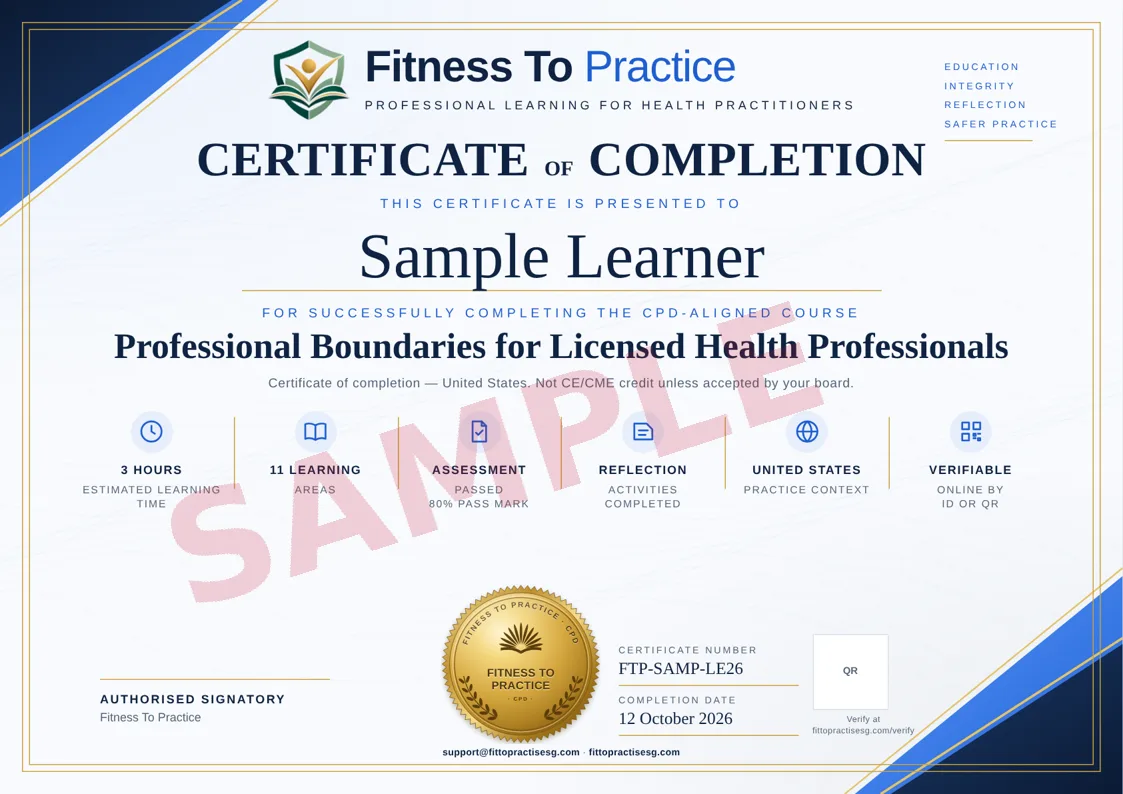
Certificate of completion. Not CE or CME credit unless accepted by your board.
Your name, the course title and the hours
Completion date and a unique certificate ID that can be verified
Ready to download as a PDF as soon as you complete the course
Sample certificate. Yours shows your name, the course, the completion date and a certificate number anyone can verify.
Your reflective account
The course includes a structured reflective account template: guided prompts to record what you learned, how you will apply it and how the change will show in your practice. It gives you written evidence of insight after a concern, and a ready record for your learning portfolio.
Write it in your own words and leave out anything that could identify a patient, a colleague or a case. If you have an open complaint or case, talk to your adviser before reflecting on it in writing.
Questions about this course
What should a written supervision agreement cover?
Goals, methods, frequency, evaluation criteria, limits of confidentiality, emergency procedures, documentation and how the arrangement ends. The course provides a structure based on NASW, ASWB, ACA and APA standards and explains client consent and boundary issues specific to supervision. A sample outline is included that you can adapt.
How do I supervise someone who is struggling?
Start with direct observation and specific, formative feedback, then agree a focused remediation plan with clear criteria and timelines, and document it fairly. The course covers developmental supervision models, the ACGME supervision levels, entrustment, and how supervisors balance support with their gatekeeping role.
What is an Individual Development Plan?
An IDP is a written plan that sets out specific learning objectives, effective activities to meet them and the evidence that shows practice has changed. The course explains how to build one from self-assessment and external data, review it, and tell voluntary development planning apart from remediation a board has ordered.
What does the supervision and development course include?
Three online hours for $89, with cases across many states and professions. Checks throughout, then a final 20 questions with 16 needed, a certificate and a reflection on how you supervise. The course also includes templates for feedback notes and an individual development plan, and it does not carry approved-supervisor credit.
How this course was built
Official sources only
Every legal and regulatory point comes from primary sources: state practice acts and board rules, federal law and national professional codes of ethics. Anything we cannot confirm is left out.
Original, edition by edition
Lessons, scenarios and assessment questions are written by us for each edition separately, then checked for accuracy, teaching quality and fair assessment before publication.
Reviewed when rules change
When a code, standard or law changes, the affected courses are reviewed and updated. Reported errors in legal or regulatory facts are corrected first.