Distinguish reentry, reactivation, renewal of a lapsed license, reinstatement and retraining, using the FSMB 2025 definitions.
Explain why time away affects knowledge, skills, systems and regulatory awareness, and why an active license does not prove current competence.
Describe common license status categories and the rule that only an active license, or a current New York registration, permits practice.
Apply state examples of reactivation requirements, including California BRN, Texas BON, Florida §456.036 and the California Board of Pharmacy.
Summarize the FSMB's ten reentry recommendations and the profession-specific routes, including SPEX, reentry programs, NCCPA's PANRE route and nurse refresher courses.
Answer reactivation, credentialing and employment questions honestly, and identify which status changes are reportable to the NPDB.
Sequence DEA registration (including the MATE Act attestation), malpractice coverage and privileges for a return.
Carry out a gap analysis and write a reentry plan with specific objectives, supervision and mentoring.
Plan a graduated, supervised return with safeguards for high-risk areas, and respond appropriately when progress is slow.
Recognize special situations, including illness, alternative-to-discipline programs, reinstatement, military service, retirement and emergencies.
Who this course is for
U.S. licensed health professionals returning to practice after a break: physicians, PAs, RNs, LPN/LVNs and APRNs, pharmacists, dentists and dental hygienists, and allied health professionals.
Structured learning and a written reflection to show insight after a complaint, an investigation or a board inquiry.
Routine learning
Focused learning on a core standard of practice, with a certificate and reflection for your portfolio.
About this course
This course guides licensed health professionals through returning to clinical practice after a break, whether for caregiving, illness, military service, research, administration, work abroad or retirement. It explains the difference between reentry, reactivation, renewal of a lapsed license, reinstatement and retraining, and walks through what state boards actually require, using examples from California, Texas, Florida and New York and the FSMB's 2025 Reentry to Practice report.
It is written for physicians, PAs, nurses and APRNs, pharmacists, dentists, dental hygienists and allied professionals. You will learn how to answer reactivation and credentialing questions honestly, what is and is not reported to the National Practitioner Data Bank, how to sequence DEA registration, malpractice coverage and privileges, and how to build a reentry plan with objective assessment, supervision and mentoring.
Because licensing in the United States is state-based, requirements vary widely, and a mistake can mean practicing without an active license or a declaration that becomes a disciplinary issue. This course helps you plan a return that satisfies your board, protects your patients and rebuilds your confidence.
Course details
Learning time
Approximately 3 hours (estimated learning time including knowledge checks, reflection and assessment)
Standards covered
FSMB Reentry to Practice report (2025); FSMB Directory of Physician Assessment and Remedial Education Programs (SPEX); NCCPA certification maintenance; California BRN and Board of Pharmacy reactivation rules; Texas BON rules 22 Tex. Admin. Code §§217.6 and 217.9; Fla. Stat. §456.036; NYSED license and registration; NPDB (45 CFR Part 60); DEA MATE Act; AMA, ANA, APhA, ADA and AAPA codes
Format
Self-paced, gated lessons with knowledge checks, case studies and reflection
Assessment
20 scenario-based questions, 80% to pass (16 of 20)
Outcome
Certificate of completion and a written reflection for your learning record
Alignment
Mapped to FSMB reentry policy, the requirements of example state boards and national certifying bodies, and professional codes; education, not board-approved
1Returning to practice in the U.S.: concepts and responsibilities3 lessons
Reentry, reactivation, reinstatement and retraining: getting the terms right
Why time away matters: skills, systems and safety
Your professional duties before, during and after a break
2License status and state requirements3 lessons
License status: active, inactive, retired, delinquent and null
State examples: what boards actually require
Physicians and the FSMB 2025 reentry framework
3Pathways by profession3 lessons
Physicians and PAs: assessment, reentry programs and certification
Nurses and APRNs: refresher courses, orientation and multistate practice
Pharmacists, dentists and other licensed professionals
4Honest declarations, records and practical prerequisites3 lessons
Honest answers on reactivation, credentialing and employment forms
The National Practitioner Data Bank and your license history
Practical prerequisites: DEA registration, insurance and privileges
5Self-assessment and the reentry plan3 lessons
Honest self-assessment and gap analysis
Writing a reentry plan
Choosing programs, supervisors and mentors
6Supervised return and safe practice3 lessons
A graduated return: from observation to independent practice
Safety-critical areas in the first months back
When the return is not going smoothly
7Special situations and sustaining your return3 lessons
Returning after illness, impairment or a board action
Caregiving, military service, retirement and emergencies
Confidence, well-being and staying current for the long term
8Conclusion and key points1 lesson
Conclusion and key points
9References and further reading1 lesson
References and further reading
10Your reflective account1 lesson
Your reflective account
Assessment and certificate
Final assessment
20scenario-based questions
Pass mark 80%: 16 correct out of 20
Knowledge checks in each section as you go
Tests whether you can apply the standards, not recall a page
Not passed yet? Review the sections and retake it
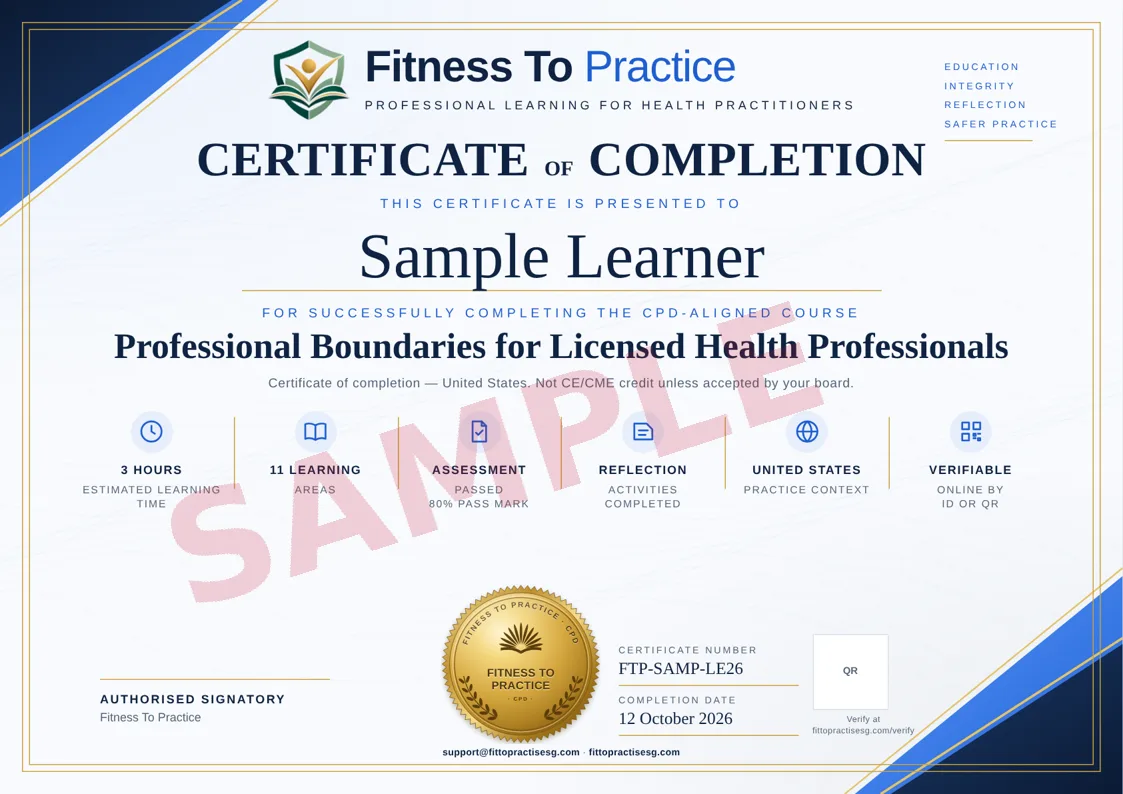
Certificate of completion
Certificate of completion. Not CE or CME credit unless accepted by your board.
Your name, the course title and the hours
Completion date and a unique certificate ID that can be verified
Ready to download as a PDF as soon as you complete the course
Sample certificate. Yours shows your name, the course, the completion date and a certificate number anyone can verify.
Your reflective account
The course includes a structured reflective account template: guided prompts to record what you learned, how you will apply it and how the change will show in your practice. It gives you written evidence of insight after a concern, and a ready record for your learning portfolio.
Write it in your own words and leave out anything that could identify a patient, a colleague or a case. If you have an open complaint or case, talk to your adviser before reflecting on it in writing.
Questions about this course
What is the difference between reentry, reactivation and reinstatement?
Reentry means returning to clinical activity after an extended absence; reactivation restores an inactive or lapsed license; reinstatement usually follows a license that was revoked or surrendered, often after discipline. The course uses the FSMB's 2025 definitions and explains why the distinction changes what a board will ask of you.
Does an active license mean I am ready to return?
Not necessarily. Time away affects knowledge, skills, familiarity with systems and awareness of regulatory changes, and an active license does not prove current competence. The course helps you run a gap analysis and write a reentry plan with specific objectives, objective assessment, supervision and mentoring.
Is this a formal physician reentry program or nurse refresher course?
No. Formal reentry programs and nurse refresher courses include supervised clinical components and may be required by your board. This course explains those routes, including SPEX, reentry programs, NCCPA's PANRE pathway and refresher courses, and helps you plan, but it does not replace them.
In what order should I sort out DEA registration, malpractice cover and privileges?
Usually the license comes first, then DEA registration with the MATE Act attestation where it applies, then malpractice coverage and hospital privileges or credentialing. The course explains the sequence, common delays and how to answer reactivation and credentialing questions truthfully, including what is reportable to the NPDB.
What is in the return-to-practice course package?
Three online hours for $89, with examples set in California, Texas, Florida and New York. Checks per module, a 20-question final at 80%, and a certificate together with a return plan written as a reflection. Access is immediate, and you can study around job applications or a refresher program.
How this course was built
Official sources only
Every legal and regulatory point comes from primary sources: state practice acts and board rules, federal law and national professional codes of ethics. Anything we cannot confirm is left out.
Original, edition by edition
Lessons, scenarios and assessment questions are written by us for each edition separately, then checked for accuracy, teaching quality and fair assessment before publication.
Reviewed when rules change
When a code, standard or law changes, the affected courses are reviewed and updated. Reported errors in legal or regulatory facts are corrected first.