Define health care quality using the six aims and Donabedian's structure, process and outcome model, and distinguish QI from quality assurance, audit, root cause analysis and research.
Describe the US bodies that drive quality improvement, including CMS, AHRQ, accreditors, measure developers and IHI.
Apply the three questions of the Model for Improvement to write a specific, measurable aim and form an effective team.
Use process maps, driver diagrams, Pareto charts and change concepts to select changes, and plan PDSA cycles with predictions and ramps.
Build a family of outcome, process and balancing measures with operational definitions, and choose practical sampling methods.
Interpret run charts using the four run chart rules and distinguish common cause from special cause variation.
Design and complete a clinical audit cycle with specific criteria, standards, reliable data collection and re-audit.
Explain the QAPI requirements of 42 CFR 482.21 and 483.75, MIPS improvement activity rules and profession-specific improvement expectations.
Apply OHRP guidance on QI and research, HIPAA rules on health care operations and the limits of peer review and patient safety protections.
Sustain and spread improvements, and present personal QI work credibly as evidence of insight and remediation.
Who this course is for
U.S. licensed health professionals: physicians, PAs, nurses and APRNs, pharmacists, dentists and dental hygienists and other licensees who lead, join or are measured by improvement and audit work.
Structured learning and a written reflection to show insight after a complaint, an investigation or a board inquiry.
Routine learning
Focused learning on a core standard of practice, with a certificate and reflection for your portfolio.
About this course
This course teaches the practical methods of quality improvement (QI) and clinical audit used in US health care. It covers the definition of quality and the six aims, Donabedian's model, and how QI differs from quality assurance, audit, root cause analysis and research; the Model for Improvement, aim statements, process maps, driver diagrams and PDSA cycles; outcome, process and balancing measures, operational definitions, sampling, run charts and control charts; the clinical audit cycle, criteria, standards, re-audit, OPPE and FPPE; and the federal and professional programs that require or reward improvement, including CMS QAPI rules for hospitals and nursing homes, MIPS improvement activities, ABMS continuing certification, QSEN, PQA and Dental Quality Alliance measures.
It is written for physicians, PAs, nurses and APRNs, pharmacists, dentists and dental hygienists and allied licensees in any state and any setting, from large hospitals to small practices, community pharmacies and dental offices. Cases are set across states including Wisconsin, Kansas, Arizona, Georgia, Florida, Michigan, Pennsylvania, Montana, Indiana, Iowa, Ohio, Texas, California, Maryland, Washington and New Mexico, and the final lesson follows a complete personal practice improvement project from aim to re-audit.
QI is now part of what US health care expects of every licensee, through Medicare Conditions of Participation, payment programs, board certification and professional codes. When a concern is raised about practice, measurable improvement is also among the most convincing evidence of insight and remediation. This course goes beyond this site's courses on root cause analysis and risk management by focusing on improvement science, measurement and audit, and on the ethical and legal handling of QI work, including the line between QI and research.
Course details
Learning time
Approximately 3 hours (estimated learning time including knowledge checks, reflection and assessment)
Standards covered
CMS QAPI Conditions of Participation, 42 CFR 482.21 (hospitals) and 42 CFR 483.75 (long-term care) and the QAPI Five Elements; MIPS improvement activities, 42 CFR 414.1355-414.1380; IHI Model for Improvement; AHRQ Quality Indicators and National Healthcare Quality and Disparities Report; ABMS Standards for Continuing Certification (2021, effective 2024); QSEN competencies; OHRP Quality Improvement Activities FAQs and 45 CFR Part 46; HIPAA health care operations, 45 CFR 164.501; Patient Safety and Quality Improvement Act of 2005; Health Care Quality Improvement Act of 1986
Format
Self-paced, gated lessons with knowledge checks, case studies and reflection
Assessment
20 scenario-based questions, 80% to pass (16 of 20)
Outcome
Certificate of completion and a written reflection for your learning record
Why quality improvement is part of your professional role
2The Model for Improvement and PDSA3 lessons
The Model for Improvement: three questions and a good aim
Understanding the process and choosing changes
Testing changes with PDSA cycles
3Measurement for improvement3 lessons
Measurement for improvement
Collecting data without drowning in it
Run charts and statistical process control
4Clinical audit and practice review3 lessons
The clinical audit cycle
Designing an audit that produces trustworthy results
From results to change: interpretation, peer review and re-audit
5US programs that require or reward improvement3 lessons
QAPI in hospitals and nursing homes: where your project fits
MIPS improvement activities and other value programs
Improvement expectations by profession
6Ethics, law and equity in quality improvement3 lessons
Quality improvement or research? Ethics and oversight
Privacy, confidentiality and legal protection of QI work
Equity, unintended consequences and patient partnership
7Leading, sustaining and using improvement in your career3 lessons
Leading improvement: people, culture and other methods
Sustaining and spreading improvement
Quality improvement, your practice and your license
8Conclusion and key points1 lesson
Conclusion and key points
9References and further reading1 lesson
References and further reading
10Your reflective account1 lesson
Your reflective account
Assessment and certificate
Final assessment
20scenario-based questions
Pass mark 80%: 16 correct out of 20
Knowledge checks in each section as you go
Tests whether you can apply the standards, not recall a page
Not passed yet? Review the sections and retake it
Certificate of completion
Certificate of completion. Not CE or CME credit unless accepted by your board.
Your name, the course title and the hours
Completion date and a unique certificate ID that can be verified
Ready to download as a PDF as soon as you complete the course
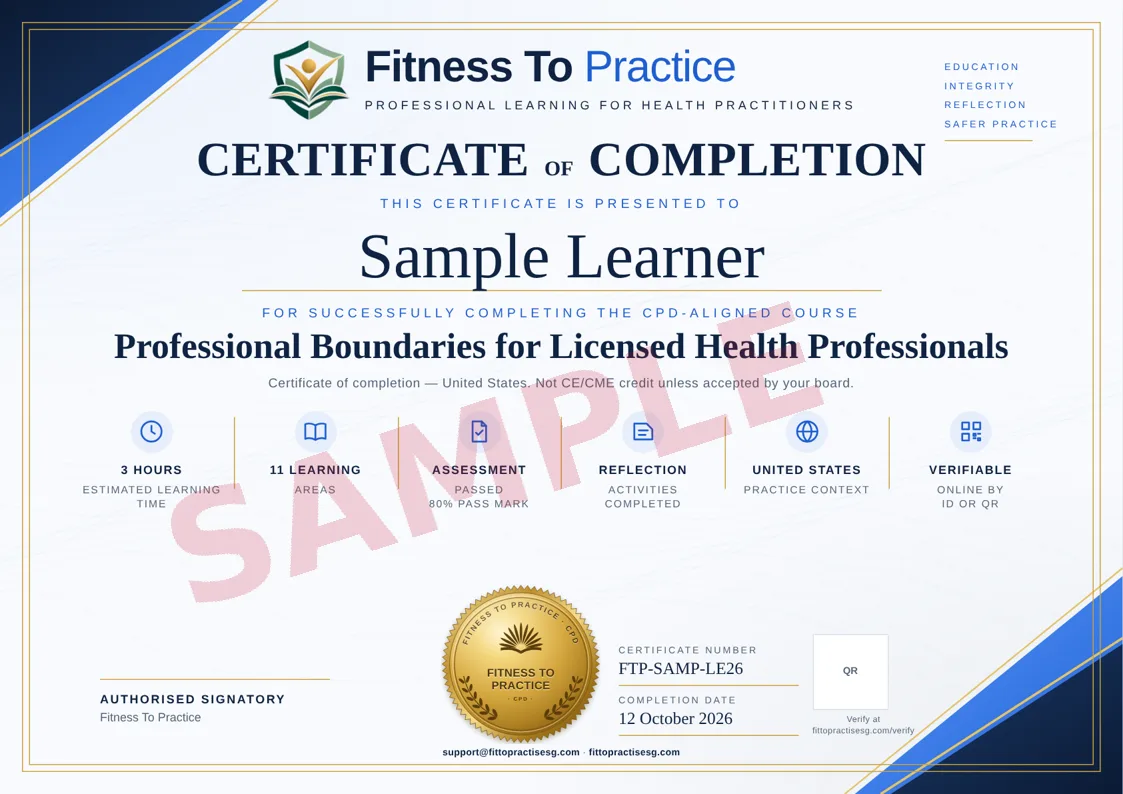
Sample certificate. Yours shows your name, the course, the completion date and a certificate number anyone can verify.
Your reflective account
The course includes a structured reflective account template: guided prompts to record what you learned, how you will apply it and how the change will show in your practice. It gives you written evidence of insight after a concern, and a ready record for your learning portfolio.
Write it in your own words and leave out anything that could identify a patient, a colleague or a case. If you have an open complaint or case, talk to your adviser before reflecting on it in writing.
Questions about this course
How does QI differ from a clinical audit?
Clinical audit measures practice against explicit criteria and standards, then re-audits after change. Quality improvement uses methods such as the Model for Improvement and PDSA cycles to test changes and learn quickly. The course explains how they fit together and how both differ from quality assurance, root cause analysis and research.
What are the four run chart rules?
The rules help you spot non-random signals: a shift (six or more consecutive points above or below the median), a trend (five or more points all going up or down), too many or too few runs, and an astronomical data point. The course shows how to apply them and when a control chart is more appropriate.
When does a QI project need IRB review?
When it becomes research, meaning a systematic investigation designed to produce generalizable knowledge. The course applies OHRP guidance on the boundary between QI and research, HIPAA rules on health care operations and the limits of peer review and patient safety protections for QI data.
Can QI work help show insight after a board concern?
It can. Measurable improvement in your own practice is some of the strongest proof of insight and remediation you can offer, provided it is genuine and well documented. The last lesson walks one personal improvement project all the way from its aim to the re-audit, ready for you to adapt.
What is included in the quality improvement course?
About three online hours for $89, with cases from many settings. Checks per section, a final of 20 questions (16 to pass), then a certificate and a reflection built around your own improvement project. MOC, MIPS or CE credit is not claimed.
How this course was built
Official sources only
Every legal and regulatory point comes from primary sources: state practice acts and board rules, federal law and national professional codes of ethics. Anything we cannot confirm is left out.
Original, edition by edition
Lessons, scenarios and assessment questions are written by us for each edition separately, then checked for accuracy, teaching quality and fair assessment before publication.
Reviewed when rules change
When a code, standard or law changes, the affected courses are reviewed and updated. Reported errors in legal or regulatory facts are corrected first.