
Profession-specific standards3 hours
Ethics for Nurses
The 2025 ANA Code provision by provision: moral agency, unsafe orders, errors, diversion, refusals, end-of-life care, abandonment and documentation.
US$89DetailsAdd to cart
Profession-specific standards
Nurse Practice Acts, scope, delegation, assignments and accountability for RNs, LPN/VNs and APRNs
U.S. nurses: registered nurses (RN), licensed practical and vocational nurses (LPN/LVN) and advanced practice registered nurses (NP, CNM, CNS, CRNA), and nurse leaders who supervise them.
Structured learning and a written reflection to show insight after a complaint, an investigation or a board inquiry.
Focused learning on a core standard of practice, with a certificate and reflection for your portfolio.
This course explains the professional standards that govern nursing practice in the United States and how boards of nursing apply them. It covers the Nurse Practice Act and board rules, the relationship between law, ANA's Nursing: Scope and Standards of Practice and employer policy, the scope of LPN/VNs, RNs and APRNs, minimum standards of practice using Texas rule 22 TAC §217.11 as a worked model, assessment and escalation, medication administration and the duty to clarify orders, scope-of-practice decisions, delegation and assignment under the National Guidelines for Nursing Delegation, accepting and refusing assignments, Texas Safe Harbor peer review, mandatory reporting, multistate practice under the Nurse Licensure Compact, license integrity and continuing competence.
It is written for registered nurses, licensed practical and vocational nurses and advanced practice registered nurses in any U.S. state, whether you are new to practice, moving states or roles, supervising others, or responding to a concern about your practice. Cases are set in hospitals, long-term care, home and outpatient care, telehealth and non-traditional settings in states including Texas, California, Florida and New York.
Nursing is licensed and disciplined state by state, and the standards that apply to you change when you cross a state line, move to a new license level or take on a new role. Many board cases begin with practice decisions made under pressure: an unclear task, an unsafe assignment, a delegation without follow-up or a late chart entry. This course gives you the frameworks to make those decisions safely and defensibly, and shows you where to check your own board's requirements.
10 sections · 24 lessons · 3 hours · 20-question final assessment
Final assessment
20scenario-based questions
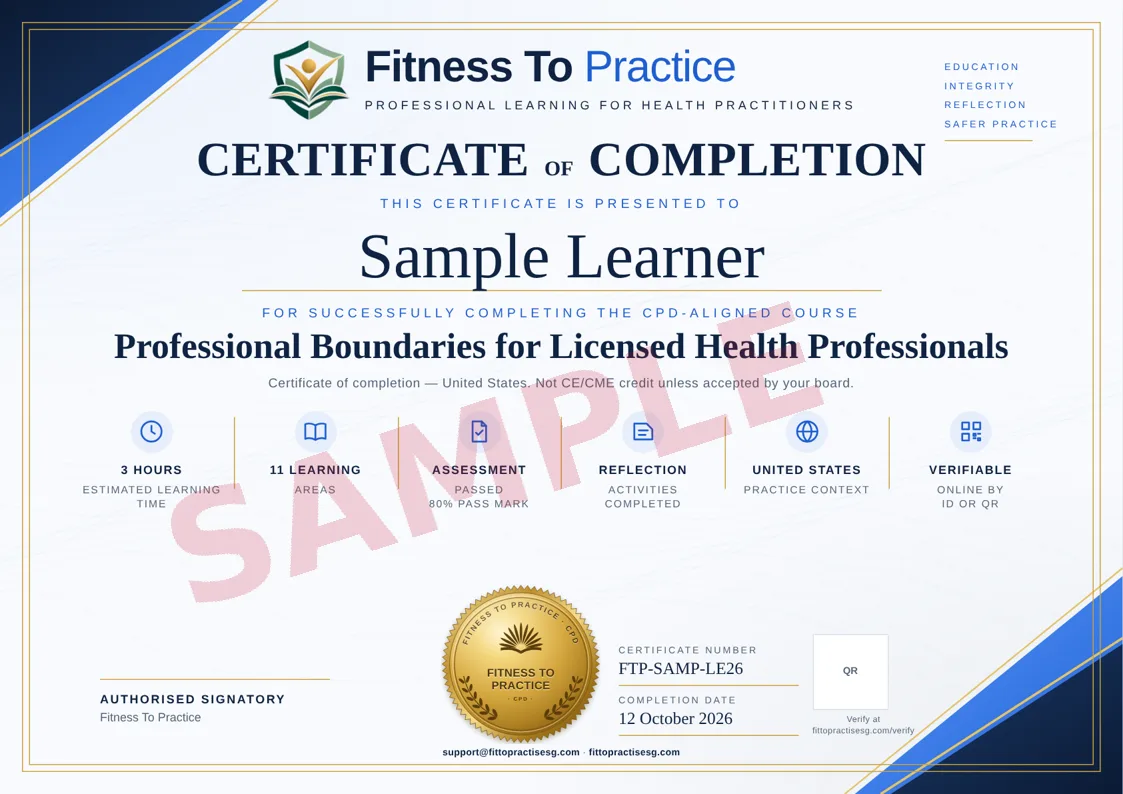
Certificate of completion
Certificate of completion. Not CE or CME credit unless accepted by your board.
The course includes a structured reflective account template: guided prompts to record what you learned, how you will apply it and how the change will show in your practice. It gives you written evidence of insight after a concern, and a ready record for your learning portfolio.
Write it in your own words and leave out anything that could identify a patient, a colleague or a case. If you have an open complaint or case, talk to your adviser before reflecting on it in writing.
Assignment is giving a task to someone whose license or role already includes it, while delegation is allowing a less-qualified person to perform a specific nursing task they would not otherwise do. The course applies the five rights of delegation and the National Guidelines for Nursing Delegation, including what can never be delegated.
The course uses the national Scope of Nursing Practice Decision-Making Framework, which asks whether the task is permitted by your Nurse Practice Act, consistent with standards and evidence, within your education and competence, and supported by your employer. If any answer is no, you should not perform the task.
It is a Texas process that lets a nurse invoke protection when asked to do an assignment the nurse believes could cause harm or violate their duty, so the request can be reviewed. The course explains how it works, equivalent processes in other states and the difference between refusing an assignment and abandoning patients.
Yes. It covers multistate practice under the NLC, including the rule that nursing law follows the patient's location, how travel and telehealth nurses should check that law, and why honest license records matter. It also covers continuing competence for renewal.
$89 and three self-paced hours for RNs, LPN/LVNs and APRNs. Checks run through each module and the final 20 questions require 16 correct; you then receive a certificate and a self-assessment against nursing standards. No contact hours or board approval are claimed.
Every legal and regulatory point comes from primary sources: state practice acts and board rules, federal law and national professional codes of ethics. Anything we cannot confirm is left out.
Lessons, scenarios and assessment questions are written by us for each edition separately, then checked for accuracy, teaching quality and fair assessment before publication.
When a code, standard or law changes, the affected courses are reviewed and updated. Reported errors in legal or regulatory facts are corrected first.
The 2025 ANA Code provision by provision: moral agency, unsafe orders, errors, diversion, refusals, end-of-life care, abandonment and documentation.
Staying inside your license: practice acts, title protection, aiding unlicensed practice, delegation, standing orders, med spas and IV therapy risks.
How boards judge professionalism: unprofessional conduct, disruptive behavior, impairment, reporting duties, online statements and honest license renewals.