Distinguish the binding obligations of a state Nurse Practice Act and board of nursing rules from the ANA Code of Ethics for Nurses, board position statements and employer policy.
Identify the substance of all 10 provisions of the ANA Code of Ethics for Nurses (2025) and select the sub-provision that applies to a given practice situation.
Explain why a nurse remains a moral agent, accountable for acts carried out on instruction and for delegation decisions, and identify the pressures that undermine ethical judgment.
Question an unsafe order or assignment with moral courage, and apply ANA's distinction between moral obligations and moral options in situations of personal risk.
Respond to a medication or care error, suspected drug diversion and colleague impairment in line with the Code and board rules.
Apply ANA positions on self-determination, end-of-life care, medical aid in dying and conscience-based refusal to nursing scenarios.
Distinguish patient abandonment from employment disputes and describe how to leave an assignment safely.
Recognize boundary red flags, privacy and social media risks, AI-related accountability and documentation practices that undermine record integrity.
Describe how boards of nursing handle ethics-related complaints and build an evidenced, targeted remediation plan.
Who this course is for
U.S. nurses: registered nurses (RN), licensed practical and vocational nurses (LPN/LVN) and advanced practice registered nurses (NP, CNM, CRNA, CNS), plus nurse leaders, educators and students preparing for practice.
Structured learning and a written reflection to show insight after a complaint, an investigation or a board inquiry.
Routine learning
Focused learning on a core standard of practice, with a certificate and reflection for your portfolio.
About this course
This course is a nursing-specific ethics program for RNs, LPN/LVNs and APRNs in the United States. It works through the ANA Code of Ethics for Nurses (2025) provision by provision and applies it to the decisions nurses actually make: moral agency and accountability for orders and delegation, moral courage in questioning unsafe instructions, advocating for patients, responding honestly to errors, acting on impaired practice and drug diversion, respecting refusals, end-of-life care and conscientious objection, patient abandonment, staffing, moral distress, boundaries, social media, AI and documentation integrity.
It is written for nurses in every setting: hospital, long-term care, home health, hospice, ambulatory care, schools and advanced practice. It suits nurses who want to strengthen their ethical reasoning, prepare for a state ethics or jurisprudence requirement, support colleagues as charge nurses, preceptors or leaders, or reflect constructively after a concern has been raised about their practice.
In the United States, ethical failures in nursing reach boards of nursing as unprofessional conduct under each state's Nurse Practice Act and rules: falsified records, diversion, boundary violations, abandonment and practice beyond scope. Board actions can be public, are reportable to the National Practitioner Data Bank and can affect multistate practice. Sound ethical judgment, honest documentation and the confidence to speak up protect both patients and your license.
Course details
Learning time
Approximately 3 hours (estimated learning time including knowledge checks, reflection and assessment)
Standards covered
ANA Code of Ethics for Nurses (2025), Provisions 1 to 10; NCSBN/ANA National Guidelines for Nursing Delegation (2019); NCSBN A Nurse's Guide to Professional Boundaries (2024) and A Nurse's Guide to the Use of Social Media; ANA position statements on ethical practice environments (2021), risk and responsibility (2022), end of life (2024), medical aid in dying (2019) and AI (2022); state Nurse Practice Acts and BON rules, with examples including 22 Texas Administrative Code §217.12, Texas BON Rule 217.20 and Occupations Code Chapter 303 (Safe Harbor) and Texas BON position statements; HIPAA Privacy Rule; 42 CFR 482.13 and 482.24; NPDB reporting rules
Format
Self-paced, gated lessons with knowledge checks, case studies and reflection
Assessment
20 scenario-based questions, 80% to pass (16 of 20)
Outcome
Certificate of completion and a written reflection for your learning record
Alignment
Mapped to the ANA Code of Ethics for Nurses (2025) and to the unprofessional conduct and practice standards of state boards of nursing; not board-approved and not accredited for CE contact hours
1The ethical foundations of U.S. nursing practice3 lessons
Why nursing ethics is a discipline of its own
Where a nurse's ethical obligations come from
How ethical failures become board of nursing matters
2The ANA Code of Ethics for Nurses (2025), provision by provision3 lessons
Provisions 1 to 3: dignity, commitment and advocacy
Provisions 4 to 6: accountability, duties to self and the work environment
Provisions 7 to 10 and using the Code in a real dilemma
3Moral agency, delegation and moral courage2 lessons
Moral agency: why 'I was told to' is not an ethical answer
Moral courage: questioning, refusing and the limits of duty
4Advocacy, patient safety and acting on concerns3 lessons
The nurse as advocate: speaking up effectively
Errors, honesty and the culture of safety
Impaired practice and drug diversion
5Autonomy, end-of-life care and conscience3 lessons
Self-determination at the bedside
End-of-life care: nurses' roles and limits
Conscientious objection in nursing
6Abandonment, staffing and the ethical work environment3 lessons
Patient abandonment versus employment disputes
Staffing, workload and the ethical environment
Moral distress, moral resilience and duties to self
7Boundaries, privacy, technology and documentation integrity3 lessons
Boundaries and conflicts of interest through a nursing lens
Privacy, confidentiality and social media for nurses
Technology, artificial intelligence and documentation integrity
8When a nursing ethics concern reaches the board2 lessons
Ethics complaints before a board of nursing: integrity during the process
Showing accountability and rebuilding ethical practice
9Conclusion and key points1 lesson
Conclusion and key points
10References and further reading1 lesson
References and further reading
11Reflection1 lesson
Your reflective account
Assessment and certificate
Final assessment
20scenario-based questions
Pass mark 80%: 16 correct out of 20
Knowledge checks in each section as you go
Tests whether you can apply the standards, not recall a page
Not passed yet? Review the sections and retake it
Certificate of completion
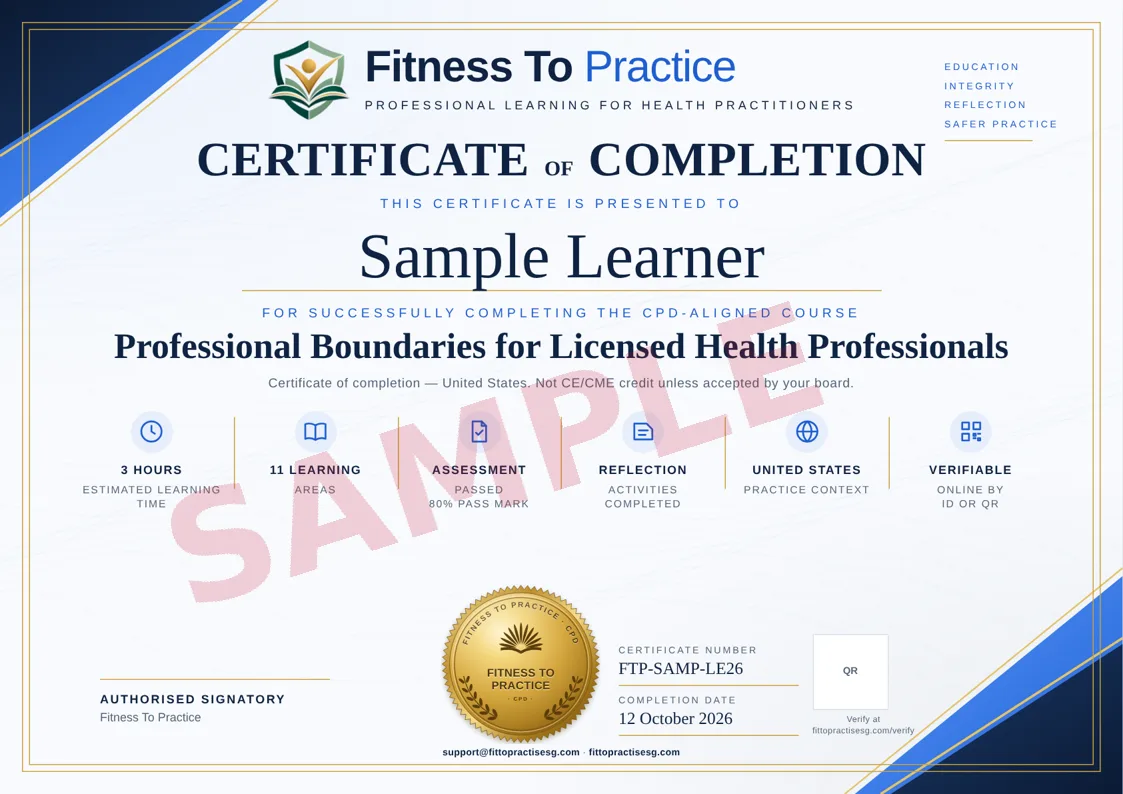
Certificate of completion. Not CE or CME credit unless accepted by your board.
Your name, the course title and the hours
Completion date and a unique certificate ID that can be verified
Ready to download as a PDF as soon as you complete the course
Sample certificate. Yours shows your name, the course, the completion date and a certificate number anyone can verify.
Your reflective account
The course includes a structured reflective account template: guided prompts to record what you learned, how you will apply it and how the change will show in your practice. It gives you written evidence of insight after a concern, and a ready record for your learning portfolio.
Write it in your own words and leave out anything that could identify a patient, a colleague or a case. If you have an open complaint or case, talk to your adviser before reflecting on it in writing.
Questions about this course
Does the nursing ethics course use the 2025 edition of the ANA Code?
Yes. It works through all 10 provisions of the 2025 ANA Code and shows how to pick the sub-provision that fits a real situation. It also explains how the Code differs from the binding duties in your state Nurse Practice Act, board rules, board position statements and employer policy.
Is refusing an assignment the same as patient abandonment?
Not necessarily. Boards of nursing usually treat abandonment as leaving patients after accepting an assignment without a safe handoff, while declining an assignment before accepting it is often an employment matter. The course explains the distinction, how to raise staffing concerns and how to leave an assignment safely if you must.
What should a nurse do about a colleague suspected of drug diversion?
Act on it through the proper channels rather than ignoring it or confronting the colleague alone. The course explains the Code's expectations, typical employer and board reporting duties, alternative-to-discipline programs and how to document what you observed factually. It also covers responding honestly to your own medication or care errors.
Will this course meet a state nursing jurisprudence and ethics requirement?
It is not designed to, and makes no claim of board approval or contact hours. States such as Texas set specific jurisprudence and ethics requirements and accept particular providers. The course is useful for strengthening ethical reasoning, supporting colleagues as a charge nurse or preceptor, or reflecting after a concern.
What does the ANA Code of Ethics course include?
$89 for three self-paced hours written for RNs, LPN/LVNs and APRNs. Nursing scenarios are checked along the way and the 20-question final requires 80%; once through, you get a certificate and a nursing ethics reflection. Cases cover staffing pressure, delegation, end-of-life care and speaking up for patients.
How this course was built
Official sources only
Every legal and regulatory point comes from primary sources: state practice acts and board rules, federal law and national professional codes of ethics. Anything we cannot confirm is left out.
Original, edition by edition
Lessons, scenarios and assessment questions are written by us for each edition separately, then checked for accuracy, teaching quality and fair assessment before publication.
Reviewed when rules change
When a code, standard or law changes, the affected courses are reviewed and updated. Reported errors in legal or regulatory facts are corrected first.
How boards of nursing apply practice standards: scope decisions, delegation and assignment, unsafe assignments, Safe Harbor, NLC practice and license integrity.
What happens after a state board letter arrives: investigation, your written response, settlement conferences, consent orders, hearings and NPDB reporting.