
Profession-specific standards3 hours
Pharmacy Ethics for Pharmacists
The APhA Code at the counter: drug review, declining to fill, corresponding responsibility, conscience, workload, billing and disclosure after error.
US$89DetailsAdd to cart
Patient safety and medicines
DEA registration, valid prescriptions, telemedicine, PDMPs, opioid and benzodiazepine safety, records, disposal and diversion under federal and state law
U.S. licensed health professionals who prescribe, dispense, administer or store controlled substances: physicians, PAs, NPs and other APRNs, dentists, pharmacists and pharmacists-in-charge, RNs and anesthesia providers, and controlled substance leads in clinics, surgical centers and dental offices.
Structured learning and a written reflection to show insight after a complaint, an investigation or a board inquiry.
Focused learning on a core standard of practice, with a certificate and reflection for your portfolio.
This course gives U.S. licensees a complete, practical working knowledge of controlled substances: how the Controlled Substances Act and DEA regulations at 21 CFR Parts 1300 to 1321 fit together with state law and board rules; how to obtain and keep a DEA registration and meet MATE Act and state education requirements; how to write prescriptions that are both legally complete and clinically legitimate, including electronic prescribing, Schedule II rules, partial fills and telemedicine; and how to apply the 2022 CDC Clinical Practice Guideline for Prescribing Opioids for Pain, PDMP checks, naloxone and treatment for opioid use disorder in everyday decisions. It then covers ordering, storage, inventories, records, waste and disposal, theft and loss reporting, and workplace diversion.
It is written for everyone who prescribes, dispenses, administers or stores controlled substances: physicians, PAs, nurse practitioners and other APRNs, dentists, pharmacists and pharmacists-in-charge, registered nurses and anesthesia providers, and practice managers of clinics, surgical centers and dental offices. It suits licensees preparing for a DEA renewal or inspection, starting telehealth or in-office dispensing, taking on a pharmacist-in-charge or controlled substance lead role, or responding to a board, DEA or employer concern about controlled substances.
In the United States, controlled substance practice is regulated on several levels at once. DEA can suspend or revoke a registration independently of the state license, state boards discipline licensees for improper prescribing, dispensing and diversion, CMS requires electronic prescribing for Medicare Part D controlled substances, and formal board actions are reported to the National Practitioner Data Bank. Rules have changed rapidly, from the end of the buprenorphine waiver and the MATE Act training requirement to new pharmacy transfer rules and the extended telemedicine flexibilities. This course brings those changes together in one place, with cases from many states and professions.
11 sections · 27 lessons · 3 hours · 20-question final assessment
Final assessment
20scenario-based questions
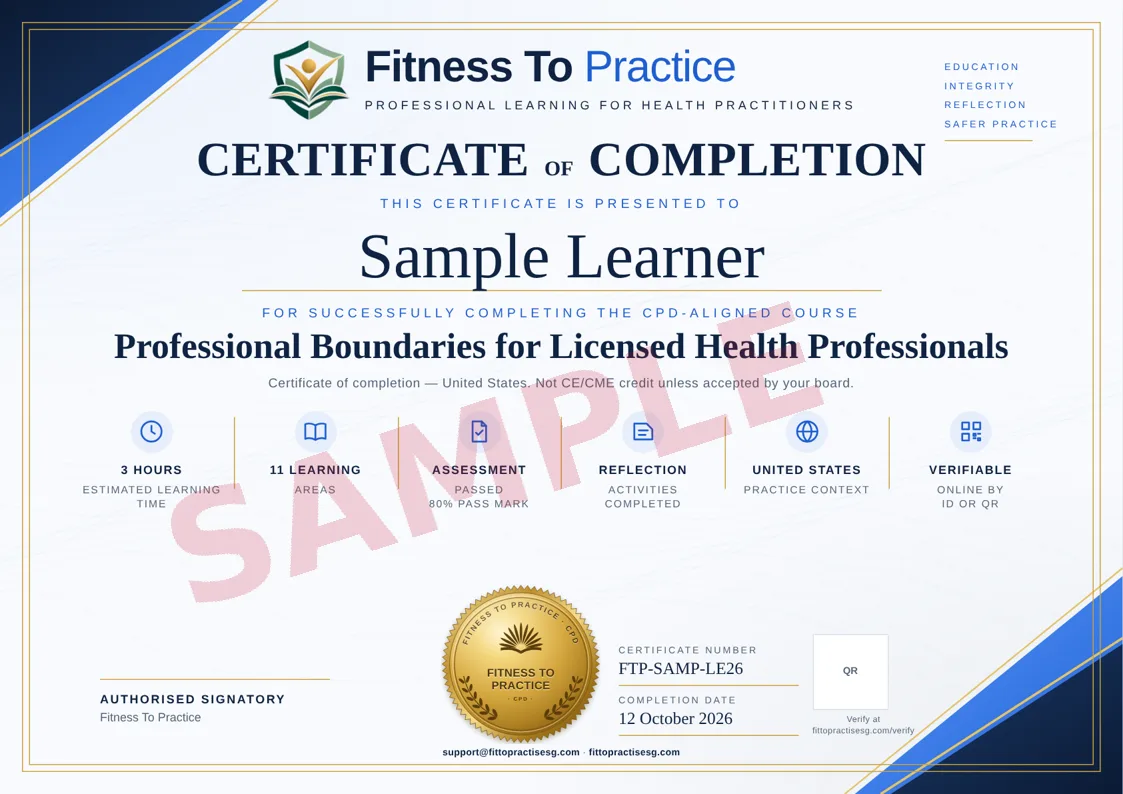
Certificate of completion
Certificate of completion. Not CE or CME credit unless accepted by your board.
The course includes a structured reflective account template: guided prompts to record what you learned, how you will apply it and how the change will show in your practice. It gives you written evidence of insight after a concern, and a ready record for your learning portfolio.
Write it in your own words and leave out anything that could identify a patient, a colleague or a case. If you have an open complaint or case, talk to your adviser before reflecting on it in writing.
No. The MATE Act training must come from specified accredited organizations, and this independent 3-hour course makes no such claim. The course explains what the MATE Act requires and how the one-time attestation works at DEA registration, so you can check that you have met it through an eligible provider.
Schedule II prescriptions cannot be refilled, but federal rules allow multiple prescriptions in some circumstances, emergency oral orders with follow-up, certain faxed prescriptions and partial fills. The course works through these rules, and the different refill and transfer rules for Schedules III to V, with examples from prescriber and pharmacy practice.
Federal rules require written notice to the DEA field office within one business day of discovering a theft or significant loss, followed by DEA Form 106 within 45 days. The course also covers internal investigation, state board and police notification, fraudulent prescriptions and how to recognize workplace diversion early.
Yes. It explains the temporary federal telemedicine flexibilities, the permanent buprenorphine pathway and the state requirements that sit on top of federal rules. Because these rules have changed several times, the course focuses on how to check current requirements and document a legitimate medical purpose for every remote prescription.
Prescribers, pharmacists and PICs, nurses who give or store controlled substances, and practice managers. The price is $89 for roughly three hours online; section checks lead to a 20-item final with an 80% bar, then the certificate and a self-review of how you handle controlled substances.
Every legal and regulatory point comes from primary sources: state practice acts and board rules, federal law and national professional codes of ethics. Anything we cannot confirm is left out.
Lessons, scenarios and assessment questions are written by us for each edition separately, then checked for accuracy, teaching quality and fair assessment before publication.
When a code, standard or law changes, the affected courses are reviewed and updated. Reported errors in legal or regulatory facts are corrected first.
The APhA Code at the counter: drug review, declining to fill, corresponding responsibility, conscience, workload, billing and disclosure after error.
What boards and hospitals expect of MDs and DOs: standard of care, prescribing, telemedicine, supervision, privileges, peer review and conflicts.
Prescribing standards for every profession: authority, assessment, valid prescriptions, off-label and REMS use, telehealth, and requests from family.