Explain how state practice acts, national professional guidance, federal law and employer policy apply to a licensee's online conduct.
Apply HIPAA de-identification standards to posts, case discussions and images, including overlooked identifiers.
Identify when a clinical image or testimonial needs a written HIPAA authorization and what it must contain.
Respond to patients' reviews, tags, recordings and direct messages without disclosing protected health information.
Decide when, if ever, it is appropriate to search for a patient online, and how to document it.
Distinguish protected personal and workplace speech from online conduct a board or employer can act on.
Apply FTC rules on endorsements, health claims and consumer reviews to practice marketing and influencer activity.
Recognize the licensing risks of individual advice online, filming at work, generative AI and impersonation.
Follow a structured response in the first 48 hours after a problematic post and prepare a credible board response.
Build a personal social media plan that demonstrates insight and reduces future risk.
Who this course is for
U.S. licensed health professionals: physicians and residents, PAs, nurse practitioners and other APRNs, RNs and LPN/LVNs, pharmacists, dentists and dental hygienists, therapists and other licensees.
Structured learning and a written reflection to show insight after a complaint, an investigation or a board inquiry.
Routine learning
Focused learning on a core standard of practice, with a certificate and reflection for your portfolio.
About this course
This course looks closely at how U.S. licensees can use social media, messaging and other online tools safely and professionally. It covers HIPAA de-identification and authorization for clinical images and testimonials, searching for patients online, professional accounts and direct messages, workplace group chats, health information and misinformation, workplace speech under the National Labor Relations Act, advertising and endorsements under FTC rules, online reviews, giving advice across state lines, filming at work, generative AI, impersonation and harassment.
It is written for physicians, physician assistants, nurse practitioners and other APRNs, registered and practical nurses, pharmacists, dentists and dental hygienists, therapists and other licensed health professionals, whether they post as individuals, run a practice account or build a public audience. It is also useful for anyone responding to an employer or board concern about online conduct.
In the United States, online conduct is judged under several layers at once: state practice acts and board rules, national guidance from the AMA, FSMB and NCSBN, federal privacy, consumer protection and labor law, and employer policy. One post can lead to employment action, a board investigation and federal enforcement at the same time. This course gives you the specific rules, realistic cases from across the country and a practical plan so that your online presence supports your practice rather than putting your license at risk.
Course details
Learning time
Approximately 3 hours (estimated learning time including knowledge checks, reflection and assessment)
Standards covered
State practice acts and board rules on unprofessional conduct and advertising; AMA Code of Medical Ethics Opinion 2.3.2; FSMB Social Media and Electronic Communications (2019); NCSBN A Nurse's Guide to the Use of Social Media; HIPAA Privacy and Breach Notification Rules (45 CFR 164.501, 164.508, 164.514, 164.530, 164.400–414); FTC Act Section 5, Endorsement Guides (16 CFR Part 255) and Consumer Reviews and Testimonials Rule (16 CFR Part 465); Consumer Review Fairness Act; NLRA Section 7; Open Payments; federal Anti-Kickback Statute
Format
Self-paced, gated lessons with knowledge checks, case studies and reflection
Assessment
20 scenario-based questions, 80% to pass (16 of 20)
Outcome
Certificate of completion and a written reflection for your learning record
Alignment
Mapped to the professional conduct expectations of state boards and to AMA, FSMB and NCSBN guidance on social media; education, not board-approved
1Online Conduct as a Licensing Issue in the U.S.3 lessons
How licensees use social media, and why one identity is the starting point
The layers of U.S. rules that apply online
How online conduct reaches a board
2Patient Information Online3 lessons
De-identification: why removing the name is not enough
Clinical photos and videos: consent, authorization and approved channels
When patients post first: reviews, tags and recordings
3Boundaries and Relationships in Digital Spaces3 lessons
Looking patients up online
Patients who follow you: managing a public professional presence
Colleagues, group chats and the workplace online
4Speech, Opinion and Advocacy3 lessons
Free speech, professional speech and health misinformation
Opinions, politics and discriminatory content
Speaking about your workplace: concerted activity and patient safety
5Advertising, Endorsements and Reviews3 lessons
Advertising your practice truthfully online
Endorsements, influencing and conflicts of interest
Ratings, reviews and reputation management
6Emerging Online Risks4 lessons
Online health advice and practice across state lines
Filming, live-streaming and trends in the workplace
Generative AI, synthetic content and impersonation
Online harassment and protecting yourself
7When Things Go Wrong Online3 lessons
The first 48 hours after a post goes wrong
How a board handles a social media complaint
Insight, remediation and a personal social media plan
8Conclusion and Key Points1 lesson
Conclusion and key points
9References and Further Reading1 lesson
References and further reading
10Reflection1 lesson
Your reflective account
Assessment and certificate
Final assessment
20scenario-based questions
Pass mark 80%: 16 correct out of 20
Knowledge checks in each section as you go
Tests whether you can apply the standards, not recall a page
Not passed yet? Review the sections and retake it
Certificate of completion
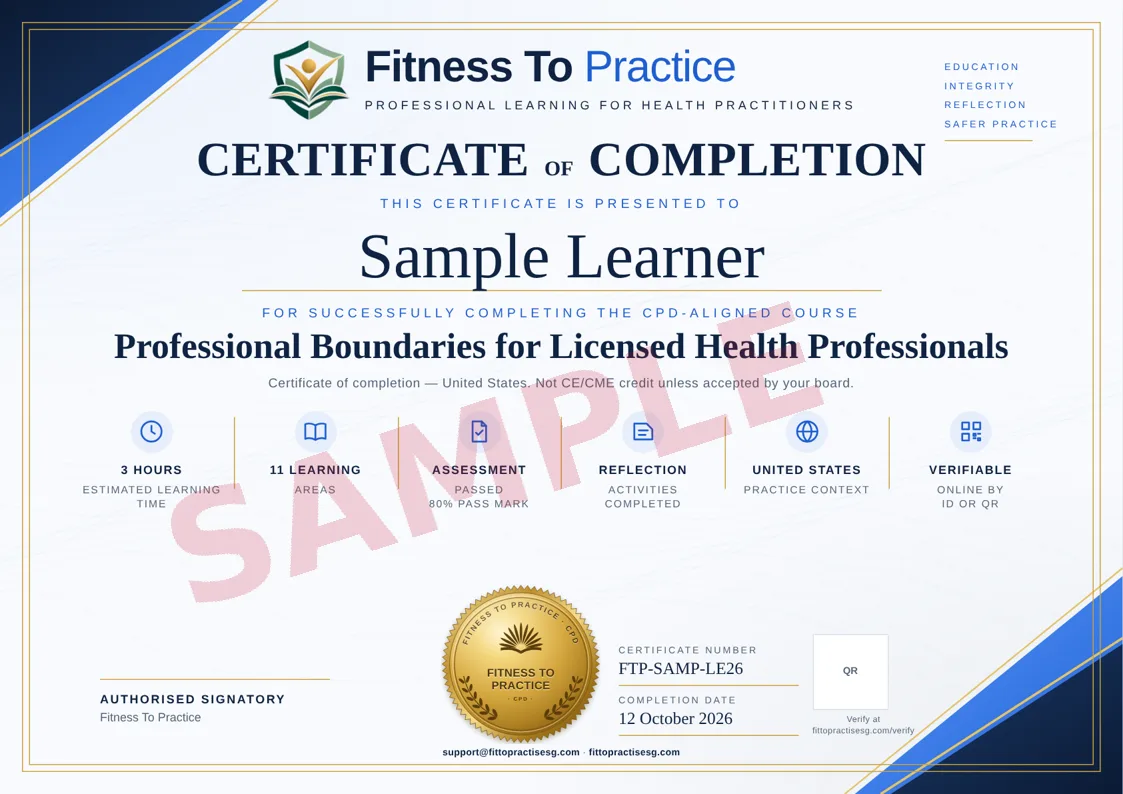
Certificate of completion. Not CE or CME credit unless accepted by your board.
Your name, the course title and the hours
Completion date and a unique certificate ID that can be verified
Ready to download as a PDF as soon as you complete the course
Sample certificate. Yours shows your name, the course, the completion date and a certificate number anyone can verify.
Your reflective account
The course includes a structured reflective account template: guided prompts to record what you learned, how you will apply it and how the change will show in your practice. It gives you written evidence of insight after a concern, and a ready record for your learning portfolio.
Write it in your own words and leave out anything that could identify a patient, a colleague or a case. If you have an open complaint or case, talk to your adviser before reflecting on it in writing.
Questions about this course
Can I post a clinical photo if the patient's face is hidden?
Not necessarily. Tattoos, rare conditions, dates, locations and background details can still identify a patient. The course applies HIPAA de-identification standards to posts, case discussions and images, and explains when a written HIPAA authorization is required and what it must contain.
Is my personal account protected free speech?
Some speech is protected, including certain discussions with coworkers about working conditions under the National Labor Relations Act. But boards and employers can act on posts that breach privacy, harass, mislead the public or show unprofessional conduct. The course explains where those lines usually fall.
Do FTC rules apply to clinicians who promote products online?
Yes. FTC rules on endorsements, testimonials, health claims and consumer reviews apply to practice marketing and influencer activity, including disclosure of paid relationships. The course explains those rules alongside state advertising restrictions and professional guidance from the AMA, FSMB and NCSBN.
What should I do in the first 48 hours after a problematic post?
Remove or secure the content, record what was posted and when, notify the people you need to (your employer, insurer or counsel where appropriate) and avoid public arguments. The course gives a structured response for the first 48 hours and explains how to prepare a credible response if a board gets involved.
What's included in the social media course?
$89 for three online hours, using realistic cases from across the country. Checks along the way and a final 20 questions at 80%; passing gives a certificate and a reflection that becomes your personal social media plan. Access starts immediately, and no CE credit is claimed.
How this course was built
Official sources only
Every legal and regulatory point comes from primary sources: state practice acts and board rules, federal law and national professional codes of ethics. Anything we cannot confirm is left out.
Original, edition by edition
Lessons, scenarios and assessment questions are written by us for each edition separately, then checked for accuracy, teaching quality and fair assessment before publication.
Reviewed when rules change
When a code, standard or law changes, the affected courses are reviewed and updated. Reported errors in legal or regulatory facts are corrected first.