
· United States edition: online, self-paced courses with certificate

Profession-specific standards

Professional Standards for Dental Professionals

Infection prevention, imaging, sedation, prescribing, scope and practice systems for U.S. dentists, hygienists and the dental team

  • 3hours
  • 11sections
  • 20final questions
  • 80%pass mark
  • PDFcertificate
  • Online and self-paced, on any device
  • Reflective account template
  • Knowledge checks in every section
  • Instant certificate of completion

Reviewed by our expert editorial team · how we check every course

Written for US practiceUpdated 5 October 2026

What you will learn

  • Distinguish licensing law, other binding federal and state law, and clinical guidance, and explain how each is used to judge dental practice.
  • Apply state supervision and scope rules to everyday scheduling, including days when no dentist is on site, and decline out-of-scope tasks professionally.
  • Describe the Dentist and Dental Hygienist Compact and the standards that follow a practitioner into another state.
  • Run an infection prevention program that meets CDC dental guidance, OSHA's Bloodborne Pathogens Standard and state rules, including sterilization monitoring and the response to a positive spore test.
  • Maintain dental unit water at or below 500 CFU/mL and explain the lessons of the pediatric pulpotomy outbreaks.
  • Justify and optimize dental imaging in line with the ADA's 2026 patient selection and 2024 radiation safety recommendations, including CBCT interpretation.
  • Apply sedation permit requirements, the ADA's 2026 sedation guidelines and pediatric staffing rules, and build a medical emergency preparedness program.
  • Prescribe analgesics and antibiotics in line with DEA, MATE Act, PDMP and state requirements, the ADA's 2024 acute pain guideline and current prophylaxis guidance.
  • Assess competence before adding procedures, manage CE and renewal attestations honestly, and maintain practice compliance systems such as amalgam separators.
  • Respond to a board concern about clinical or systems failures and plan remediation that combines personal learning with verifiable system change.

Who this course is for

U.S. licensed dentists (general dentists, specialists, owners and associates) and registered dental hygienists; also relevant to dental therapists, expanded-function dental assistants and dental practice managers.

After a concern

Structured learning and a written reflection to show insight after a complaint, an investigation or a board inquiry.

Routine learning

Focused learning on a core standard of practice, with a certificate and reflection for your portfolio.

About this course

This course covers the clinical and practice standards that U.S. dental boards, federal agencies and national guidance expect of dentists, dental hygienists and the wider dental team. It works through scope of practice and supervision, the Dentist and Dental Hygienist Compact, infection prevention (CDC dental guidance, sterilization monitoring, dental unit water quality and OSHA's Bloodborne Pathogens Standard), radiation safety under the ADA's 2024 and 2026 recommendations, sedation and anesthesia permits and the ADA's 2026 guidelines, medical emergency preparedness, prescribing (DEA and MATE Act requirements, PDMPs, the ADA's 2024 acute pain guideline and antibiotic prophylaxis), clinical competence, continuing education and practice compliance systems such as amalgam separators.

It is written for licensed dentists (general dentists, specialists, practice owners and associates), registered dental hygienists and others who run or work in dental practices, including dental therapists, assistants with expanded functions and practice managers. It suits professionals who want to check their practice against current standards, are taking on new procedures or sedation, are moving between states, or are responding to an inspection or board concern about clinical or systems failures.

In the United States, dental licensure is state-based, and Dental Practice Acts, board rules and permits turn infection control, sedation, radiography, prescribing and supervision lapses into grounds for discipline. National guidance changed significantly between 2024 and 2026, and formal board actions are public and reportable to the National Practitioner Data Bank, so keeping systems current is essential to protecting patients, the team and your license.

Course details

Learning time
Approximately 3 hours (estimated learning time including knowledge checks, reflection and assessment)
Standards covered
State Dental Practice Acts and board rules (examples from California, including 16 CCR §1005 and SB 501 sedation permits, Texas, Florida and New York); CDC Guidelines for Infection Control in Dental Health-Care Settings (2003) and Summary of Infection Prevention Practices in Dental Settings; OSHA Bloodborne Pathogens Standard (29 CFR 1910.1030); EPA dental effluent guidelines (40 CFR Part 441); ADA radiography recommendations (2024, 2026); ADA Guidelines for the Use of Sedation and General Anesthesia by Dentists (2026); ADA acute dental pain guideline (2024) and opioid policy (2018); ADA 2015 prosthetic joint and AHA 2021 infective endocarditis guidance; DEA registration and MATE Act; Dentist and Dental Hygienist Compact; NPDB reporting (45 CFR Part 60)
Format
Self-paced, gated lessons with knowledge checks, case studies and reflection
Assessment
20 scenario-based questions, 80% to pass (16 of 20)
Outcome
Certificate of completion and a written reflection for your learning record
Alignment
Mapped to the clinical and practice standards applied by state boards of dentistry, dental examiners and dental hygiene; not board-approved and not recognized for dental CE

Course curriculum

11 sections · 26 lessons · 3 hours · 20-question final assessment

  1. 1The dental license and the standards that surround it3 lessons
    • What professional standards mean for a dental licensee
    • The dental team: licenses, registrations and roles
    • Licensure portability and the Dentist and Dental Hygienist Compact
  2. 2Scope of practice and supervision across the dental team3 lessons
    • Scope of practice and levels of supervision
    • Working within your own license: hygienists and assistants
    • Dental therapy and new workforce models
  3. 3Infection prevention and control4 lessons
    • The infection prevention framework for dental settings
    • Instrument reprocessing and sterilization monitoring
    • Dental unit water quality
    • Exposure incidents and protecting the team
  4. 4Radiation safety and diagnostic imaging2 lessons
    • Justifying every image: patient selection
    • Optimizing dose, equipment and operator qualifications
  5. 5Sedation, anesthesia and medical emergencies3 lessons
    • Sedation and anesthesia permits and the ADA guidelines
    • Pediatric sedation and general anesthesia
    • Medical emergency preparedness
  6. 6Prescribing standards in dentistry3 lessons
    • The legal framework for dental prescribing
    • Acute dental pain: the evidence-based standard
    • Antibiotic prescribing and prophylaxis
  7. 7Clinical competence, continuing education and practice systems3 lessons
    • The standard of care and the limits of your competence
    • Continuing education as a professional standard
    • Practice compliance systems: environment, hazards and records
  8. 8When standards are questioned: board scrutiny and remediation2 lessons
    • How boards respond to clinical and systems failures
    • Remediation that rebuilds confidence in your practice
  9. 9Conclusion and key points1 lesson
    • Conclusion and key points
  10. 10References and further reading1 lesson
    • References and further reading
  11. 11Reflection1 lesson
    • Your reflective account

Assessment and certificate

Final assessment

20scenario-based questions

  • Pass mark 80%: 16 correct out of 20
  • Knowledge checks in each section as you go
  • Tests whether you can apply the standards, not recall a page
  • Not passed yet? Review the sections and retake it

Certificate of completion

Certificate of completion. Not CE or CME credit unless accepted by your board.
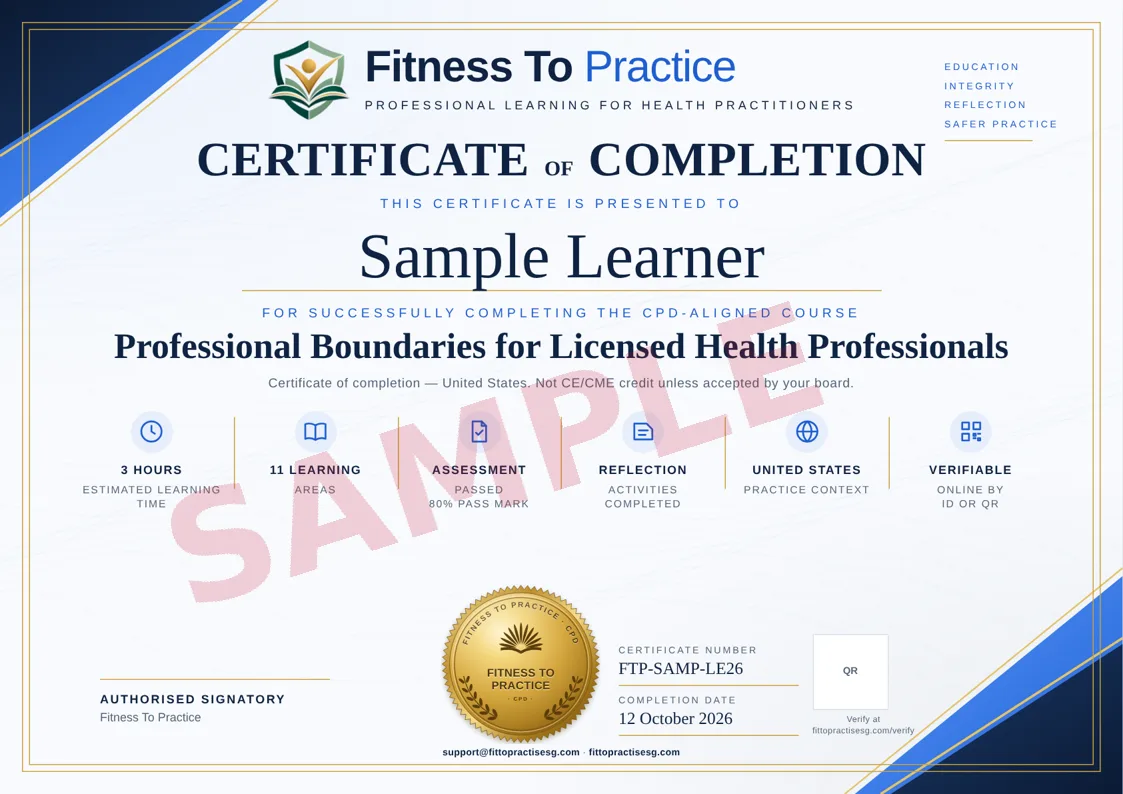
  • Your name, the course title and the hours
  • Completion date and a unique certificate ID that can be verified
  • Ready to download as a PDF as soon as you complete the course
Sample certificate of completion issued to a sample learner
Sample certificate. Yours shows your name, the course, the completion date and a certificate number anyone can verify.

Your reflective account

The course includes a structured reflective account template: guided prompts to record what you learned, how you will apply it and how the change will show in your practice. It gives you written evidence of insight after a concern, and a ready record for your learning portfolio.

Write it in your own words and leave out anything that could identify a patient, a colleague or a case. If you have an open complaint or case, talk to your adviser before reflecting on it in writing.

Questions about this course

What is the dental unit waterline standard?

CDC guidance for dental unit water used in routine nonsurgical procedures is a limit of 500 CFU/mL of heterotrophic bacteria, the drinking water standard. The course explains how to treat, monitor and document waterline quality, and the lessons of pediatric pulpotomy outbreaks linked to contaminated dental water.

How should a practice respond to a positive spore test?

Take the sterilizer out of service, review loading and operating procedures, retest, and decide whether to recall instruments processed after the last negative result. The course walks through the steps, the records to keep and how sterilization monitoring fits into a wider infection prevention program under CDC and OSHA rules.

Does the course cover sedation and anesthesia permits?

Yes. It explains how state sedation permits work, the ADA's 2026 sedation guidelines, pediatric staffing rules and how to build a medical emergency preparedness program with drills, drugs and equipment checks. Sedation-related adverse events and the duty to report them to the board are also covered.

Does this overlap with the dental ethics course?

No. The dental ethics course applies the ADA and ADHA codes to fees, advertising and treatment planning. This course covers clinical and systems standards: scope and supervision, infection control, radiation safety, sedation, prescribing, CE and compliance systems such as amalgam separators. They complement each other.

What do dental professionals get with this course?

Three self-paced hours for $89, aimed at dentists, hygienists and practice teams. Checks throughout, a final 20 questions where 16 is the pass mark, followed by a certificate and a written review of office standards. No ADA CERP or AGD PACE credit is claimed.

How this course was built

Official sources only

Every legal and regulatory point comes from primary sources: state practice acts and board rules, federal law and national professional codes of ethics. Anything we cannot confirm is left out.

Original, edition by edition

Lessons, scenarios and assessment questions are written by us for each edition separately, then checked for accuracy, teaching quality and fair assessment before publication.

Reviewed when rules change

When a code, standard or law changes, the affected courses are reviewed and updated. Reported errors in legal or regulatory facts are corrected first.

Page updated 5 October 2026

Related courses

All courses
US$893 hours · 20 questions
Enrol now