Define human factors and describe how person, task, tools, environment and organization interact to shape clinical performance.
Summarize the findings of To Err Is Human and identify the main US bodies that shape human factors practice.
Use Reason's model and the Swiss cheese model to explain how an adverse event occurred.
Classify errors as slips, lapses, mistakes or violations and select remedies that match each type.
Recognize common cognitive biases and apply strategies such as diagnostic time-outs and independent double checks.
Protect high-risk tasks from interruption and maintain situation awareness in individual and team work.
Explain the effects of fatigue, workload and impairment, and apply personal readiness checks and fitness-for-duty obligations.
Identify design, alarm and workaround hazards and propose interventions from the stronger end of the hierarchy.
Use TeamSTEPPS tools, speaking-up techniques, the Universal Protocol and closed-loop communication.
Apply human factors to an event review and explain an error credibly to an employer or state board while taking personal responsibility.
Who this course is for
U.S. licensed health professionals: physicians, PAs, nurses and APRNs, pharmacists, dentists and dental hygienists, respiratory and physical therapists and other licensees, in any setting.
Structured learning and a written reflection to show insight after a complaint, an investigation or a board inquiry.
Routine learning
Focused learning on a core standard of practice, with a certificate and reflection for your portfolio.
About this course
This course explains the science of human factors and how it applies to everyday clinical work in the United States. It covers the foundations laid by the Institute of Medicine's To Err Is Human, the work system model, Reason's model of active failures and latent conditions, the Swiss cheese model, types of error and how to match the response to the behavior, cognitive bias and diagnostic error, interruptions and situation awareness, fatigue and workload, fitness for duty, design and usability, alarm fatigue, workarounds and normalization of deviance, the hierarchy of interventions, TeamSTEPPS, speaking up, the Universal Protocol and closed-loop communication.
It is written for physicians, PAs, nurses and APRNs, pharmacists, dentists and dental hygienists, and allied licensees such as respiratory and physical therapists, in any US state and any setting, from hospitals and ambulatory surgery centers to community pharmacies, dental offices, clinics and home care. Cases are set across states including Texas, Florida, North Carolina, Tennessee, Pennsylvania and California.
Most errors happen to competent, conscientious professionals working in systems that make errors likely. Understanding human factors helps you protect your own performance, strengthen the defenses around you, contribute to safer systems and, if an error does reach a patient, explain what happened honestly and credibly to your employer and your state board. The course draws on AHRQ PSNet, The Joint Commission, the FDA and state board sources, and is distinct from our courses on incident reporting, root cause analysis, handoffs and disclosure.
Course details
Learning time
Approximately 3 hours (estimated learning time including knowledge checks, reflection and assessment)
Standards covered
Institute of Medicine, To Err Is Human (1999); AHRQ PSNet primers and TeamSTEPPS 3.0; Joint Commission Sentinel Event Alerts 40 and 48, alarm system safety (NPSG.06.01.01, for hospitals now NPG.01.05.01), the Universal Protocol (for hospitals now NPG.01.06.01 to NPG.01.06.03) and National Performance Goals (2026); FDA human factors guidance for medical devices; ACGME work hour requirements; Patient Safety and Quality Improvement Act of 2005; North Carolina Board of Nursing Complaint Evaluation Tool
Format
Self-paced, gated lessons with knowledge checks, case studies and reflection
Assessment
20 scenario-based questions, 80% to pass (16 of 20)
Outcome
Certificate of completion and a written reflection for your learning record
1Human factors and patient safety in the United States3 lessons
What human factors means in health care
From To Err Is Human to today's US safety framework
Why human factors matters to you as a licensee
2How errors happen: models and types of error3 lessons
How accidents happen: Reason's model and the Swiss cheese
Types of error: slips, lapses, mistakes and violations
Matching the response to the behavior
3Cognition, attention and situation awareness4 lessons
How clinicians think: fast thinking, slow thinking and bias
Attention, interruptions and memory
Situation awareness and recognizing deterioration
Strategies to protect clinical judgment
4Fatigue, workload and fitness for duty3 lessons
Fatigue and patient safety
Workload, stress and the personal safety check
Fitness for duty, impairment and the licensee's obligations
5Design, technology and the work environment4 lessons
Design, usability and look-alike risks
Alarms, alerts and alarm fatigue
Work-as-imagined, work-as-done and the drift to unsafe practice
Strong and weak fixes: the hierarchy of interventions
6Teams, communication and speaking up3 lessons
Teams as a safety system
Hierarchy, authority gradients and speaking up
Checklists, read-backs and standard communication
7Applying human factors after an event and in daily practice3 lessons
Looking at an event through a human factors lens
Human factors, accountability and your state board
Your personal human factors toolkit
8Conclusion and key points1 lesson
Conclusion and key points
9References and further reading1 lesson
References and further reading
10Your reflective account1 lesson
Your reflective account
Assessment and certificate
Final assessment
20scenario-based questions
Pass mark 80%: 16 correct out of 20
Knowledge checks in each section as you go
Tests whether you can apply the standards, not recall a page
Not passed yet? Review the sections and retake it
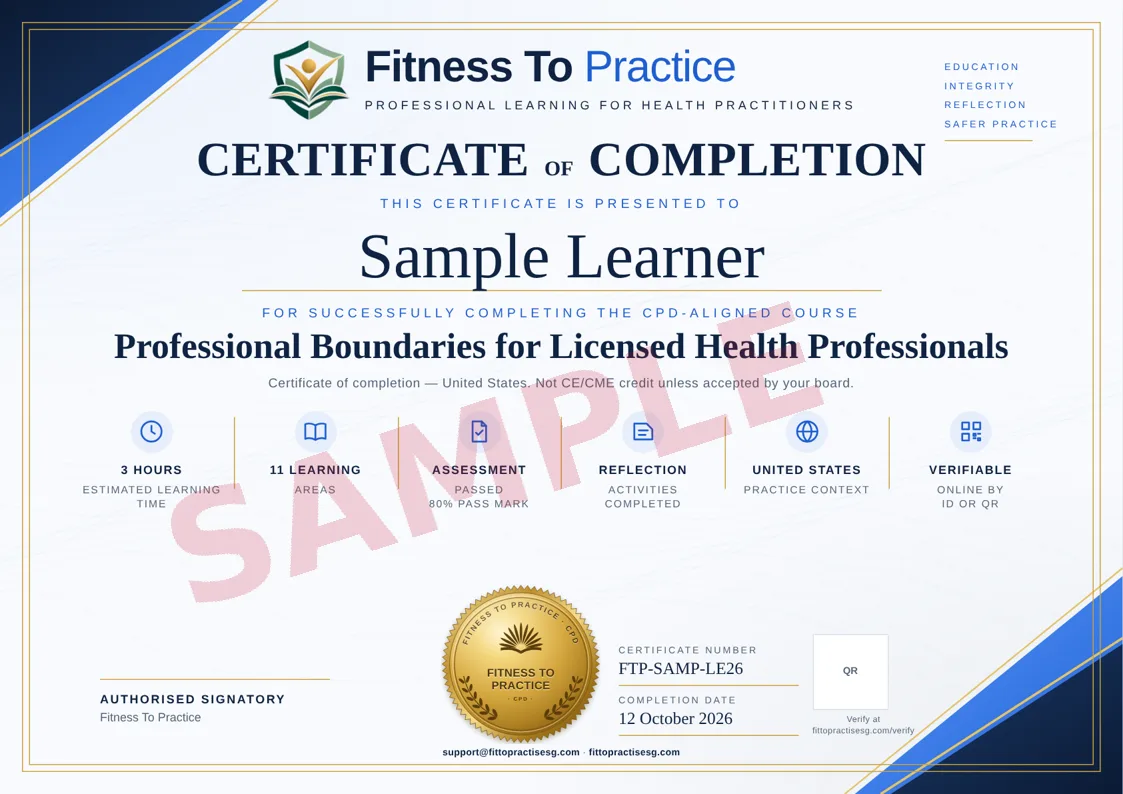
Certificate of completion
Certificate of completion. Not CE or CME credit unless accepted by your board.
Your name, the course title and the hours
Completion date and a unique certificate ID that can be verified
Ready to download as a PDF as soon as you complete the course
Sample certificate. Yours shows your name, the course, the completion date and a certificate number anyone can verify.
Your reflective account
The course includes a structured reflective account template: guided prompts to record what you learned, how you will apply it and how the change will show in your practice. It gives you written evidence of insight after a concern, and a ready record for your learning portfolio.
Write it in your own words and leave out anything that could identify a patient, a colleague or a case. If you have an open complaint or case, talk to your adviser before reflecting on it in writing.
Questions about this course
What is the difference between a slip, a lapse, a mistake and a violation?
Slips and lapses are execution failures, such as picking the wrong vial or forgetting a step. Mistakes are planning errors made with good intent, and violations are deliberate deviations from a rule. The course explains why each needs a different remedy, so retraining is not used for problems that need design changes.
How does fatigue affect my professional responsibility?
Fatigue, workload and impairment all degrade performance, and licensees have fitness-for-duty obligations under board rules and employer policy. The course explains the evidence, how to use personal readiness checks before high-risk tasks and what to do if you or a colleague is not safe to work.
Can human factors help me explain an error to my state board?
Yes, if used honestly. The course shows how to describe the system conditions that contributed to an error while still taking personal responsibility, which is what boards and employers look for. Blaming the system alone, or yourself alone, is usually less credible than a balanced account that shows what you changed.
How does this course differ from incident reporting or RCA courses?
It is about the science of performance itself: how attention, cognition, fatigue, design and teams shape what people do. The incident reporting course covers reporting systems, and the RCA² course covers the investigation method. This course gives you the concepts both rely on, applied to your own daily practice.
What do I get with the human factors course?
Three hours online for $89, using cases from hospitals, pharmacies, dental offices and clinics across several states. Checks run throughout, the final 20 questions need 80%, and passing brings a certificate and a systems-thinking reflection. You also map the error traps in your own workplace.
How this course was built
Official sources only
Every legal and regulatory point comes from primary sources: state practice acts and board rules, federal law and national professional codes of ethics. Anything we cannot confirm is left out.
Original, edition by edition
Lessons, scenarios and assessment questions are written by us for each edition separately, then checked for accuracy, teaching quality and fair assessment before publication.
Reviewed when rules change
When a code, standard or law changes, the affected courses are reviewed and updated. Reported errors in legal or regulatory facts are corrected first.
Working in interprofessional teams: TeamSTEPPS 3.0, IPEC competencies, briefs and huddles, cross-monitoring, challenging decisions and resolving conflict.