Define sensitive examinations by exposure, contact and instrumentation across professions and settings.
Explain the functions and limits of a chaperone, including the FSMB's concern about an illusion of safety.
Compare chaperone guidance from the AMA, ACP, ACOG, AAP and FSMB.
Describe named state chaperone rules and find the rules that apply in your own state.
Design a chaperone policy covering scope, model, eligibility, training, declines, unavailability and audit.
Act effectively as or with a chaperone, including positioning, intervening and reporting concerns.
Adapt chaperone practice for emergency, sedation, imaging, therapy, dental, pharmacy, telehealth and home settings.
Apply chaperone practice for children and adolescents, trauma survivors, patients with disabilities and patients with cultural, identity or language needs.
Document chaperone use accurately and respond appropriately to a complaint about an examination.
Comply with a board-ordered chaperone or practice monitor condition and show credible insight.
Who this course is for
U.S. licensed health professionals and their teams: physicians, PAs, NPs and other APRNs, nurses, midwives, sonographers, physical therapists, dentists and dental teams, pharmacists, and medical assistants and other staff who act as chaperones.
Structured learning and a written reflection to show insight after a complaint, an investigation or a board inquiry.
Routine learning
Focused learning on a core standard of practice, with a certificate and reflection for your portfolio.
About this course
This course takes a detailed look at chaperones and sensitive examinations in U.S. health care. It covers what makes an examination sensitive across professions and settings, what chaperones can and cannot achieve, the national guidance from the AMA, ACP, ACOG, AAP and FSMB, named state rules in Oregon, New Jersey and California, and how to design, staff, train and audit a chaperone program. It also covers the chaperone's own role, including speaking up, as well as telehealth, home visits, children and adolescents, trauma-informed care, disability, culture, gender identity and interpreters.
It is written for physicians, physician assistants, nurse practitioners and other APRNs, nurses, midwives, sonographers and imaging professionals, physical therapists, dentists and dental teams, pharmacists and the medical assistants and other staff who act as chaperones. It is also useful for practice leaders writing a policy and for licensees responding to a complaint or board condition involving an examination.
Sensitive examinations are where clinical care and allegations of misconduct most often meet. In the United States, chaperone expectations come from professional guidance, state board rules and statutes, hospital rules and employer policy, and they are changing quickly. This course gives you the specific standards, realistic cases from across the country and practical tools so that your examinations protect patients, support staff and stand up to scrutiny.
Course details
Learning time
Approximately 3 hours (estimated learning time including knowledge checks, reflection and assessment)
Standards covered
AMA Code of Medical Ethics Opinion 1.2.4; ACP Ethics Manual (7th ed.); ACOG Committee Opinion 796; AAP policy statement on chaperones (2025); FSMB Physician Sexual Misconduct report (2020); Oregon OAR 847-010-0130; N.J.A.C. 13:35-6.23; California AB 849 (2025); Medical Board of California Third Party Chaperone condition; 42 CFR 482.13(c); Section 1557 language access
Format
Self-paced, gated lessons with knowledge checks, case studies and reflection
Assessment
20 scenario-based questions, 80% to pass (16 of 20)
Outcome
Certificate of completion and a written reflection for your CE record
Alignment
Mapped to state board expectations on examinations and sexual misconduct and to AMA, ACP, ACOG, AAP and FSMB guidance on chaperones; education, not board-approved
1Sensitive examinations and the purpose of chaperones3 lessons
What makes an examination sensitive
What a chaperone does, and what a chaperone cannot do
How this course fits with your other training
2The U.S. framework: guidance, state rules and boards3 lessons
National professional guidance compared
State laws and board rules on chaperones
How boards treat chaperone failures
3Designing and running a chaperone program3 lessons
Writing a chaperone policy that works
Training chaperones
Staffing, small practices and auditing compliance
4The chaperone's role in practice3 lessons
Working together in the room: before, during and after
Recognizing and acting on concerns
Hierarchy, dependence and speaking up
5Sensitive examinations across settings and professions3 lessons
Hospital, emergency and procedural settings
Imaging, therapy, dentistry and pharmacy
Telehealth, home visits and requests for a clinician of a particular sex
6Patients with particular needs3 lessons
Children and adolescents
Trauma-informed examinations and patients with disabilities
Culture, religion, gender identity and interpreters
7Records, complaints and board conditions3 lessons
Documenting chaperone use
When a patient complains about an examination
Complying with a board-ordered chaperone or monitor, and showing insight
8Conclusion and key points1 lesson
Conclusion and key points
9References and further reading1 lesson
References and further reading
10Your reflective account1 lesson
Your reflective account
Assessment and certificate
Final assessment
20scenario-based questions
Pass mark 80%: 16 correct out of 20
Knowledge checks in each section as you go
Tests whether you can apply the standards, not recall a page
Not passed yet? Review the sections and retake it
Certificate of completion
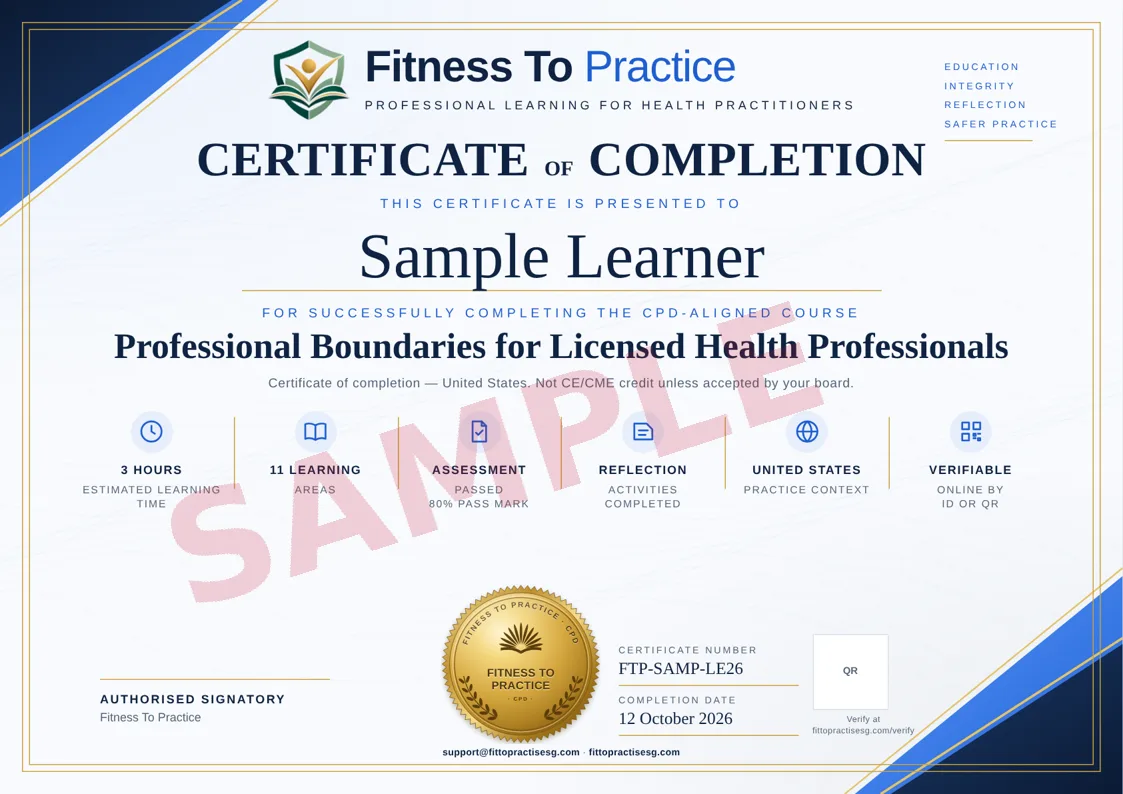
Certificate of completion. Not CE or CME credit unless accepted by your board.
Your name, the course title and the hours
Completion date and a unique certificate ID that can be verified
Ready to download as a PDF as soon as you complete the course
Sample certificate. Yours shows your name, the course, the completion date and a certificate number anyone can verify.
Your reflective account
The course includes a structured reflective account template: guided prompts to record what you learned, how you will apply it and how the change will show in your practice. It gives you written evidence of insight after a concern, and a ready record for your learning portfolio.
Write it in your own words and leave out anything that could identify a patient, a colleague or a case. If you have an open complaint or case, talk to your adviser before reflecting on it in writing.
Questions about this course
Which state laws on chaperones does the course explain?
It uses Oregon, New Jersey and California rules as worked examples and shows you how to find the rules in your own state, since requirements differ by state, profession and setting. It also compares what the AMA, ACP, ACOG, AAP and FSMB recommend, and explains how employer policy and hospital rules add to the legal minimum.
Can staff who act as chaperones take this course?
Yes. Medical assistants, nurses and other staff who chaperone will find a full section on the chaperone's role: where to stand, what to watch for, when and how to intervene, and how to report a concern. Licensed clinicians and practice leaders who write chaperone policies are the main audience, but the role content is written for both sides of the exam.
What does the FSMB mean by a chaperone's illusion of safety?
The FSMB has warned that a chaperone can create false reassurance if they are untrained, distracted, junior to the clinician or unable to see the examination. The course explains this concern and how a policy should address it, through training, positioning, the right to stop an exam and a clear reporting route that does not depend on the examining clinician.
I have a board-ordered chaperone condition. Is this course relevant?
It can help you understand and comply with the condition, including logs, patient explanations and showing credible insight. If your order names an education requirement, confirm with the board or your attorney which providers it accepts before enrolling.
How long is the chaperone training and how is it assessed?
Around three hours, fully online, $89, with immediate access. Checks appear throughout, and a final test of 20 questions needs 80%. Passing earns a certificate and a written review of how you yourself conduct sensitive examinations. Scenarios include offering, declining and documenting a chaperone, and what to do when no chaperone is available.
How this course was built
Official sources only
Every legal and regulatory point comes from primary sources: state practice acts and board rules, federal law and national professional codes of ethics. Anything we cannot confirm is left out.
Original, edition by edition
Lessons, scenarios and assessment questions are written by us for each edition separately, then checked for accuracy, teaching quality and fair assessment before publication.
Reviewed when rules change
When a code, standard or law changes, the affected courses are reviewed and updated. Reported errors in legal or regulatory facts are corrected first.
Informed consent from Canterbury v. Spence to the bedside: five elements, capacity, surrogates, minors, interpreters, intimate exams and documentation.
What happens after a state board letter arrives: investigation, your written response, settlement conferences, consent orders, hearings and NPDB reporting.