Explain where U.S. capacity and substitute decision rules come from, including state statutes, the 2023 Uniform Health-Care Decisions Act and federal hospital, privacy, emergency and research rules.
Prepare for a capacity assessment by writing a decision statement and addressing reversible barriers.
Test the four abilities with open, decision-specific questions and explain why screening scores are not capacity findings.
Assess capacity fairly in patients with fluctuating cognition, communication disabilities or psychiatric illness.
Write a capacity note that records the decision, supports, findings in the patient's words, conclusion and plan.
Manage patients who want to leave against advice and apply 42 CFR 482.13(e) restraint and seclusion requirements.
Verify the type, scope and activation of a health care power of attorney or guardianship order and apply HIPAA personal representative rules.
Support surrogates, recognize when a surrogate's choice should be questioned, and plan for unrepresented patients.
Describe adult guardianship, limited guardianship and supported decision-making, and write a useful guardianship evaluation.
Distinguish emergency psychiatric holds in states such as California, Florida and New York from decision-making capacity.
Who this course is for
U.S. licensees: physicians (MD/DO), PAs, nurses (RN, LPN/LVN, APRN), pharmacists, dentists and dental hygienists, therapists, paramedics, social workers and other licensed health professionals.
Structured learning and a written reflection to show insight after a complaint, an investigation or a board inquiry.
Routine learning
Focused learning on a core standard of practice, with a certificate and reflection for your portfolio.
About this course
This course teaches U.S. licensees how to assess decision-making capacity in a way that is fair, decision-specific and defensible, and what to do when a patient cannot decide. It goes beyond the basics of informed consent to cover high-stakes assessment interviews and documentation, patients who want to leave against advice, restraint and covert medication, emergency department refusals under EMTALA, verifying health care powers of attorney and guardianship orders, unrepresented patients, limited guardianship and supported decision-making, and the basics of emergency psychiatric holds.
It is written for physicians, physician assistants, nurses and APRNs, pharmacists, dentists and dental hygienists, therapists, paramedics, social workers and other licensed professionals in hospitals, long-term care, community practice, home health and telehealth. Case studies are set in many different states and professions.
Capacity rules in the United States are set mainly by state law, with federal rules for hospitals, emergency care, privacy and research layered on top. Mistakes in either direction, overriding a capable patient or failing to protect one who cannot decide, lead to harm, litigation and board complaints. This course gives you a practical method and a clear map of the legal tools so that you can act lawfully and confidently.
Course details
Learning time
Approximately 3 hours (estimated learning time including knowledge checks, reflection and assessment)
Standards covered
AMA Opinion 2.1.2; 42 CFR 482.13(b)(2) and (e); 42 CFR 489.24 (EMTALA); 45 CFR 164.502(g) (HIPAA personal representatives); 45 CFR 46.102 (Common Rule); Uniform Health-Care Decisions Act (2023); Uniform Guardianship, Conservatorship, and Other Protective Arrangements Act (2017); state examples including California Welfare and Institutions Code 5150, Florida Statutes 394.463, New York Mental Hygiene Law 9.39 and Texas Estates Code ch. 1357
Format
Self-paced, gated lessons with knowledge checks, case studies and reflection
Assessment
20 scenario-based questions, 80% to pass (16 of 20)
Outcome
Certificate of completion and a written reflection for your CE record
Alignment
Mapped to the capacity, surrogate and patient-rights expectations of state medical, nursing, pharmacy and dental boards and national professional codes (independent; not board-approved or endorsed by any board or association)
1The U.S. capacity landscape: concepts, law and common failures3 lessons
Why capacity judgments deserve a course of their own
The legal map: where capacity rules come from in the United States
Presumption, proportionality and the line between capacity and wisdom
2Running a defensible capacity assessment4 lessons
Preparing: define the decision before you test the person
The interview: testing each ability with purpose-built questions
Hard cases: fluctuating, partial and communication-limited capacity
Documenting the assessment and handling disagreement
3When capacity is doubtful and the patient says no: leaving, restraint and the emergency department3 lessons
Discharge against medical advice and the patient who wants to leave
Restraint, seclusion, sitters and covert medication
Emergencies, EMTALA and refusal in the emergency department
4Working with surrogates: verifying authority, supporting decisions and resolving conflict3 lessons
Checking that a surrogate's authority is real and has started
Helping surrogates decide well and handling conflict
Patients with no one: the unrepresented adult
5Guardianship, conservatorship and less restrictive alternatives3 lessons
How adult guardianship works and the clinician's role
Limited guardianship and the least restrictive alternative
Supported decision-making and psychiatric advance directives
6Emergency psychiatric holds and involuntary treatment: the basics every licensee needs3 lessons
How emergency holds work: three state examples
A hold is not a capacity finding
Working across professions when a hold is in place
7Capacity across professions, research and board oversight3 lessons
Capacity in community, dental, pharmacy, home and telehealth practice
Research with adults who may lack capacity
When capacity decisions lead to a board complaint
8Conclusion and key points1 lesson
Conclusion and key points
9References and further reading1 lesson
References and further reading
10Your reflective account1 lesson
Your reflective account
Assessment and certificate
Final assessment
20scenario-based questions
Pass mark 80%: 16 correct out of 20
Knowledge checks in each section as you go
Tests whether you can apply the standards, not recall a page
Not passed yet? Review the sections and retake it
Certificate of completion
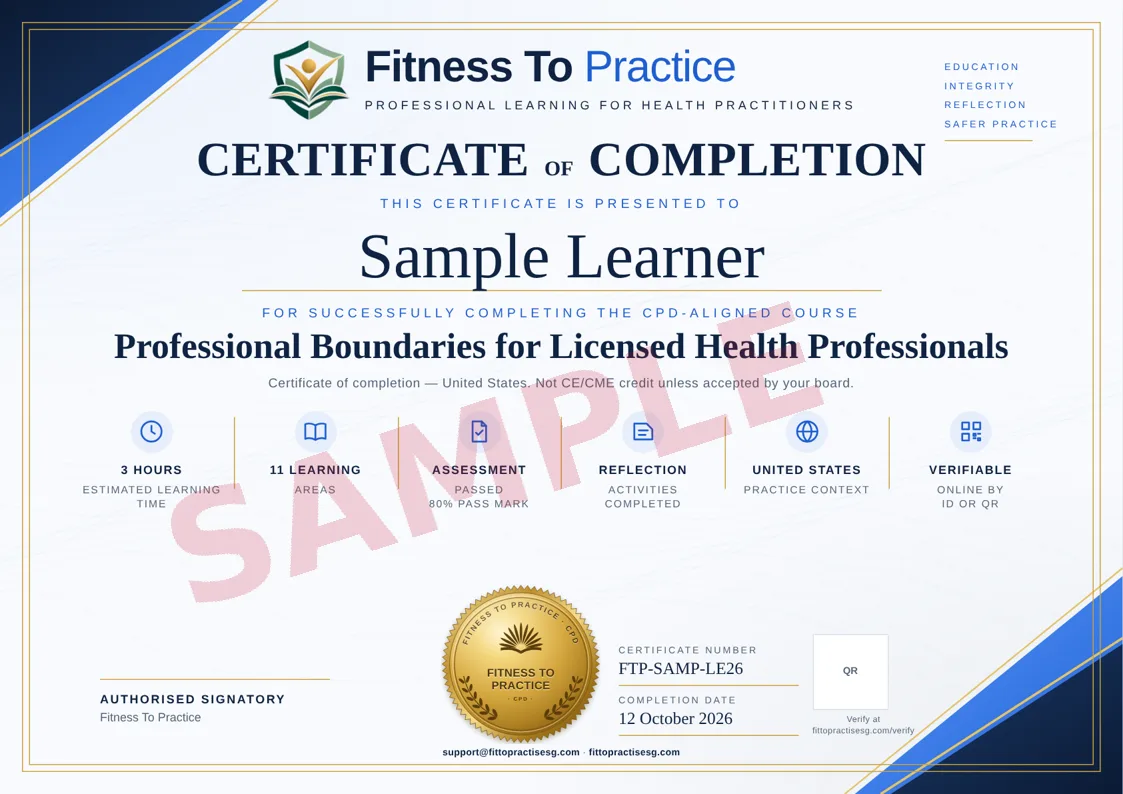
Certificate of completion. Not CE or CME credit unless accepted by your board.
Your name, the course title and the hours
Completion date and a unique certificate ID that can be verified
Ready to download as a PDF as soon as you complete the course
Sample certificate. Yours shows your name, the course, the completion date and a certificate number anyone can verify.
Your reflective account
The course includes a structured reflective account template: guided prompts to record what you learned, how you will apply it and how the change will show in your practice. It gives you written evidence of insight after a concern, and a ready record for your learning portfolio.
Write it in your own words and leave out anything that could identify a patient, a colleague or a case. If you have an open complaint or case, talk to your adviser before reflecting on it in writing.
Questions about this course
Is a low MMSE or MoCA score enough to show a patient lacks capacity?
No. Screening scores measure cognition, not the ability to make a particular decision. The course teaches the four abilities test (understanding, appreciation, reasoning and expressing a choice) using open, decision-specific questions, and explains how to address reversible barriers such as pain, delirium, hearing loss or language before you reach a conclusion.
What should a capacity note in the chart contain?
A defensible note records the specific decision, the information given, any supports used, the patient's answers in their own words for each ability, your conclusion and the plan that follows. The course gives a template and worked examples, so the note will stand up if the decision is later reviewed by a court, an ethics committee or a state board.
How do I verify that a surrogate actually has authority to decide?
Check the type of document, its scope and whether it has been activated, or for a guardian, the court order and any limits on it. The course covers health care powers of attorney, state default surrogate lists, HIPAA personal representative rules and what to do for unrepresented patients who have no one legally able to decide.
Does the course cover patients who want to leave against medical advice?
Yes. One section deals with patients who refuse care or try to leave when capacity is doubtful, including emergency department refusals under EMTALA, restraint and seclusion requirements in 42 CFR 482.13(e), covert medication and the basics of emergency psychiatric holds in states such as California, Florida and New York.
What do I receive after finishing the capacity training?
About three hours online, $89. Every section has a knowledge check, and the closing 20-question test needs 16 correct (80%). Pass, and you get a certificate and a guided reflection on how you assess capacity. It is education with no CE or CME credit attached.
How this course was built
Official sources only
Every legal and regulatory point comes from primary sources: state practice acts and board rules, federal law and national professional codes of ethics. Anything we cannot confirm is left out.
Original, edition by edition
Lessons, scenarios and assessment questions are written by us for each edition separately, then checked for accuracy, teaching quality and fair assessment before publication.
Reviewed when rules change
When a code, standard or law changes, the affected courses are reviewed and updated. Reported errors in legal or regulatory facts are corrected first.
Informed consent from Canterbury v. Spence to the bedside: five elements, capacity, surrogates, minors, interpreters, intimate exams and documentation.
Accurate, timely, defensible records: CMS entry rules, medical necessity, cloned notes and AI scribes, corrections and addenda, access requests and retention.